Stradun Dubrovnik: A Complete Guide to the Old Town's Main Street
The Stradun is the 298-metre spine of Dubrovnik's Old Town, the street every visitor walks whether they planned to or not. Here is what it is, when to walk it, what to eat around it, and the mistakes to avoid.
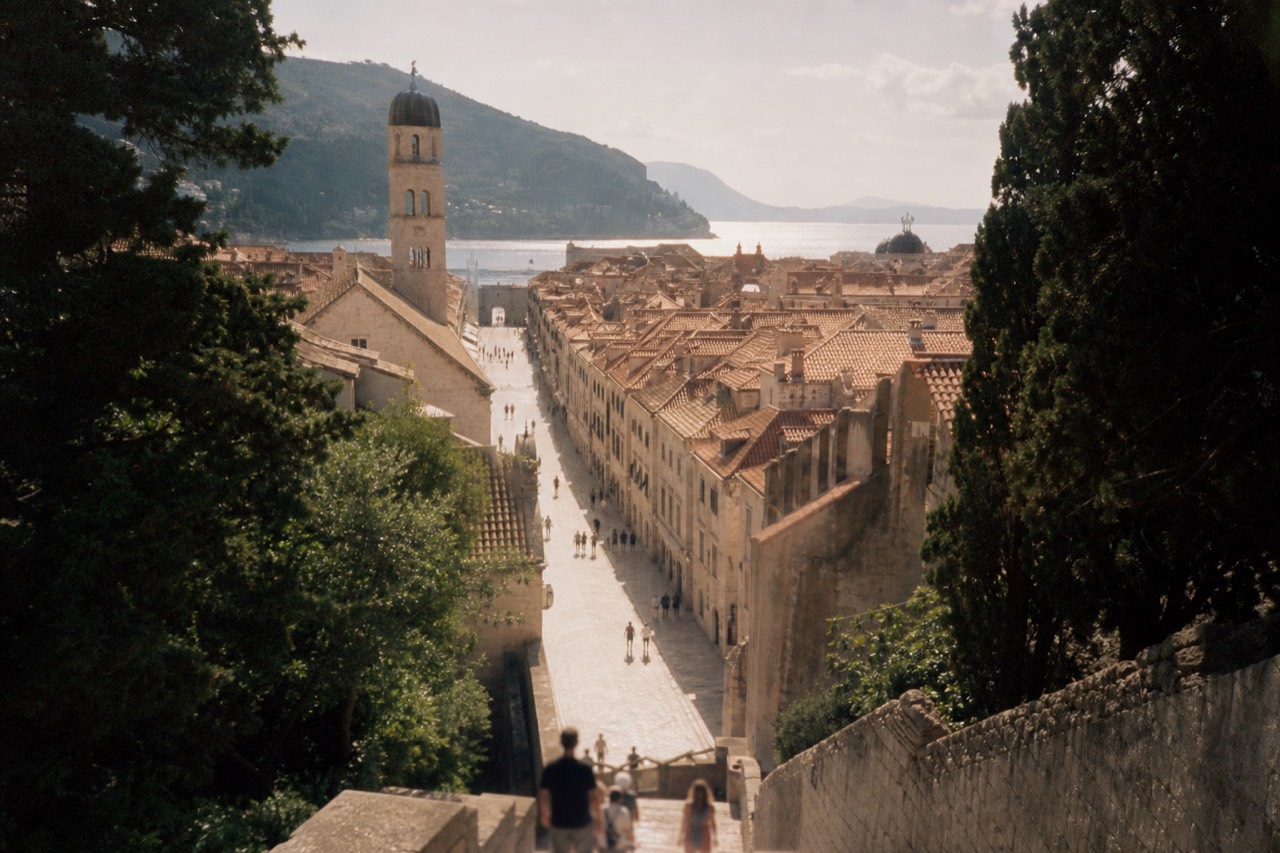
Short answer
The Stradun is Dubrovnik's main street, 298 metres of polished limestone running from Pile Gate to the clock tower, its final plan fixed by the 1272 Statute. It is free to walk, at its best before 08:00 and after 19:00, and it sits inside a UNESCO site inscribed in 1979 covering 24.7 hectares.
The Stradun does not need an introduction in Dubrovnik, because you will find it whether you look for it or not. Every road of any consequence in the Old Town either crosses it, feeds into it or points at it. Locals call it Placa, visitors call it the Stradun, and both names describe the same 298 metres of pale limestone running from Pile Gate in the west to Luža square and the clock tower in the east. The Dubrovnik Tourist Board's own page on the street records that the Statute from 1272 determined the final plan of both the city and its main street, which means the line you walk today was fixed by law more than seven centuries ago.
I have walked this street in every month of the year, in downpours and at 07:00 in near silence, and the one thing I can tell you with certainty is that timing changes it completely. At eight in the morning it belongs to delivery vans and cats. By eleven it belongs to everyone in Europe at once. This guide covers the street itself, the food around it, the side streets that matter, and the honest mistakes I watch visitors make on it every season.
What Is the Most Beautiful Street in Dubrovnik?
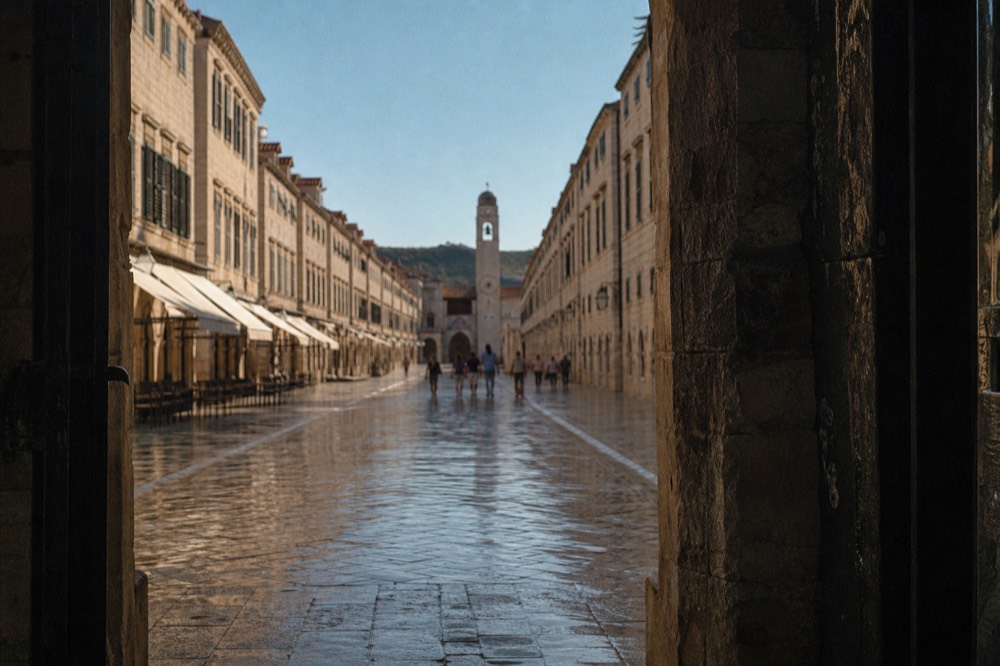
Ask ten locals and most will say the Stradun, but for opposite reasons than visitors expect. It is not beautiful because it is charming or quaint, it is beautiful because it is a single, disciplined architectural gesture: identical stone facades, uniform windows, one uninterrupted limestone ribbon 298 metres long, all fixed by the 1272 Statute and rebuilt to the same rules after the great earthquake. The street is a masterpiece of restraint rather than decoration, and understanding that changes how you look at it. The uniformity is not an accident of dull city planning, it is a Renaissance-era building code enforced to the letter, and it is the reason the whole Old Town earned UNESCO World Heritage status, inscribed in 1979 under criteria (i), (iii) and (iv) with a property area of 24.7 hectares.
The comparison with the rest of the Old Town is what makes the point. Wander into the lanes north of the Stradun and the terrain climbs immediately into steep staircases and narrow shadows. South of it, the lanes fall toward the sea in equally tight steps. The Stradun is the only flat, open line in the entire walled city, the valley floor between the two hills the town was built on. That geography is why it became the main street in the first place: it was a marshy channel between the settlements, later paved over, and the channel became the corridor.
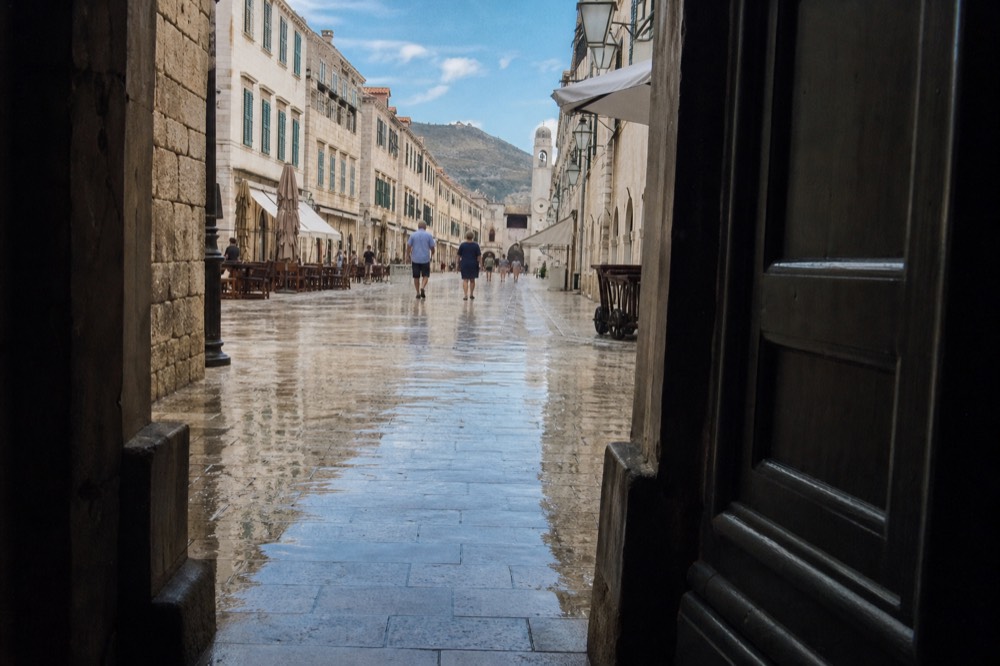
Beauty here is also about surfaces. The limestone paving has been walked smooth by centuries of feet, and after rain it becomes genuinely slippery, a small practical point I will return to in the mistakes section. Stand at the Pile end at first light and the whole street reads as one composition: Onofrio's Fountain at your back, the clock tower ahead, the dome of the cathedral rising over the rooftops to the left. There is no other street in the city that composes itself that way, and no other street where the city presents itself so completely in a single glance.
If you want the view from above rather than along it, the walls themselves frame the Stradun beautifully. The walls run 1,940 metres with 16 towers and 3 fortresses, and several stretches look straight down the length of the main street, which is the single best way to appreciate its discipline.
Why Is the Stradun the Center of the Old Town?
Every practical thing in the walled city happens on or just off the Stradun because it is the only flat, wide corridor inside 24.7 hectares of steep terrain. The 1272 Statute fixed its plan, the great earthquake levelled the city and the rebuild followed the same line, and today it connects the two anchors of Old Town life: Pile Gate and the Luža square cluster of the clock tower, Sponza Palace and the church of St Blaise. That is why every walking tour, every procession, every festival event and every evening promenade uses it. The street is not just scenic, it is infrastructure.
The layout rewards a little orientation. Coming in through Pile Gate you pass Onofrio's Fountain almost immediately, and from there the Stradun runs dead straight. The Franciscan Monastery sits on the northern side near the fountain, and the Sponza Palace and Rector's Palace cluster waits at the far eastern end. Side lanes break off left and right every few dozen metres, north toward the cathedral and the Serbian Orthodox church, south toward the Jesuit stairs and the sea gates. If you learn nothing else before arriving, learn that the Stradun is your compass: cross it and you know you have changed from the north half of town to the south half.
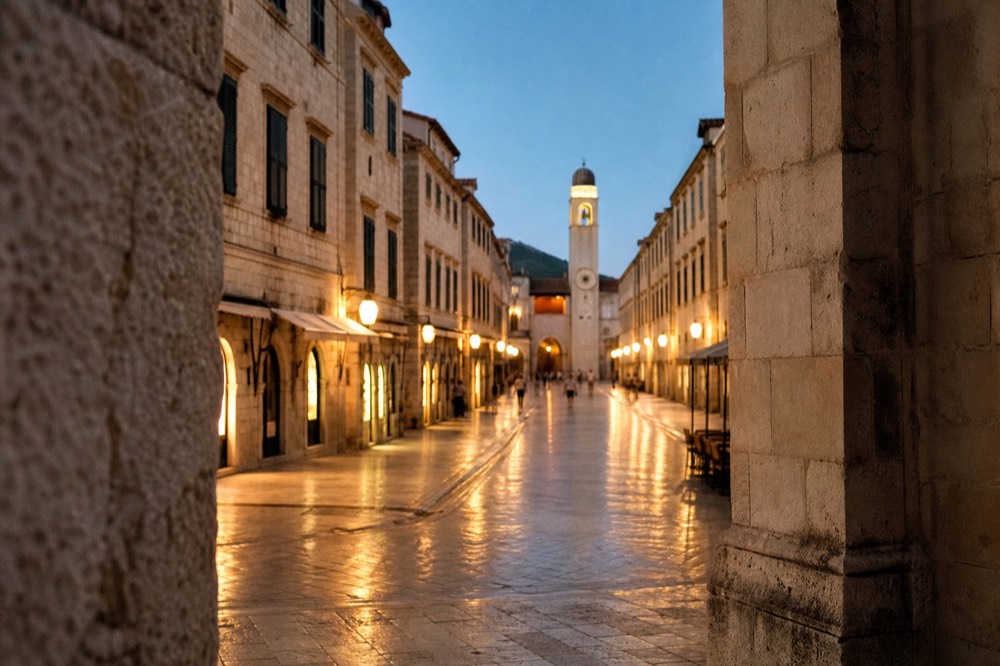
The evening promenade is the living tradition here. After the day crowds drain out, residents and visitors alike walk the street slowly, and the cafe terraces fill. The city's cultural calendar leans on the same corridor, with the summer festival using the Stradun and the squares around Luža as stages. There is a dedicated guide to the Dubrovnik summer festival schedule if you are timing a visit around performances.
For most visitors the practical question is how to see the street with some context rather than as a corridor between shops. A guided walk solves that cheaply, and the cheapest paid option on this site's roster starts at $20 per person, rated 4.8 across 5,826 reviews.
What Is the Main Food in Dubrovnik?
The signature dish of Dubrovnik is roast lamb or veal under a peka, a domed metal lid buried in embers, but the everyday food you will actually encounter around the Stradun is simpler: black cuttlefish risotto, grilled fish, green pasta with shrimp, and the cheese-and-ham starter combo. A three-hour food and drink walking tour rated 5 across 704 reviews covers the ground from $165.64 per person if you would rather eat your orientation than read it. The honest summary is that Dubrovnik's main food is seafood plus a handful of hearty Dalmatian standards, and the Stradun's immediate vicinity contains both the best and the worst versions of them.
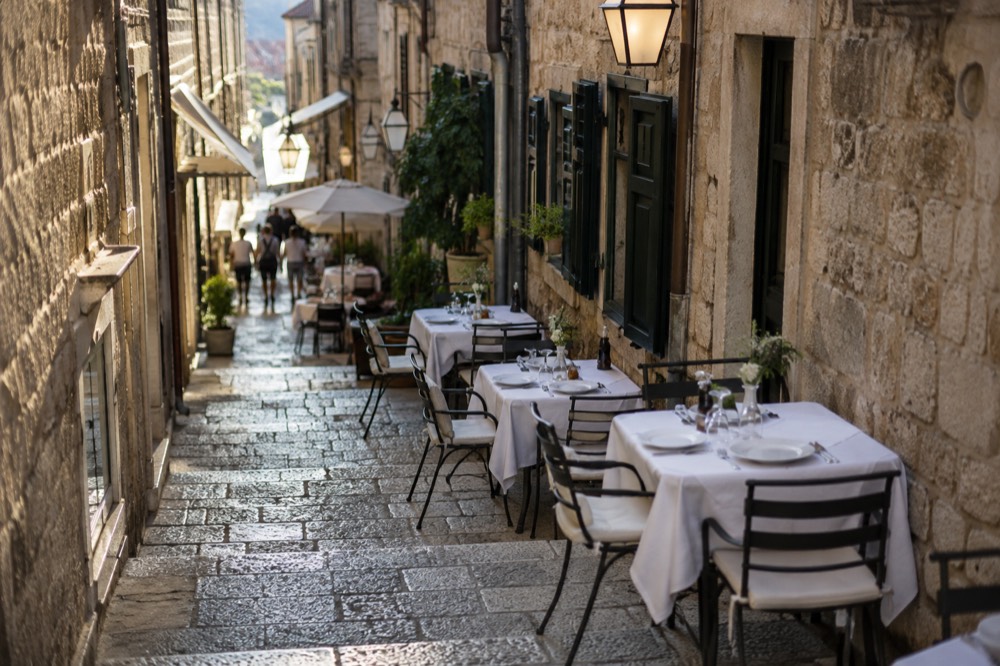
The trap is geography. Restaurants sitting directly on the Stradun pay the highest rents in the city and some of them serve food designed for people who will never return. Walk two lanes off the main street, north or south, and quality rises while prices fall, which is a pattern repeated in every heavily visited old town in Europe but is especially sharp here because the walled city is so small. The difference between a meal on the Stradun itself and a meal three minutes away can be half the bill.
| Dish | What It Is | Where to Find a Good Version |
|---|---|---|
| Black risotto | Cuttlefish risotto dyed dark with its own ink | Konobas in the lanes north of the Stradun |
| Green pasta with shrimp | Fresh pasta in a parsley and shrimp sauce | Family-run places off Prijeko street |
| Peka | Meat or octopus slow-roasted under an ember-covered dome | Requires ordering ahead, usually outside the walls |
| Grilled fish | Whole fish priced by the kilo, grilled simply | Anywhere that displays the fish on ice |
| Dubrovnik rozata | Local custard pudding with caramel, the classic dessert | Old Town patisseries, best mid-afternoon |
For a deeper run at the food itself, the site carries a full guide to what to eat in Dubrovnik and an answer page on Dubrovnik's signature dish. Wine deserves the same warning as food: the house pouring on the main street is rarely the local Plavac Mali worth traveling for, and there is a dedicated wine tasting guide for the rooms that pour it seriously.
The food tour mentioned above is the one product on the roster that turns this problem into the itinerary, moving between local stops with a guide who explains what each plate is.
What Is the Best Street in Old Town, Dubrovnik?
The Stradun is the best street in Old Town Dubrovnik for a first visit, but the best street once you know the city is Od Puča, the parallel lane one block south, which carries the same limestone character with a fraction of the crowd, real shops, a bakery worth queueing for and the best light in the late afternoon. Prijeko, running parallel one block north, is the restaurant lane, loud and tourist-facing. The lane climbing to the Jesuit stairs is the most photographed. Each has a role, and the mistake is treating the Stradun as the only street worth walking.
Here is how the candidates actually compare, from the perspective of someone who walks them weekly:
| Street | Character | Best Time |
|---|---|---|
| Stradun (Placa) | The grand main street, uniform facades, all the landmarks | Before 08:00 or after 19:00 |
| Od Puča | Parallel south lane, local shops, quieter, cheaper coffee | Mid-morning |
| Prijeko | Restaurant lane one block north, terraces, buskers | Dinner time |
| Uz Jezuite | The baroque staircase climb to the Jesuit church | Early evening for the light |
| Pred Dvorom | Short lane past the Rector's Palace toward the cathedral | Morning, before tours arrive |
The honest answer for most visitors is that the best street is the Stradun at the right hour and a side lane at the wrong one. Between 10:00 and 18:00 the main street is at its densest, and everything charming about it is competing with crowd noise. That is the window to be on the walls looking down at it, or two lanes deep in the grid. The staircase streets north of the Stradun climb steeply and reward the effort with doorways, washing lines and sudden sea glimpses, the texture the main street deliberately lacks.
A guided walk stitches these together efficiently. The Old Town walk with a local guide runs from $20 per person, rated 4.8 across 5,826 reviews, and operators typically route through both the main street and the lanes that flank it. Check availability if that suits your first morning.
Alex was a fantastic guide, she explained the complex history of Dubrovnik to give a lasting impression of the history of the area. Really appreciated that she aimed for shaded areas on a boiling September day. The food recommendations for after were much appreciated too! Great tour for a first experience of the old town!
Sophie
When Is the Stradun at Its Best and Worst?
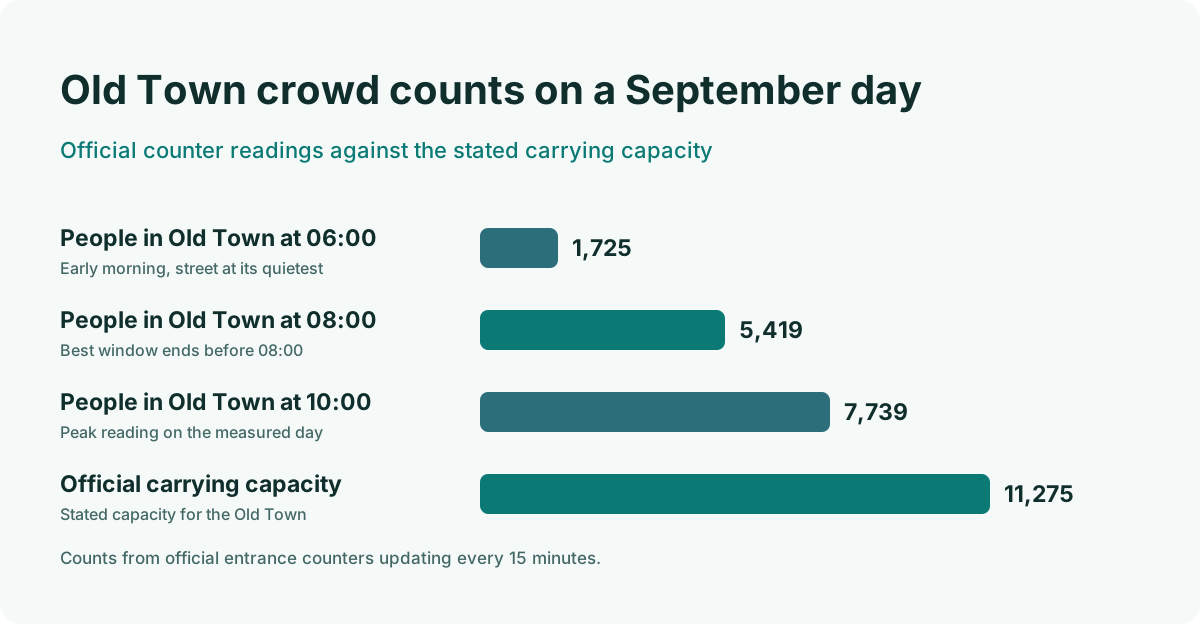
The Stradun is at its best early in the morning, between 06:00 and 08:00, when a September day saw official counters record 1,725 people in the Old Town at 06:00 and 5,419 at 08:00. It is at its worst between 10:00 and 16:00, with the same day peaking at 7,739 people at 10:00 against an official carrying capacity of 11,275, measured by six entrance counters updating every 15 minutes. Those numbers come from the official Dubrovnik visitors platform, and they turn vague advice about crowds into something you can actually plan around.
The half-hourly curve from that September day is worth internalising, because it holds broadly true across the season:
| Time | People in the Old Town | What It Means for You |
|---|---|---|
| 04:00 | 1,200 | Empty, only night owls and cleaners |
| 06:00 | 1,725 | Photographers and runners, perfect light |
| 08:00 | 5,419 | Still walkable, cafes opening |
| 09:00 | 7,297 | Crowds building fast |
| 10:00 | 7,739 | Daily peak, avoid the Stradun |
| 11:00 | 7,205 | Stays dense through the afternoon |
Cruise schedules compound this, and counter to intuition the peak months are not July and August. Port Authority data shows cruise passengers in 2025 peaked in September at 101,246 and October at 100,132, above July's 96,072 and August's 87,385. If you are visiting in early autumn expecting the crowds to have gone, they have not, and on some days they have intensified. The Port Authority limits cruise passengers to 8,000 a day in most cases, but those are ship capacities, not the number of people who actually walk ashore, so treat any single-day figure as an upper bound.
The practical playbook is simple. Walk the Stradun before 08:00 or after 19:00, and give the middle of the day to the walls, the museums, Lokrum or a boat. The walls operator's stated hours are 08:00 to 19:30, which pairs perfectly with a morning walls circuit followed by a late-afternoon return to the main street once the counter curve falls. There is a fuller treatment in the guide to the best time of day to walk the walls.
What Not to Do in Dubrovnik?
The five mistakes to avoid are eating directly on the Stradun at peak hours, walking the polished limestone in smooth-soled shoes after rain, buying the walls ticket in December when you could pay 20 euro instead of 40, assuming July and August are the busiest cruise months when September actually leads, and treating the main street as the whole city when the best of it sits one lane away. None of these are complicated, and every one of them is visible on the street within an hour of arriving.
Take them in order. The restaurant geography problem was covered in the food section above: two lanes off the Stradun, better food, lower bill. The limestone is a genuine safety point, not a joke, because the paving is worn to a sheen and rain turns it into a skating rink, so shoes with real grip matter more here than anywhere else in Croatia.
The ticketing mistake is the most expensive one. The adult City Walls ticket is 40 euro in main season, 1 March to 30 November, and 20 euro in December, with children 7 to 18 at 15 euro then 5 euro, and under 6 free. There is no family ticket, the operator sells exactly adult and child. The 40-euro ticket is actually a walls plus Fort Lovrijenac combination, and it also covers the Western Outer Wall and the coin collection. A one-day Dubrovnik Pass costs the same 40 euro in main season and adds ten more sights plus a 24-hour bus ticket, but that equivalence is a main-season claim only, because in December the walls ticket drops to 20 euro while no pass tier is on sale at all.
| Ticket | Main Season (1 Mar to 30 Nov) | December |
|---|---|---|
| City Walls adult | 40 euro | 20 euro |
| City Walls child 7 to 18 | 15 euro | 5 euro |
| Child 6 and under | free | free |
| Dubrovnik Pass 1 day | 40 euro | not on sale |
| Dubrovnik Pass 3 days | 50 euro | not on sale |
| Dubrovnik Pass 7 days | 60 euro | not on sale |
The last mistake is the subtlest: pacing. Visitors who sprint from Pile Gate to the clock tower, photograph the fountain, and leave, have seen a corridor and missed a city. The Old Town is 24.7 hectares, small enough to cross in minutes and dense enough to fill days, and the UNESCO inscription covers the whole fabric, not just the famous street. Slow down, pick two lanes, and the visit changes character entirely.
Which Side Streets Deserve Your Attention Off the Stradun?
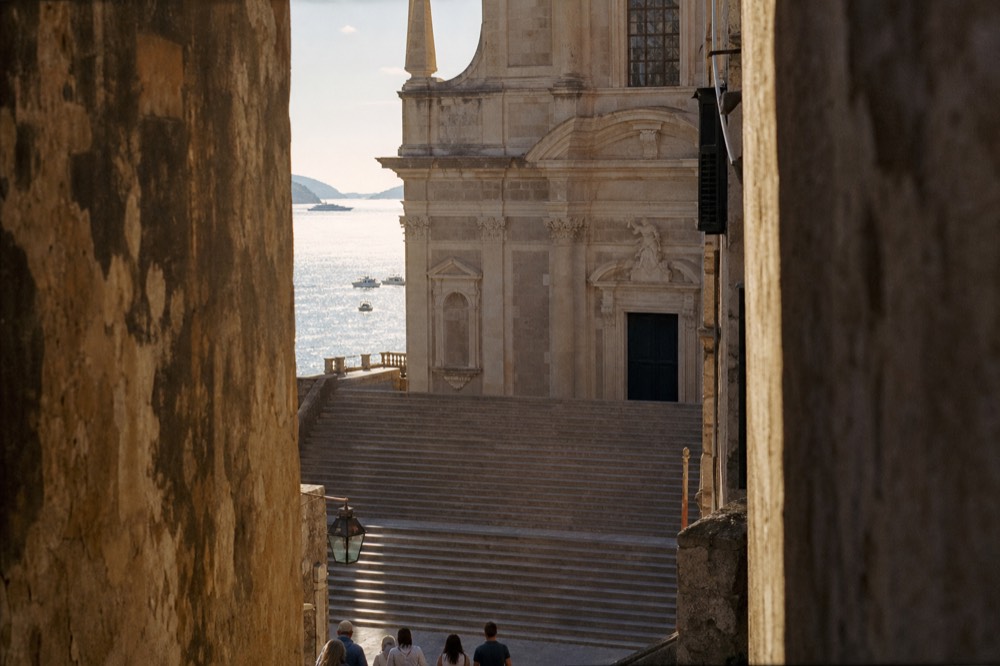
Four side streets repay the detour: the Jesuit staircase for the single most dramatic view in the Old Town, Prijeko for dinner terraces, Od Puča for everyday local commerce, and the lane down to the old port for the fishing-boat morning scene. The grid around the Stradun is small, roughly a dozen lanes each side, so none of these detours costs more than a few minutes, and together they deliver almost everything the main street cannot: texture, quiet, and the sense of a lived-in city rather than a stage set.
The Jesuit staircase is the one most visitors already know without knowing its name, because it is the broad baroque flight of steps climbing to the church of St Ignatius, and it doubles as a famous filming location. Fans of the show will recognise it instantly, and there is a full guide to Game of Thrones locations in Dubrovnik covering it and the rest. Arrive early if you want it empty, because by mid-morning it is one of the most photographed staircases on the Adriatic.
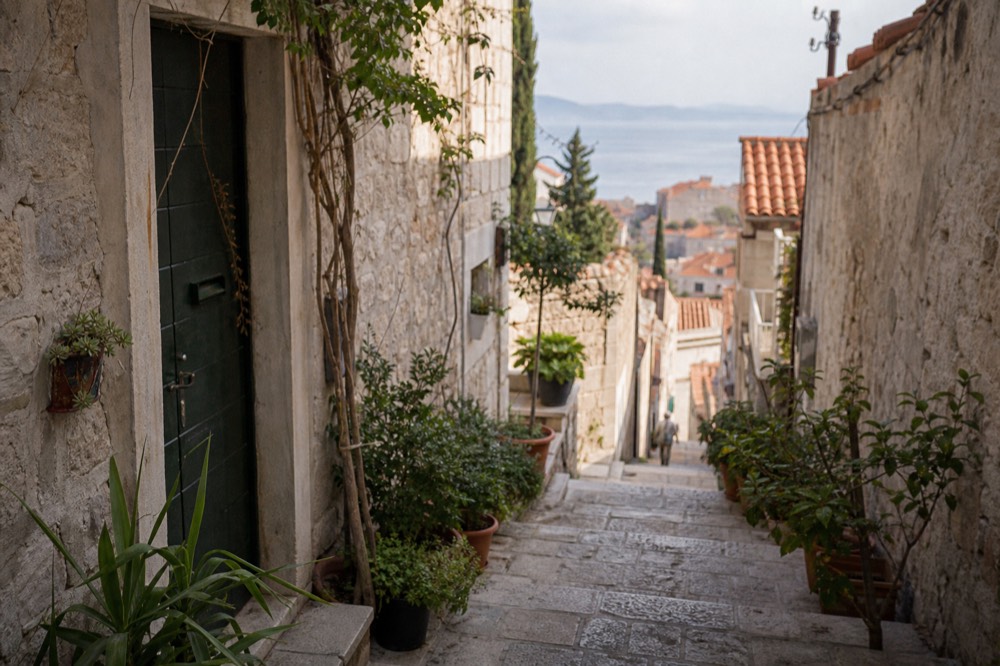
North of the Stradun the lanes climb fast, and this is where the Old Town stops performing. Doorways, shrines set into walls, laundry overhead, cats on warm stone, and every so often a sliver of blue sea at the end of a flight of steps. South of the street the lanes fall toward the walls and the Buža bars, where a hole in the fortifications frames the open Adriatic. Both halves are worth an aimless half hour, and aimless is the right mode, because the grid is too small to get genuinely lost in and every lane eventually returns you to the Stradun or the walls.
A combo walking tour is the efficient way to get this orientation on day one, since it covers the main street and the walls in a single 3 hour 30 minute circuit.
How Does the Stradun Look From Above?
From the city walls and from Mount Srđ the Stradun reads as a single pale seam cutting the Old Town in half, and the cable car ride to the 405-metre upper terminal costs 30 euro round trip for an adult, 17 euro one way, with children 4 to 12 at 8 euro round trip and under 4 free. The cable car climbs 367 metres over a 778.2-metre track in 3 minutes 30 seconds, and the operator states a view range of up to 60 km on a clear day. From that height the discipline of the 298-metre main street becomes visible in a way it never does at street level.
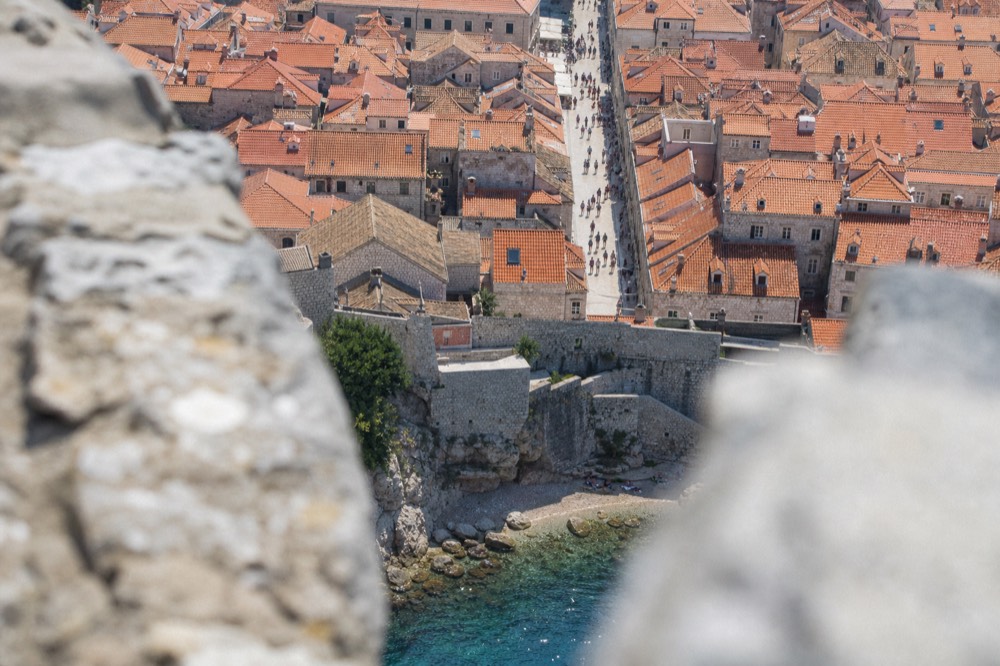
The walls are the closer, cheaper and arguably better vantage. Several stretches of the 1,940-metre circuit look directly down the Stradun's length, and because you are walking the circuit anyway, these views cost nothing beyond the walls ticket itself. The classic shot comes from the section near the Minceta end, where the street runs away from you toward the clock tower with the red rooftiles stacked on either side. Morning light favours the eastward look, evening the westward.
| Vantage Point | Cost | What You See of the Stradun |
|---|---|---|
| City Walls circuit | 40 euro adult main season | Direct overhead views along the full length |
| Mount Srđ cable car | 30 euro adult round trip | The whole walled city, street as a pale seam |
| Fort Lovrijenac | 15 euro alone, included with walls | Western approach and Pile Gate end |
| Bell tower climb | Fee on site | Along the street from its eastern end |
Fort Lovrijenac, standing on its 37-metre sea rock across the bay, gives the least crowded angle, and since it is included in the 40-euro walls ticket there is no reason to skip it. The cable car has its own guide on this site, Dubrovnik cable car tickets and tips, including how the combined cable car and walking tour products compare on price. One of those products pairs the ride with an Old Town walk in a 4 hour 30 minute format, rated 4.6 across 716 reviews, which covers both the view from above and the street below in one booking.
How Do You Fit the Stradun Into a Perfect Day?
The pattern that works is Stradun at dawn, walls in the morning, a side-lane lunch, museums or Lokrum through the afternoon heat, and the Stradun again after 19:00 when the promenade begins and the day visitors have left. The counter data makes the case on its own: 1,725 people at 06:00 against 7,739 at 10:00 is a fivefold difference in the same street, and the only variable is the hour. Everything else in the day slots around those two windows.
A concrete schedule for a first day, assuming a main-season visit:
| Time | Where | Why |
|---|---|---|
| 06:30 to 08:00 | Stradun and Pile Gate | Empty street, best light, coffee on Od Puča |
| 08:00 to 10:30 | City Walls circuit | Operator hours open at 08:00, cooler walking |
| 10:30 to 12:00 | Rector's Palace and cathedral lanes | Indoors as the counter peaks |
| 12:00 to 14:00 | Lunch two lanes off the Stradun | Better food, lower prices |
| 14:00 to 18:00 | Lokrum or a beach | Boats leave the old port every 15 minutes from 10:00 |
| 19:00 onward | Stradun promenade and dinner | The street at its best second showing |
The Lokrum leg deserves one planning note: the 30-euro Lokrum ticket covers both reserve entry and the return boat transfer, boats leave the City Harbour at 09:00 then every 15 minutes from 10:00 to 18:00, and the ticket office at Luža sits at the eastern end of the Stradun itself, so the excursion starts exactly where your morning did. There is a full Lokrum Island guide if the island is competing for an afternoon.
For visitors with only a few hours, the honest minimum is the dawn or dusk Stradun walk plus either the walls or one good side lane, and nothing else. The walled city punishes checklists. It rewards a single street walked twice, at two different hours, which is precisely the thing the Things to Do in Dubrovnik approach is built around: fewer things, done at the right time.
Common Questions About the Stradun in Dubrovnik
What Is the Most Beautiful Street in Dubrovnik?
The Stradun is the most beautiful street in Dubrovnik for its discipline rather than its decoration: 298 metres of uniform stone facades fixed by the 1272 Statute and rebuilt to the same rules after the great earthquake. For pure charm, the parallel lane Od Puča and the Jesuit staircase run it close, with a fraction of the crowd.
what is the most beautiful street in dubrovnik?
Most people mean the Stradun, the 298-metre limestone main street running from Pile Gate to the clock tower. It is the only flat, open line in the walled city and the reason the Old Town reads as a single composition.
What Is the Main Food in Dubrovnik?
Seafood leads: black cuttlefish risotto, grilled fish and green pasta with shrimp, with roast peka as the celebratory signature dish. Eat two lanes off the Stradun rather than on it, where rents are highest and quality is most variable.
What Is the Best Street in Old Town, Dubrovnik?
The Stradun is best for a first visit, especially before 08:00 or after 19:00. Once you know the city, Od Puča one block south offers the same limestone character with local shops and far fewer people, while Prijeko is the restaurant lane.
What Not to Do in Dubrovnik?
Do not eat on the Stradun at peak hours, walk its polished limestone in smooth shoes after rain, buy a 40-euro walls ticket in December when it costs 20 euro, assume July is peak cruise season when September leads at 101,246 passengers, or treat the main street as the whole city.
When Is the Stradun Least Crowded?
Between 06:00 and 08:00, when the official counter system recorded 1,725 people in the Old Town at 06:00 rising to 5,419 at 08:00 on a September day, against a 7,739 peak at 10:00. After 19:00 the street empties again and the evening promenade begins.