Dubrovnik Food Tour Guide: What to Eat and How to Taste It
Dubrovnik's food scene runs from konoba grills inside the walls to oyster beds up the coast in Ston, and a good food tour stitches it together in a single afternoon.
Short answer
Yes, the food in Dubrovnik is genuinely good, and the best way into it is a guided tasting walk. The leading food and drink tour runs about 3 hours from $165.64 per person and is rated 5 across 704 reviews. Signature dishes include black risotto, peka, oysters from Ston and local Plavac Mali wine.
Is the Food in Dubrovnik Good?
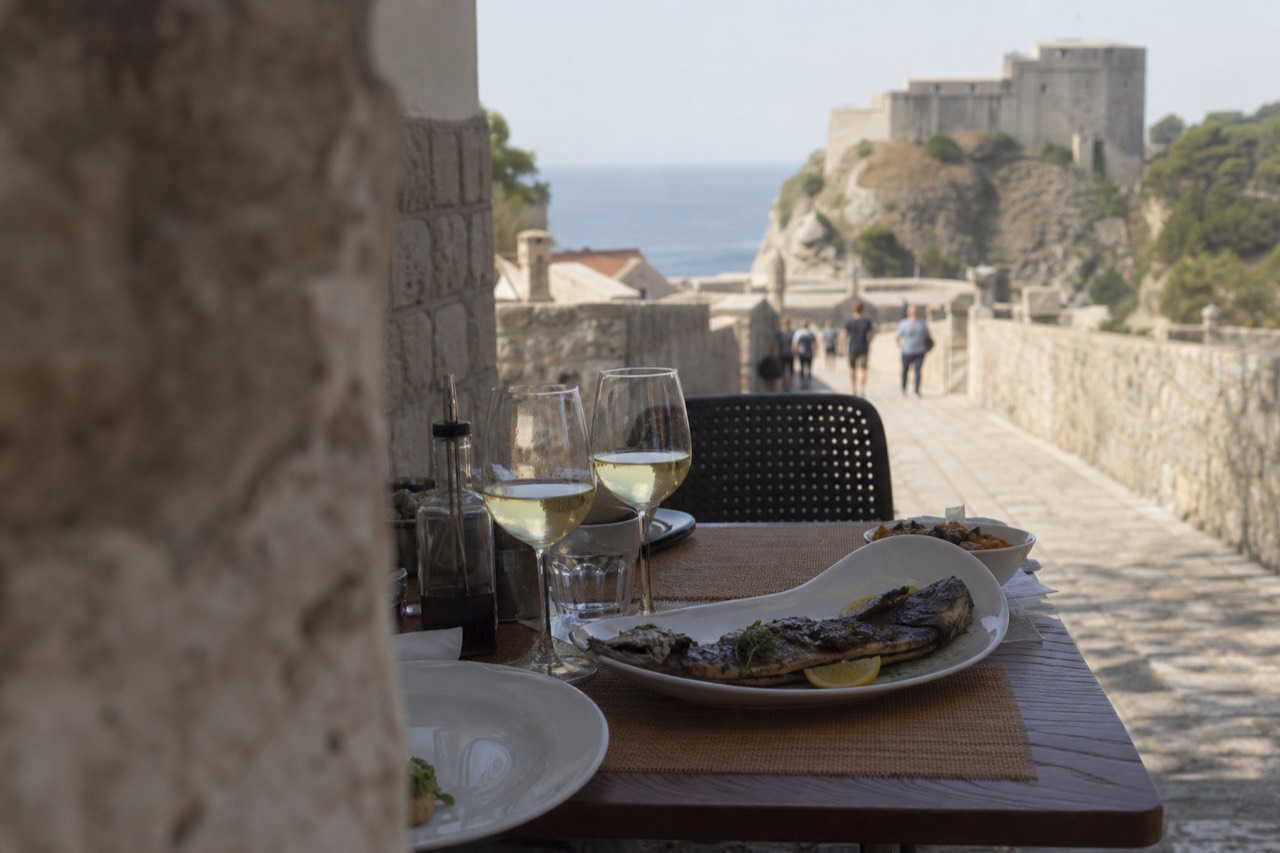
Yes, the food in Dubrovnik is genuinely good, and it improves sharply the moment you step off the main drag. The city recorded about 4.2 million overnight stays in 2025, sharing first place among Croatian destinations with Rovinj, and a visitor economy that size supports real depth: konoba grills, market produce, fresh Adriatic fish and a wine region an hour down the coast. The trap is eating blindly on the Stradun, where the 298-metre main street carries the highest rents and the most forgettable plates in town.
I walk these streets for a living, and the pattern has held for years. The restaurants ten minutes from Pile Gate, up the side stairs of the Old Town or across in Gruž, serve food that would embarrass the terrace places on the main square, at two-thirds of the price. The Croatian Bureau of Statistics counted 20.7 million arrivals and 94.8 million nights in commercial accommodation across Croatia in 2025, and Dubrovnik's slice of that is enough to keep a serious restaurant scene alive year round for locals, not just for summer visitor economy statistics.
What makes the food here distinct from the rest of Dalmatia is a mix of sea and hinterland. You get the coastal staples, grilled fish, octopus salad, black risotto, but also the Konavle valley's prosciutto, peka cooked under a bell of embers, and Ston oysters from beds that sit just up the Pelješac peninsula. A food tour exists precisely to compress that spread into one walk.
The honest caveat: Dubrovnik is not a cheap-eats city. Prices sit at the top of the Croatian scale, and a mediocre meal near the Stradun costs more than an excellent one in Lapad. Planning where you eat matters more here than in most Mediterranean cities, which is the whole argument for either a guided tasting walk or a bit of research before you sit down. Our what to eat in Dubrovnik guide covers the dishes in depth if you want the full picture before booking anything.
What Food Is Dubrovnik Known For?
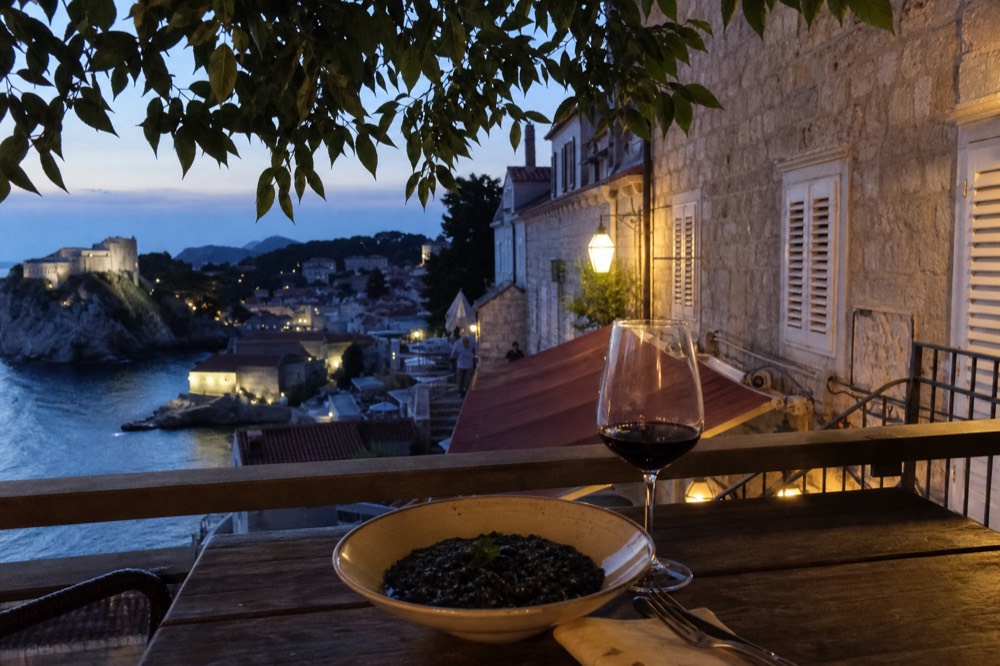
Dubrovnik is known for black cuttlefish risotto, grilled Adriatic fish, octopus salad, peka (meat or octopus slow-cooked under a burning iron bell), Ston oysters, prosciutto from Konavle, and the Plavac Mali red wine grape grown on the nearby Pelješac peninsula. Green pasta with a shrimp-cream ragu is a local restaurant signature, and rozata, a rose-scented custard, is the classic dessert.
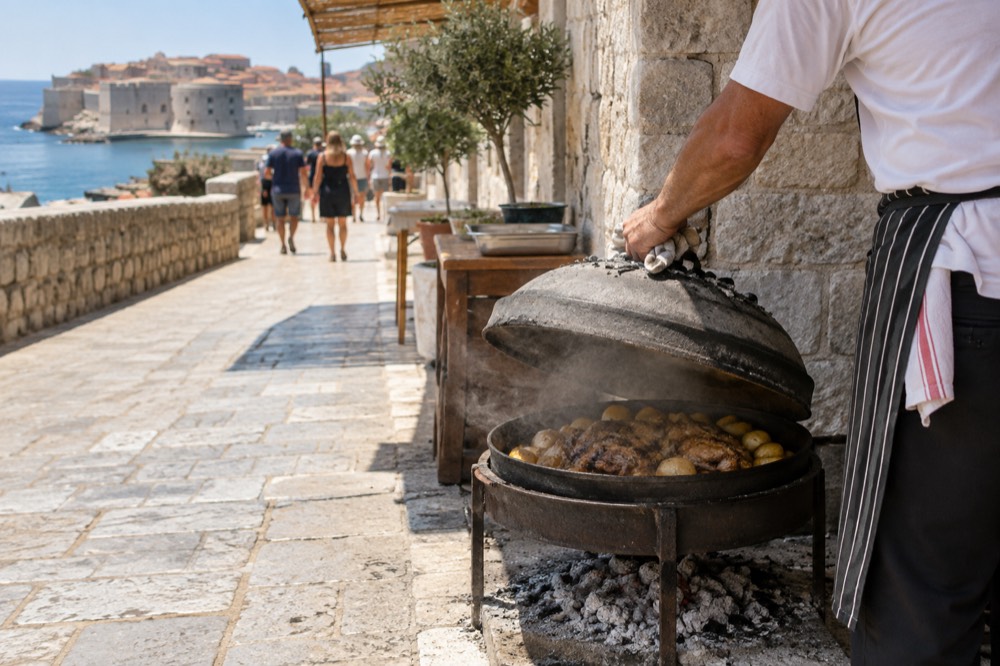
The one dish I tell first-time visitors to hunt down is peka, because it is the one you cannot improvise. It needs hours under a sac, the domed lid buried in embers, so only konobas that planned ahead have it, and many ask you to order it a day in advance. Octopus peka is the coastal version; lamb peka is the inland one. Either way it is the closest thing this coast has to a national Sunday dish.
| Dish | What it is | Where to find the best version |
|---|---|---|
| Black risotto (crni rižot) | Cuttlefish risotto coloured and flavoured with its own ink | Konobas with daily fish, usually written on a chalkboard |
| Peka | Meat or octopus with potatoes slow-cooked under an iron bell | Family konobas, often ordered a day ahead |
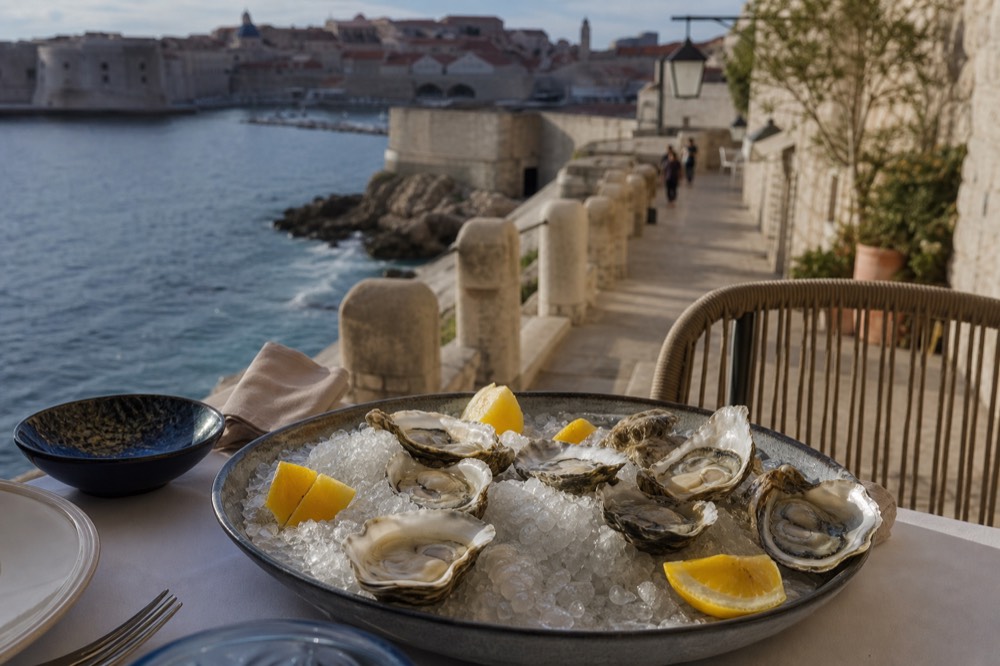
| Ston oysters | European flat oysters from beds on the Pelješac peninsula | Ston itself, or restaurants that buy from the beds daily |
| Green pasta (zelena tjestenina) | Pasta with a creamy shrimp ragu, a Dubrovnik restaurant invention | Established Old Town restaurants |
| Octopus salad | Cooled octopus with potato, onion, parsley and olive oil | Anywhere the octopus is cooked that morning |
| Rozata | Rose-liqueur-scented custard with caramel, the Ragusan classic | Old Town dessert spots and konobas |
The wine side matters just as much. Plavac Mali, the great red of southern Dalmatia, grows on the steep, sun-baked slopes of Pelješac and Dingać, and it is the pour that should be beside your grilled fish, not an imported red. If the grape is new to you, our Plavac Mali grape primer explains why the same variety tastes different from terrace to terrace.
If you would rather have someone arrange the tastings than research each stop yourself, the three products below are the strongest food-and-drink experiences on the roster: the Old Town tasting walk itself, a half-day wine trip into the Konavle valley behind the city, and a full oyster-and-wine excursion to Ston.
What Food Is Famous in Dubrovnik?
The single most famous food in Dubrovnik is the Ston oyster, served minutes out of the water on the Pelješac peninsula, followed closely by black risotto and peka. Internationally, the city is also famous as a filming location, and Game of Thrones tours now feed almost as many visitors as restaurants do. The Dubrovnik food tour most travellers book is the 3-hour walk rated 5 across 704 reviews, from $165.64 per person.
Fame and quality are not the same thing here, and it helps to know which famous foods travel well. Oysters from Ston are famous because the beds have been producing for centuries and the shellfish is genuinely exceptional; that fame is earned. Black risotto is famous partly because it photographs dramatically, but a well-made one, creamy, deeply savoury, not bitter, is still one of the best plates on the coast.
The food walk that anchors this whole category is the Dubrovnik Food and Drink Walking Tour with a Local Guide. It runs about 3 hours from $165.64 per person, is rated 5 across 704 reviews, and is operated by Fabula Ragusea, a local team. The format is simple: a local guide walks you through the Old Town with tastings and wines at every stop, and the stops double as a geography lesson for the rest of your trip.
Amazing food tour! Marija was a great guide, full of stories and facts that really brought Dubrovnik to life. The food was delicious, and generous. Wines at every stop. Would highly recommend this tour to anyone visiting Dubrovnik, especially to help get your bearings of the city and know where to go for dinner!
Bryan_M
That last point in the review is the real argument for booking a food tour on day one rather than the last evening. A good tasting walk tells you which streets hold the honest konobas, what a fair price for fish looks like, and which wine to order, and then you eat better for the rest of the stay.
One practical note before you commit to a date: the walk runs on fixed departures and the small-group format means the popular evening slots fill first, especially once the September and October cruise crowds land. Checking availability a few days ahead of your trip, rather than the night before, is the difference between the time slot you want and the one that is left.
Which Dubrovnik Food Tour Should You Book?
Book the Old Town food and drink walk if you want tastings plus city orientation, and the Ston oyster and mussel tour with lunch if you want the famous shellfish at its source. They run from $165.64 and $157 per person respectively, and the two formats barely overlap, so the choice is about appetite, not ranking.
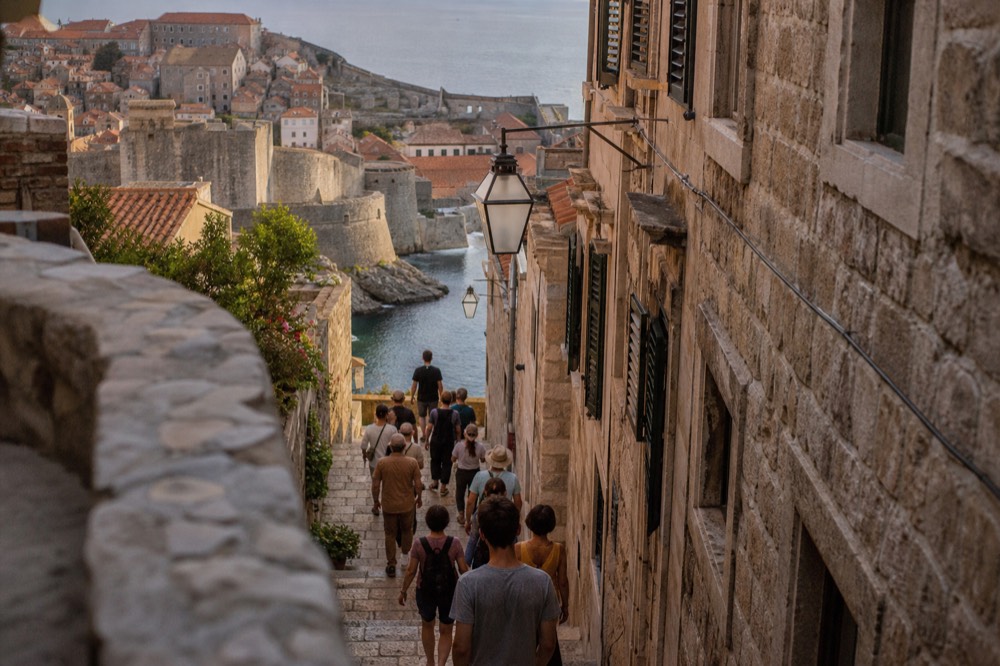
The Konavle trip deserves more attention than it gets. Konavle is the agricultural pantry of Dubrovnik, and tasting there explains half of what shows up on Old Town menus.
| Tour | Length | From (per person) | Rating | Best for |
|---|---|---|---|---|
| Food and Drink Walking Tour with a Local Guide | 3 hours | $165.64 | 5 across 704 reviews | Tastings plus Old Town orientation on day one |
| Oyster, Mussels and Wine Tasting in Ston with lunch | Full day | $157 | 4.9 across 111 reviews | Oysters at the source plus Pelješac wine |
| Peka Cooking Lesson | 4 hours | $159.83 | Rating not shown, 10 reviews | Cooking the signature dish yourself |
One more format belongs on the list even though it is a cooking lesson rather than a tour: the Croatian Traditional Cuisine Peka Cooking Lesson runs about 4 hours from $159.83 per person and puts you in the kitchen while the bell lid goes on. It has only 10 reviews on the listing, too few for a fair star rating, but the concept is exactly what peka deserves.
If your interest is less food than wine generally, the Dubrovnik wine tasting guide lays out the cellar rooms and tasting bars inside the city, and the Ston oysters guide covers the beds in depth for anyone planning the drive independently.
Where Do Locals Eat in Dubrovnik?
Locals eat away from the Stradun: in the stair-streets of the Old Town's northern flank, around Gruž where the market and the port kitchens sit, and at konobas in Lapad and the suburbs. The pattern is consistent, look for chalkboard fish menus, houses full of Croatian voices, and kitchens that cook one region's food rather than a tourist composite of all of them.
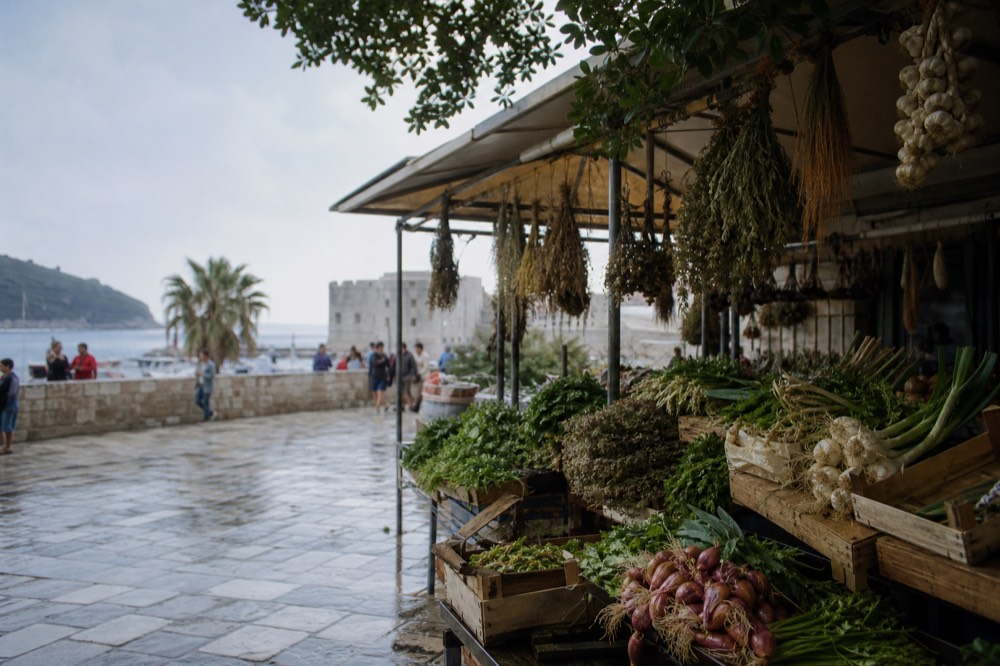
The Gruž market is the honest heart of the food scene, and I send people there before any restaurant. Fishermen land the morning catch at the port end, farmers from Konavle sell vegetables and honey, and the stalls tell you exactly what is in season, which is the same information the good kitchens are cooking from. Our Gruž market guide has the practical details, and the where locals eat in Dubrovnik answer names specific tables.
| Area | Character | What to order there |
|---|---|---|
| Old Town side streets | Stone stair konobas, quieter than the Stradun | Black risotto, green pasta, daily fish |
| Gruž | Market and port neighbourhood, working kitchens | Whatever the market sold that morning |
| Lapad | Residential bay with a long restaurant strip | Grilled fish, peka ordered ahead |
| Bosanka and the slopes of Srđ | Village konobas above the city | Lamb peka, Konavle prosciutto |
A food tour solves the same problem from the opposite direction. Instead of you guessing which staircase hides the good kitchen, a local guide walks you into four or five of them in an evening, and you leave with names for the rest of the week. That is why I recommend booking the walk early in a stay rather than as a farewell dinner.
Can You Taste the Region on a Day Trip From Dubrovnik?
Yes, and the two best food day trips from Dubrovnik are Ston, about an hour up the coast, for oysters and mussels pulled from the beds at your feet, and the Konavle valley behind the city for wine and prosciutto. The Ston oyster, mussel and wine tasting tour with lunch runs from $157 per person and is rated 4.9 across 111 reviews.
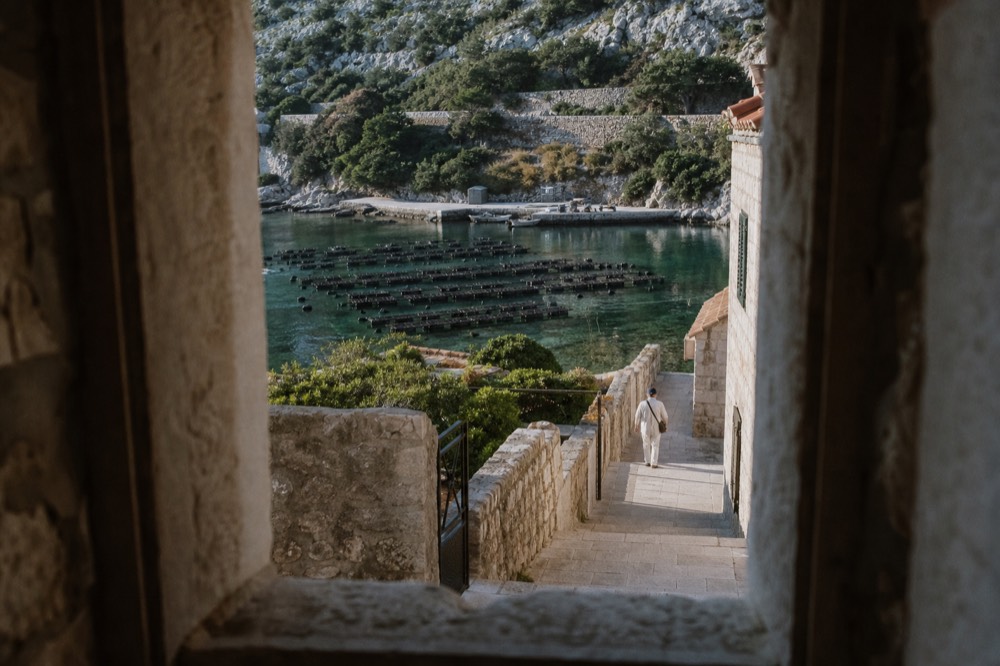
Ston is the one I would fight for. The town guards the entrance to the Pelješac peninsula with the longest complete stone walls in Europe after the Great Wall of China, and the salt pans and shellfish beds below them have fed the region for centuries. Eating an oyster that was in the water an hour earlier, with a glass of local Pošip or Plavac Mali beside it, is the single best food experience within reach of Dubrovnik.
The tour version handles the logistics: transport up the coast, tastings at the beds, mussels, and lunch, plus wine from the peninsula's cellars. It is operated by a Ston-based agency, which matters, because the beds they visit are the ones their families farm.
If you would rather build the trip yourself, the Ston and Pelješac guide covers the drive, the walls and the shellfish farms, and the Pelješac wine guide maps the wineries along the road back.
What Does a Food Tour in Dubrovnik Cost?
Eating independently runs cheaper per meal but higher per insight, since no chalkboard explains itself.**
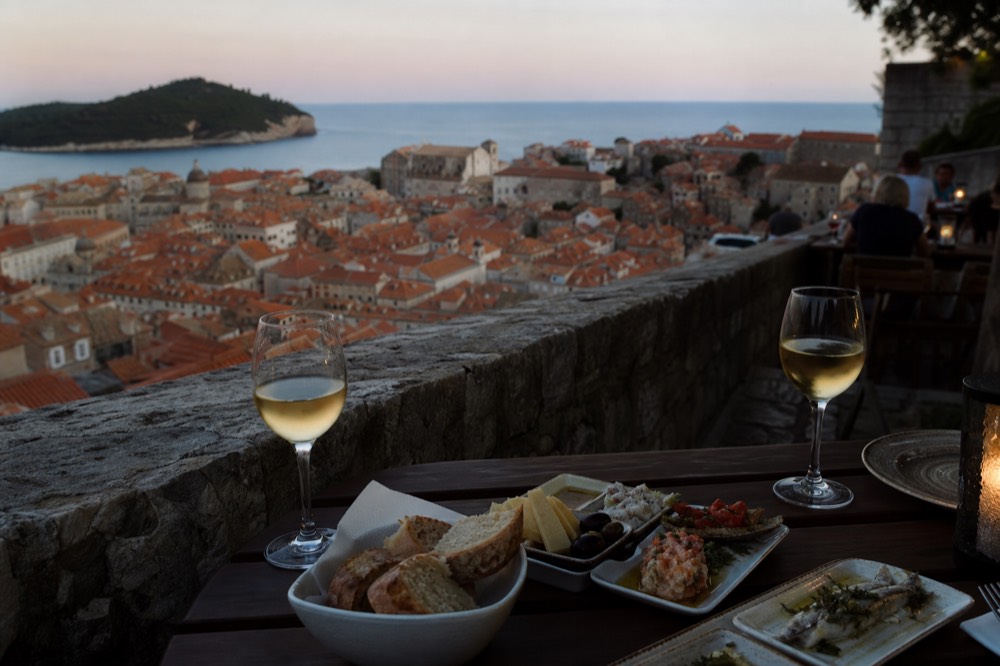
The price spread reflects format, not quality. The wine trip is cheapest because you sit in one or two cellars; the Old Town walk costs the most because a licensed guide walks you between five or six stops with food and wine at each. Tasting fees and small plates inside the city usually run in the mid double digits per stop if you assemble the same evening yourself, and a restaurant dinner with local wine adds more on top, so the guided walk is closer to fair value than it first looks.
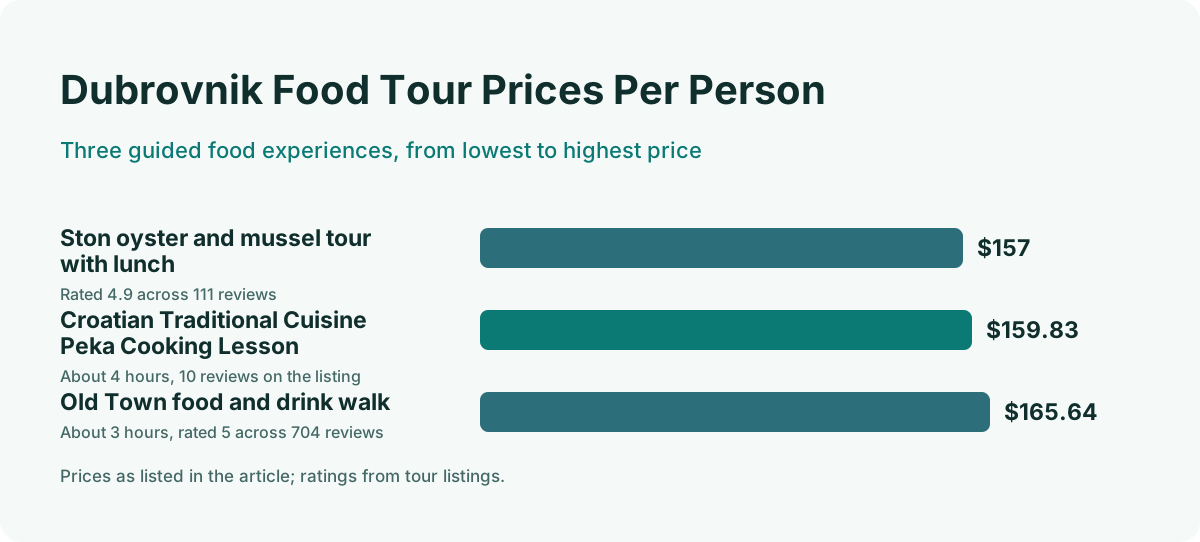
| Experience | From (per person) | Meals included | Alcohol included |
|---|---|---|---|
| Ston Oyster, Mussels and Wine Tour | $157 | Full lunch | Yes, tastings |
| Peka Cooking Lesson | $159.83 | You eat what you cook | Check the listing |
| Food and Drink Walking Tour | $165.64 | Tastings at every stop | Yes, wine at stops |
Prices on the live listings shift with season and availability, so treat these as the floor and check the current figure when you book. What stays constant is the ratio: every one of these products costs about the same as one long restaurant dinner for two in the Old Town, and each one leaves you knowing the city's food better than any single dinner will.
When Is the Best Time of Year for a Food Tour?
September and October are the best months for a food tour in Dubrovnik: the sea is still swimmable, the grape and oyster harvests are in, and the crowd curve bends down after the summer peak. Cruise passengers actually peaked in September at 101,246 and October at 100,132 in 2025, above July's 96,072 and August's 87,385, so book timed tours ahead even in autumn.
That cruise figure surprises people, and it should, because it inverts the "avoid summer" reflex. The Port Authority's own data shows autumn, not August, is when the most cruise passengers step ashore, and 461 cruise calls are scheduled for 2026. The counting system helps you plan around it: six counters at every Old Town entrance update a headcount every 15 minutes, and on a September morning the curve climbs from 5,419 people at 08:00 to a 7,739 peak at 10:00 before easing to 7,205 at 11:00. An evening food walk sidesteps that curve entirely.
| Season | Food highlights | Trade-offs |
|---|---|---|
| May to June | First grilling season, fresh local greens | Warm, busy, book ahead |
| July to August | Full menus, longest opening hours | Hottest and most crowded, peak prices |
| September to October | Grape harvest, oysters at their best, rozata season begins | Still cruise-busy, book timed tours |
| November to March | Quiet konobas, peka weather | Some tour kitchens close for winter |
Whenever you come, the same sequencing rule applies: put the tasting walk on day one or two, then use what you learned, the street names, the wine, the fair price of fish, for the rest of the trip. The Old City's UNESCO inscription covers 24.7 hectares of medieval street plan, and every good food stop hides inside it World Heritage listing; a guide finds them faster than a map does. For everything else the city offers beyond the table, start with Things to Do in Dubrovnik and work outward.
Common Questions About Dubrovnik Food Tours
Is the food in Dubrovnik good?
Yes. The city supports a deep restaurant scene built on fresh Adriatic fish, Konavle produce, Ston shellfish and local Plavac Mali wine, and quality climbs sharply a few streets off the Stradun. Avoid the main-square terraces and the food is among the best on the Croatian coast.
What food is Dubrovnik known for?
Black cuttlefish risotto, peka cooked under an iron bell of embers, octopus salad, green pasta with shrimp ragu, Ston oysters, Konavle prosciutto, and rozata for dessert, all poured alongside Plavac Mali red or Pošip white wine.
What food is famous in Dubrovnik?
The Ston oyster is the most famous food associated with Dubrovnik, followed by black risotto and peka. The dishes are famous for good reason: the oysters come from centuries-old beds on Pelješac, and peka is the region's signature slow-cooked dish.
Is a food tour in Dubrovnik worth it?
For most visitors, yes. The leading walk is rated 5 across 704 reviews and doubles as an orientation to the Old Town's best streets, so you eat better for the rest of your trip, not just during the three hours of the tour itself.
When should I book a Dubrovnik food tour?
Book your tasting walk for day one or two of your stay, and reserve ahead in September and October, when cruise passengers actually peak. An evening slot sidesteps the morning crowd curve inside the Old Town.