What Are Some Quirky Things to Do in Dubrovnik?
Beyond the walls and the Stradun: Dubrovnik's odd corners, abandoned hotels, cliff bars, a giant chess set and the strange sights most visitors walk straight past.
What Are Some Quirky Things to Do in Dubrovnik?
Dubrovnik's quirkiest experiences are a giant stone chess set played by locals near the Pile entrance, the abandoned Kupari hotel resort a short bus ride down the coast, Buza Bar clinging to the seaward cliffs, the War Photo Limited gallery, and the nightclub inside a fortress. Each sits minutes from the standard route, and none needs more than an hour or two. The city rewards this kind of wandering. The Old Town is small, 24.7 hectares inside the walls, so the odd stuff sits close together, and the further you get from the Stradun, the stranger and quieter it becomes.
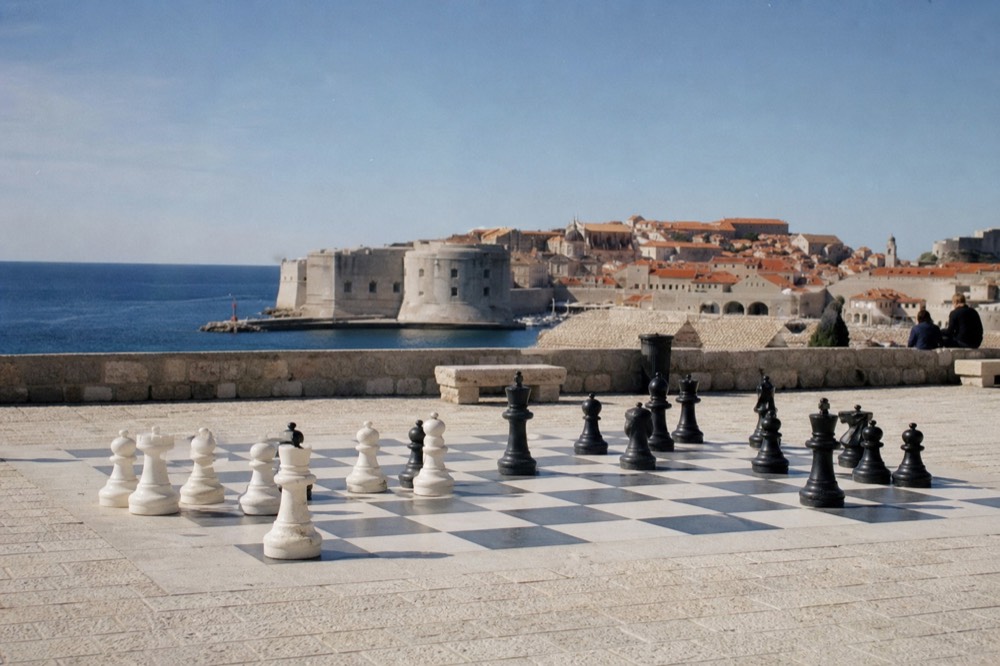
I have walked these streets with travellers since 2015, and the pattern never changes. People arrive with a list of three sights, tick them off by noon, and then ask what else there is. The honest answer is that the "what else" is better than the list. The chess set near Pile is a working board where pensioners play serious games with pieces tall enough that you notice them from the wall above. Watching a match costs nothing, and it is one of the few genuinely local scenes left in the old core. We cover the details, including when the board is busiest, in our giant Dubrovnik chess set guide.
Then there is the matter of drinking outside the walls, literally. Buza Bar is reached through a hole in the city wall on the seaward side, with tables on rock platforms above open water. It is strange by design: no sign at street level, just a painted hint saying "cold drinks" at the passage. Our Buza Bar cliff bar guide explains how to find the doorway, which most people walk past twice.
A third oddity sits a level above the nightlife. Culture Club Revelin is a nightclub inside the Revelin Fortress, and its stone vaults host DJs until late. Above it, in the same building complex near the Ploče end, War Photo Limited shows documentary photography from conflict zones, a sobering and unusual gallery for a party street. The pairing of a fortress that once guarded the eastern land approach, now holding both a museum and a club, is Dubrovnik in miniature: layers stacked on layers.
If you want the quirky corners explained rather than discovered by accident, a guided walk does the job efficiently. The selection below pairs the two strongest Old Town walks with a panorama bus tour for contrast.
The Old Town Walking Tour with a Local Guide, from $20 per person and rated 4.8 across 5,826 reviews, is the one I would point a first-timer at, because local guides are exactly the people who know which doorway leads to the cliff bar and which staircase hides the best view. Sophie, a guest on that walk, put it well:
Alex was a fantastic guide, she explained the complex history of Dubrovnik to give a lasting impression of the history of the area. Really appreciated that she aimed for shaded areas on a boiling September day. The food recommendations for after were much appreciated too! Great tour for a first experience of the old town!
Sophie
What Are Some Hidden Gems to See in Dubrovnik?
The strongest hidden gems are the Collection of Coins of the Republic of Ragusa at Gundulić Square 6, included free with your walls ticket, the Western Outer Wall walk, also on the same ticket, the Cave Bar below the Hotel More, and the quiet residential lanes above the Stradun where laundry still hangs between Baroque facades. The coin collection surprises people most. The 40-euro City Walls ticket, valid 1 March to 30 November, is actually a combination covering the walls, Fort Lovrijenac, the Western Outer Wall and that coin museum, yet most ticket holders never visit the last two.
The walls themselves are a hidden-gem factory because of how few people walk them fully. The circuit is 1,940 metres long, up to 25 metres high, and carries you past 16 towers, 3 fortresses, 6 bastions and 2 drawbridges, according to the operator's own figures. Most visitors enter, photograph the Stradun from above, and exit. The stretch around the harbour side and the Minceta end is where the crowds thin and you get the city almost to yourself. The operator's stated hours at the time of check were 08:00 to 19:30, and the morning entries beat both the heat and the coach groups.
Fort Lovrijenac deserves its own mention because it is both a hidden gem and a quirk. It stands on a 37-metre-high sea rock just outside the western wall, a separate fortress you reach by leaving the Old Town, and it is included on the same walls ticket. Bought alone it is 15 euro. Most people never cross to it, which is a pity, because the view back across to the walls is the best single photograph of the city, and the interior is usually near empty. Our Fort Lovrijenac guide covers the approach and the best light.
The Cave Bar is stranger still. It sits in a natural cave beneath the Hotel More on the Lapad peninsula, a short bus ride from Pile, and drinking inside a floodlit limestone grotto is an experience no other bar in the city can copy. Our Cave Bar guide has the practical details. For a fuller route through the quiet side of the peninsula, the Lapad area guide maps it.
Here is how the hidden-gem shortlist stacks up, with the practical details that matter:
| Hidden gem | Where | Cost | Time needed |
|---|---|---|---|
| Coin collection of the Republic of Ragusa | Gundulić Square 6, Old Town | Included with the 40-euro walls ticket | 30 to 45 minutes |
| Western Outer Wall | Bokar end of the walls circuit | Included with the walls ticket, closed December to February | 45 minutes |
| Fort Lovrijenac | Outside Pile Gate, across the small bay | 15 euro alone, or on the walls ticket | 1 hour |
| Cave Bar | Hotel More, Lapad peninsula | Drinks at bar prices | 1 to 2 hours |
| Giant chess set | Gradska kavana park, near Pile | Free to watch | 20 minutes |
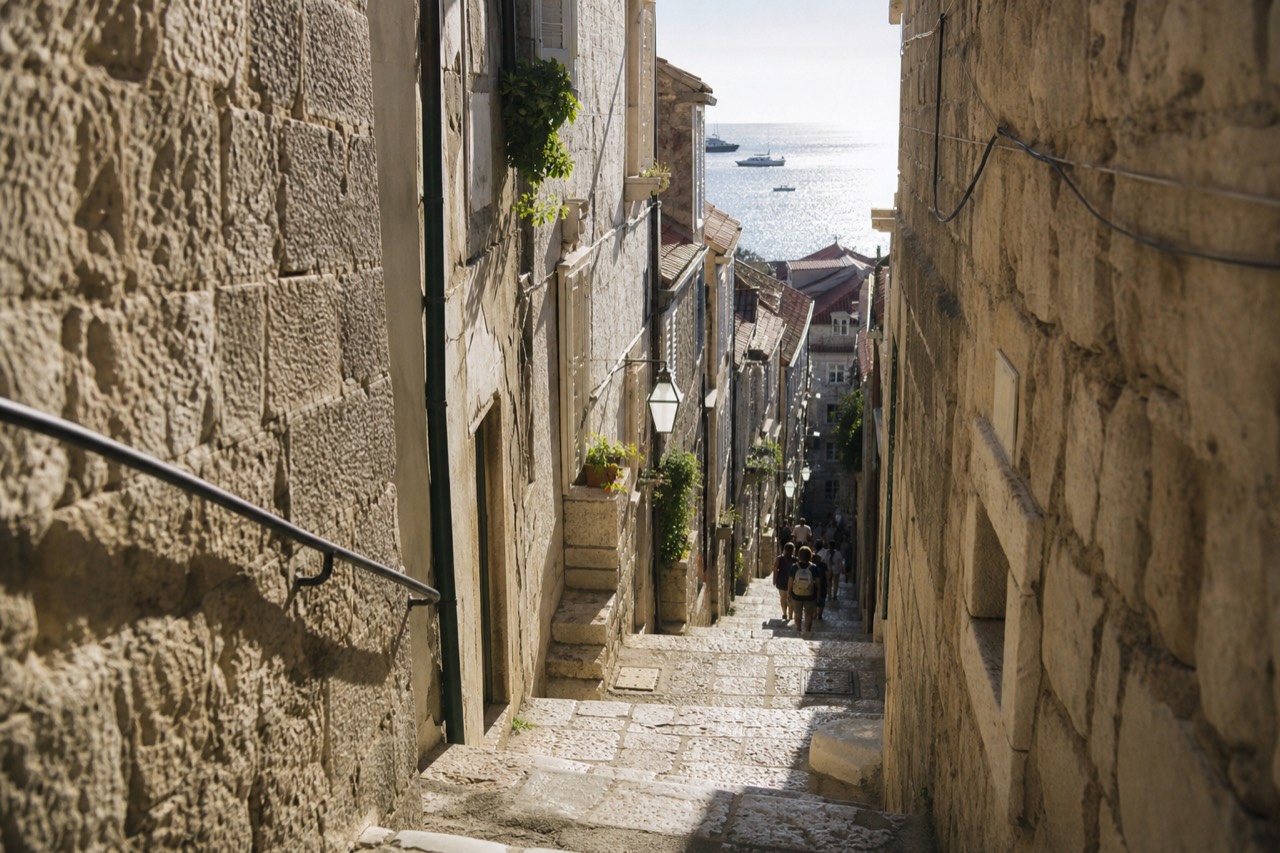
One more gem that costs nothing: the harbour-side stairs at the Ploče end, which climb past small houses to a terrace where locals sit in the evening. The Ploče Gate area is covered in our Ploče Gate guide, and it is the quietest corner of the old core at sunset.
What Are Some Good Towns to Visit Near Dubrovnik?
The best towns near Dubrovnik are Cavtat, a quiet harbour town on a wooded peninsula reachable by boat or bus, Ston with its long walls and oyster farms on the Pelješac peninsula, Trsteno with its historic arboretum, and Korčula town on the island of the same name. Each is a genuine half-day or full-day trip, and each gives you the old-stone Dalmatian atmosphere at a fraction of the Old Town's crowd level. The official combined Dubrovnik, Trsteno, Lokrum ticket at 42 euro even bundles Trsteno's arboretum with a boat ride.
Cavtat is the easy one. A boat from the Old City Harbour or a short bus ride gets you there, and the town wraps around a bay with a seaside promenade, a hilltop cemetery with a knockout view, and restaurants that cost meaningfully less than their Old Town equivalents. The three-day and seven-day Dubrovnik Pass tiers even include suburban bus coupons and House Bukovac in Cavtat, so pass holders can ride out and see the gallery on the same ticket. Our Cavtat guide covers the boat options.
Ston is the quirky one. Its walls climb the hill above the town in a shape that locals happily compare to a smaller Dubrovnik, and the salt works and oyster farms below them supply half the region's shellfish. Eating oysters a few metres from where they were harvested is the whole point of the trip, and our Ston oysters guide explains the ordering. The Ston walls guide covers the climb if you want the walls-without-the-crowds experience.
Korčula town, on the island, is the furthest of the four and the most rewarding for a full day: a compact walled town on a narrow peninsula, with a claimed connection to Marco Polo and a wine region behind it. Our Korčula day trip guide has the ferry detail, and the Korčula wine guide covers what to taste once you are there. Trsteno, closest of all, holds the arboretum with its ancient plane trees and a seaside aqueduct, and pairs naturally with Lokrum on the combined ticket.
A practical note on timing these trips: September and October are now the busiest cruise months, with 101,246 and 100,132 cruise passengers respectively in 2025, above July and August, so the "shoulder season is quiet" assumption no longer holds for day trips. Check the schedule before committing, because a town that felt empty at 09:00 can fill by noon when two ships tie up. Everything else covered here is indexed on Things to Do in Dubrovnik.
| Town | Distance and route | Best for | Half or full day |
|---|---|---|---|
| Cavtat | Boat from the Old City Harbour or bus from Dubrovnik | Seafront calm, a hilltop view, cheaper meals | Half day |
| Ston | Road, on the way to the Pelješac peninsula | Walls without crowds, oysters at the source | Half day, or combine with wine |
| Trsteno | Short coastal bus ride north-west | The arboretum and the aqueduct | Half day |
| Korčula town | Ferry or catamaran, plus local transfer | A full walled town and winemakers | Full day |
What Not to Do in Dubrovnik?
Do not drive into the Old Town, there is no vehicle access inside the walls, do not plan the walls walk at midday in summer, do not expect to swim comfortably before June, do not buy a one-day Dubrovnik Pass in December when no pass tier is on sale, and do not rely on a single card for everything, because plenty of small konobas prefer cash. Each of these mistakes is common, and each is avoidable with a little planning.
The timing point deserves emphasis because the data surprises people. The Old Town's counting system showed 5,419 people inside the walls at 08:00 on one September morning, a 7,739 peak at 10:00, and 7,205 still there at 11:00. The walls circuit has almost no shade, the operator's stated hours run 08:00 to 19:30, and the difference between walking at 08:00 and at 13:00 in July is the difference between a pleasant morning and an ordeal. Walk early, swim later. The sea is part of this too: the September long-run average for this coast is about 23.6 degrees, but that is an open-water climatological figure, not a beach thermometer, and spring water is far cooler, with the May average at 18.6 degrees.
The pass mistake is seasonal and specific. In main season, 1 March to 30 November, the one-day Dubrovnik Pass costs 40 euro, exactly the same as the standalone walls ticket, and adds ten more sights plus a 24-hour bus ticket, so it is almost always the better buy. In December the standalone adult walls ticket drops to 20 euro and no winter pass tier is on sale at all, so the "buy the pass, it is the same price" advice becomes false. Every sentence comparing the two needs that season attached. Our is the Dubrovnik Pass worth it guide works through the arithmetic.
Two smaller don'ts. Do not skip the northern side streets: the Stradun is 298 metres long and beautiful, but everything genuinely local sits one lane to either side of it. And do not treat the cruise calendar as a mystery, because it is published: the Port Authority's own statistics pages list scheduled calls, and planning a quiet walls morning against them works.
| Mistake | Why it fails | Do this instead |
|---|---|---|
| Walking the walls at midday in high summer | Almost no shade on 1,940 metres of stone | Enter at 08:00 opening, swim after |
| Buying a one-day pass in December | No winter pass tier is on sale; the walls ticket is 20 euro | Buy the standalone ticket in the off season |
| Driving to the Old Town | No vehicle access inside the walls | Use a transfer to Pile or Ploče |
| Eating only on the Stradun | Highest prices, most average food | Walk two lanes in any direction |
What Are Some Good Day Trips to Islands from Dubrovnik?
The best island day trips from Dubrovnik are the three Elaphiti islands on a full-day boat cruise with lunch, Lokrum for a half day just off the Old Town harbour, the Blue Cave and Šunj beach by speedboat, and Mljet National Park for lakes and forest. The Elaphiti cruise is the most popular by a wide margin: the Zrinka boat's full-day trip with a fish picnic lunch runs from $59.16 per person and carries a 4.9 rating across 10,312 reviews, the most reviewed product in the city's whole roster.
Lokrum is the quirky island option, and the closest. A ticket is 30 euro per person and covers both the reserve entry and the return boat transfer, whether you ride the official boat or arrange your own transport. Boats leave the City Harbour at 09:00, then every 15 minutes from 10:00 to 18:00, and the ticket office at Luža works 08:00 to 18:00. A ticket stays usable for three days, which almost nobody knows. The island itself is a nature reserve with peacocks, botanical plantings, a small lake and swimming rocks, and it sits close enough that you can see the Old Town walls from the shore. Our Lokrum Island guide covers the practicalities.
The Elaphiti cruise covers Koločep, Lopud and Šipan in one loop, with a swim stop and lunch on board. Shelby_S, a guest on the full-day cruise, described the day:
This was a wonderful day. Nice and shaded on the boat as we cruised on the cool adriatic. Loved seeing the neat Elphiti Islands and a wonderful way to get out the the heat and large crowds for a bit. They kept the drinks flowing and lunch was phenomenal and a generous portion. This is the way to cruise the Adriatic.
Shelby_S
For a faster, smaller-boat day, the Blue Cave and Šunj Beach tour with drinks runs from $63.48 per person and is rated 4.87 across 3,105 reviews, combining a cave swim with the shallow sandy beach on Lopud. At the far end of the effort scale, Mljet National Park trips run around 10 hours, from $153.99 per person, and trade swimming time for two salt lakes and pine forest. If you want to compare the full spread before committing, our island hopping guide and the Elaphiti islands guide lay out the options, and the best time to visit guide helps with the month choice.
A note on the water, because island trips are swimming trips. The monthly sea figures for this coast are long-run open-water averages, not beach readings: July averages 24.9 degrees and August 25.8, while May sits at 18.6. Sheltered bays run warmer than the open water, so Šunj in August will feel warmer than the grid-cell number suggests. Plan the boat day for the months when the water and the cruise calendar both cooperate, and remember that September, not July, is now the peak cruise month.
Common Questions About Quirky Things to Do in Dubrovnik
What are some quirky things to do in Dubrovnik?
Watch a match on the giant stone chess set near Pile, find the doorway through the city wall to Buza Bar, visit the coin collection of the Republic of Ragusa on your walls ticket, see documentary photography at War Photo Limited, and dance in a nightclub built inside the Revelin Fortress. All of it sits within a few minutes' walk of the Stradun.
What Are Some Hidden Gems to See in Dubrovnik?
The Coin Collection at Gundulić Square 6, the Western Outer Wall and Fort Lovrijenac, all included with the 40-euro main-season walls ticket, plus the Cave Bar in its limestone grotto in Lapad and the quiet lanes above the Stradun where residents still hang laundry between the Baroque facades.
What Are Some Good Towns to Visit Near Dubrovnik?
Cavtat for a calm harbour and cheaper meals, Ston for walls and oysters, Trsteno for its arboretum, and Korčula town for a full day of walls, wine and a walled peninsula. Cavtat and Trsteno work as half days; Ston and Korčula reward a full day.
What Not to Do in Dubrovnik?
Do not walk the walls at midday in summer, do not drive to the Old Town since no vehicles enter, do not buy a one-day Dubrovnik Pass in December when no winter tier is on sale, and do not eat every meal on the Stradun. Walk early, eat two lanes in, and check the cruise calendar before planning quiet days.
What Are Some Good Day Trips to Islands from Dubrovnik?
The Elaphiti islands on a full-day cruise with lunch, from $59.16 per person and rated 4.9 across 10,312 reviews, Lokrum for a half day at 30 euro including the return boat, the Blue Cave and Šunj Beach by speedboat, and Mljet National Park for lakes and forest on a 10-hour day.