Can Tourists Drink Tap Water in Dubrovnik?
Yes, tourists can drink tap water in Dubrovnik. What the local supply is like, which drinks the city is famous for, and what eating and drinking really cost.
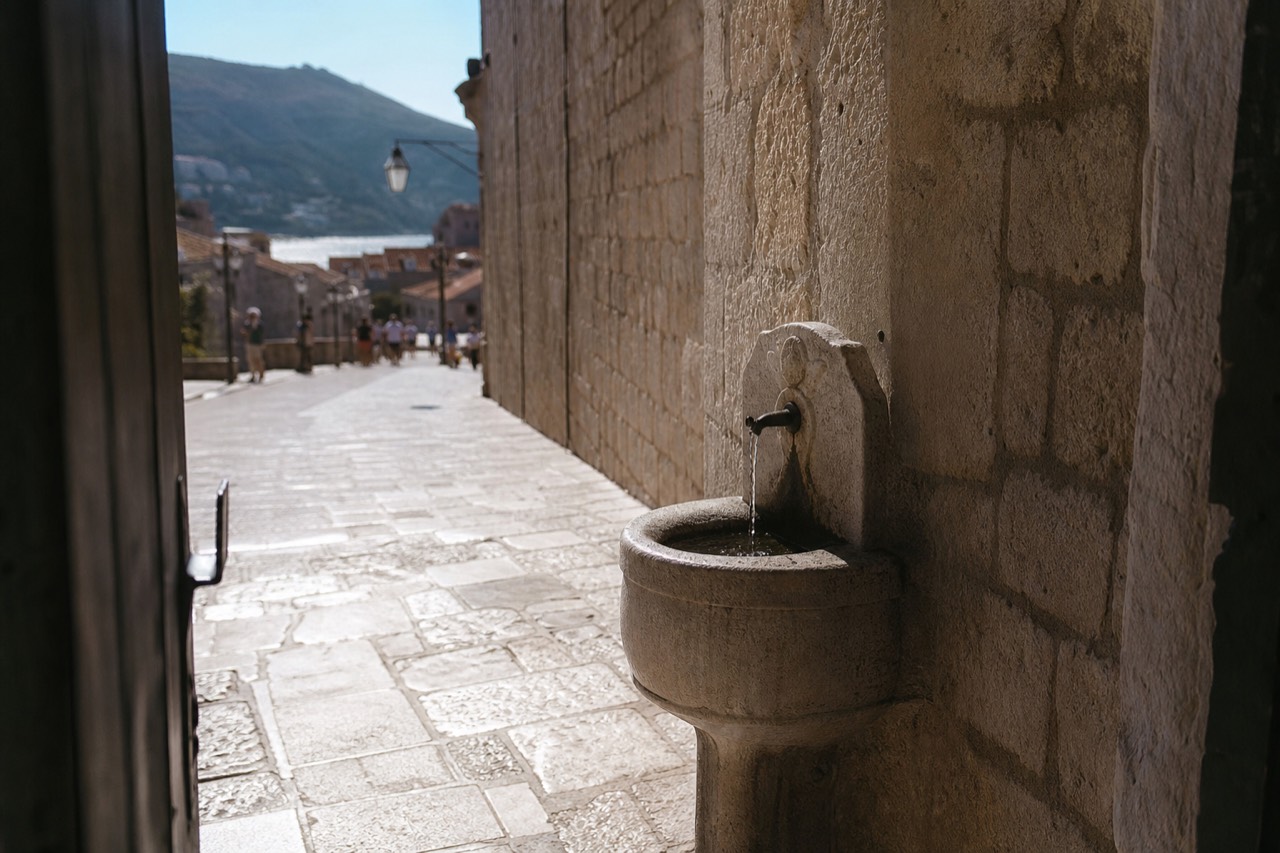
Can Tourists Drink Tap Water in Dubrovnik?
Yes, tourists can safely drink tap water in Dubrovnik. Croatia's public water supply is regulated to European Union drinking-water standards, and the water reaching Dubrovnik taps is treated, chlorinated and routinely tested. Locals drink it, restaurants serve it on request, and there is no need to buy bottled water for health reasons. The taste is clean, slightly mineral, and perfectly pleasant.
That is the practical answer, and it is the one most visitors want within five seconds of landing. But a few details make the situation clearer. The tap water here is not well water drawn under the hotel. It is a treated municipal supply, and the same standard applies whether you are filling a bottle at an apartment in Lapad, a hotel in Ploče or a public fountain inside the Old Town. If a tap is marked as non-potable, which happens occasionally at marinas or work sites, there will be a sign. Otherwise, drink freely.
I fill my bottle at the fountains around the Old Town on every hot walk, and I have never once thought twice about it. The large fountain near the western entrance is the one most visitors encounter first, and it runs continuously through the season. Bring a reusable bottle rather than buying plastic: the heat inside the walls from June to September is real, the limestone reflects it straight back at you, and a litre of water from a shop costs more than it would at home. The free things to do in Dubrovnik guide covers the fountains and other no-cost stops in more detail.
One honest caveat about taste. The water is safe everywhere, but the flavour varies a little between buildings and districts depending on the plumbing in that particular structure. Some older stone buildings have older pipes, and a few visitors notice a faint mineral note. If your tap water tastes odd to you, that is plumbing, not safety, and the fix is a filter bottle rather than a switch to bottled water for health reasons.
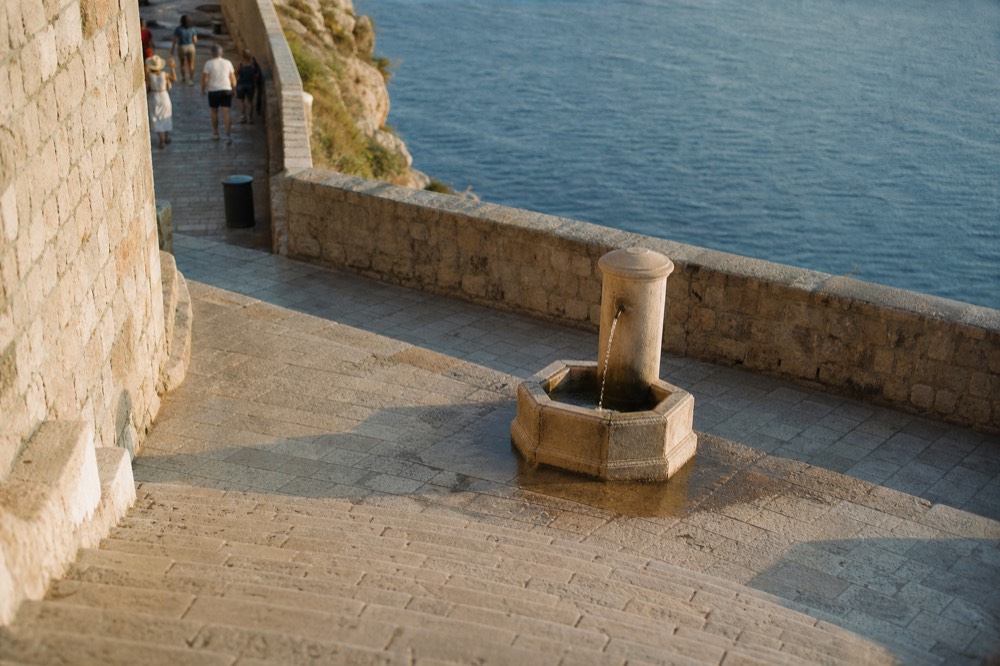
Restaurants are a separate question, and it is worth knowing the local custom before you sit down. In most Dubrovnik restaurants, waiters will bring bottled water to the table by default, sometimes still, sometimes sparkling, and it appears on the bill. That is not a scam, it is simply how table service works in much of Croatia. If you want tap water, ask for "voda iz pipe" and you will get a jug of perfectly safe tap water. Nobody will be offended, though in busy tourist restaurants during peak season the answer is occasionally a polite no. Ice in drinks is made from the same treated supply, so there is no reason to avoid it.
While we are settling the basics, the water you actually came for is worth a moment too. The Adriatic here is a swimmer's sea for months of the year. The September average for this coast is about 23.6 degrees, a long-run open-water average rather than a beach thermometer reading, and sheltered bays run warmer than that. If your trip is built around water rather than drinking water, the swimming season in Dubrovnik guide has the full picture.
Is Dubrovnik Worth Visiting for Tourists?
Yes, and the numbers make the case better than any brochure. The walled Old Town was inscribed by UNESCO in 1979, covers 24.7 hectares inside the walls, and Dubrovnik recorded about 4.2 million overnight stays in 2025, sharing first place among Croatian destinations with Rovinj. The city drew 625,257 cruise passengers in 2025, and 461 cruise calls are scheduled for 2026. It is busy, and it is genuinely worth it.
The Old Town earned its World Heritage listing under criteria (i), (iii) and (iv), reference C 95bis, and it sat on the List of World Heritage in Danger from 1991 to 1998 after the siege, which is part of why the restored city you walk today feels hard-won rather than merely pretty. The UNESCO listing page records the full history. The Stradun, the limestone main street, runs 298 metres from end to end, and the 1272 Statute fixed the final plan of both the city and that street. Very few European main streets can say a medieval statute set their dimensions.
Worth visiting also means worth timing. The counter-intuitive fact most first-time visitors miss is that cruise passengers peak in September and October, not July and August. In 2025 September brought 101,246 cruise passengers and October 100,132, ahead of July's 96,072 and August's 87,385. Those are Port Authority figures, and they flip the usual "avoid summer" advice on its head: if you want fewer crowds, early summer or late spring beats autumn, not the other way round. These are ship-capacity numbers, so write "up to" rather than "exactly this many people ashore", but the pattern is real.
| Month (2025) | Cruise passengers |
|---|---|
| July | 96,072 |
| August | 87,385 |
| September | 101,246 |
| October | 100,132 |
The city manages this pressure openly. Six counters at every Old Town entrance update a headcount every 15 minutes, and the official carrying capacity from the UNESCO assessment is 11,275 people. The Port Authority limits cruise passengers to 8,000 a day in most cases and refused about forty cruise call requests in a single season. A real half-hourly curve read on 8 September 2026 shows the rhythm of a day: 5,419 people at 08:00, a 7,739 peak at 10:00, then 7,205 at 11:00. Walk the walls at 08:00 and you will feel the difference against 10:30.
For a first visit, the honest answer is that the city rewards two or three days rather than one rushed afternoon. The walls alone take most people two hours with stops, and that is before Lokrum, the cable car or a single leisurely meal. The Things to Do in Dubrovnik homepage pulls the whole menu together, and the how many days in Dubrovnik guide breaks the trade-offs down day by day.
What Drink Is Dubrovnik Known For?
Dubrovnik is known for wine before anything else, above all plavac mali, the powerful red grape of the nearby Pelješac and Dingač slopes, closely followed by local rosé and herbal brandy. The region also produces pošip and other southern Croatian whites. Water may be safe from the tap, but the drink this city is actually famous for is a glass of local red beside the sea.
Plavac mali deserves the top spot on any list. It is a dark, full-bodied red that grows on steep, sun-baked stone terraces just up the coast, and the Dingač vineyards on the Pelješac peninsula are its most celebrated expression. The plavac mali grape guide explains why the same grape tastes different depending on which slope it grew on, and the Pelješac wine region guide covers the tasting trips you can make in a day. If you only order one local drink in Dubrovnik, make it a glass of plavac mali and ask where the grapes came from.
Beyond red wine, the southern coast drinks a good deal of rosé in summer, and the whites from Korčula, pošip above all, appear on nearly every serious wine list in town. Herbal brandy, often homemade and offered as a welcome gesture, is the old local ritual: a small glass, strong, scented with herbs from the hills behind the city. Nobody expects you to love it, but refusing it outright is a small social loss. Coffee culture is equally serious; the espresso standing at a bar counter is a morning institution, and it costs a fraction of the same cup at a table on the Stradun.
| Drink | What it is | Where to try it |
|---|---|---|
| Plavac mali | Full-bodied local red, best from Pelješac and Dingač slopes | Konobas and wine bars in the Old Town, or a Pelješac tasting trip |
| Pošip | Dry white from Korčula | Restaurant wine lists across the city |
| Local rosé | Light summer red, served chilled | Beach bars and Lapad terraces |
| Herbal brandy | Small-batch herb-infused spirit, often homemade | Offered in family-run konobas |
| Espresso at the bar | Standing coffee, the local morning ritual | Any bar counter away from the Stradun |
If you want the drinks brought to you with the stories attached, there are good bookable options. A food and drink walking tour with a local guide runs about 3 hours and starts from $165.64 per person, rated 5 across 704 reviews, and pairs tastings with a walk through the streets. For oyster lovers, the Ston oyster, mussel and wine tasting tour with lunch starts from $157 per person, rated 4.9 across 111 reviews. The wine tasting in Dubrovnik guide compares them all in one place.
What Is the Famous Drink in Dubrovnik?
The single most famous drinking experience in Dubrovnik is a glass of wine at Buža, the bar clinging to the cliffs outside the city walls above the open Adriatic. The drink itself is ordinary, the setting is not, and that combination, local wine above the sea, is what people remember and photograph. Ask a returning visitor for one drink memory and this is usually it.
Buža means "hole" in local dialect, and the name is accurate: you pass through a gap in the city wall near the southern edge and the bar opens onto bare rock above the water. There are actually two of them, Buža and Buža II, a short walk apart, and both serve drinks at tables with nothing between you and the Adriatic. Sunset is the hour everyone wants, which means the best tables go early in high season. The Buža bar guide covers how to find the entrances, which are genuinely easy to miss, and when to go.
The other famous drinking setting is the konoba, the family-run tavern where the wine arrives in unmarked bottles and the brandy appears at the end of the meal whether you ordered it or not. This is where the famous drink of Dubrovnik stops being a product and becomes a custom. The konoba tradition in Dubrovnik guide explains what to order and how the ritual works, and the signature dish of Dubrovnik answer pairs it with the food that belongs alongside.
Before the evening, a guided walk is the most efficient way to earn your dinner drinks. The Old Town Walking Tour with Local Guide starts from $20 per person and is rated 4.8 across 5,826 reviews, which makes it both the cheapest paid walk in the city and one of the most reviewed. A guest review from Sophie sums up what it does well: "Alex was a fantastic guide, she explained the complex history of Dubrovnik to give a lasting impression of the history of the area. Really appreciated that she aimed for shaded areas on a boiling September day. The food recommendations for after were much appreciated too! Great tour for a first experience of the old town!"
Those food recommendations matter, because the guides know which konobas pour the good house wine and which ones cater to the cruise rush. Take the tip, walk the two minutes off the main street, and the same city suddenly costs less and tastes better.
Is It Cheap to Eat and Drink in Dubrovnik?
Honestly, no, Dubrovnik is one of the more expensive places to eat and drink in Croatia, though it is cheaper than most visitors fear if you step off the Stradun. The adult City Walls ticket is 40 euro in main season, the one-day Dubrovnik Pass is also 40 euro, and a three-hour food tour starts from $165.64. Budget for a mid-range European city, not a bargain, and the numbers stop surprising you.
The fixed, verifiable costs are the easiest place to start, because they are published and stable. The walls operator, the Society of Friends of Dubrovnik Antiquities, sells exactly two paid ticket types: adult at 40 euro in main season, 1 March to 30 November, and 20 euro in December, with child 7 to 18 at 15 euro then 5 euro, and under 6 free. There is no family ticket. That 40-euro ticket is the walls plus Fort Lovrijenac combination, and it also covers the Western Outer Wall and the coin collection. The operator's own site carries the full details.
| Ticket or pass | Main season (1 Mar to 30 Nov) | December |
|---|---|---|
| City Walls adult (includes Lovrijenac) | 40 euro | 20 euro |
| City Walls child 7 to 18 | 15 euro | 5 euro |
| City Walls child 6 and under | free | free |
| Dubrovnik Pass, one day | 40 euro | not on sale |
| Dubrovnik Pass, three days | 50 euro | not on sale |
| Dubrovnik Pass, seven days | 60 euro | not on sale |
Note the season qualifier on that pass comparison, because it is the honest version of a claim you will see stated without it everywhere. In main season the one-day pass costs the same 40 euro as the standalone walls ticket and adds ten more sights plus a 24-hour bus ticket, which is a genuinely good deal. In December the walls ticket drops to 20 euro and no pass tier is on sale at all, so "the pass costs the same as the walls" is true from March to November and false afterwards. Every pass tier allows a one-time visit to each institution, the walls included. The is the Dubrovnik Pass worth it guide runs the arithmetic for different trip lengths.
Eating and drinking is where the budget bends most. The Stradun and the terrace restaurants with a view carry a premium you can see coming, and the drinks on the bill are part of it, which loops back to the tap-water question that opened this article. Ask for tap water instead of bottled and you save a little at every single meal, legally and without fuss. Beyond that, the standard advice holds: eat one street back from the main square, look for the konobas where the menu is short, and treat the cheap eats in Dubrovnik guide as your map. The Croatian Bureau of Statistics counted 20.7 million arrivals and 94.8 million overnight stays in commercial accommodation across Croatia in 2025, and the official release shows Dubrovnik at the very top of it; a city hosting that many visitors prices accordingly.
For drinking specifically, the cheapest good glass in town is rarely on a menu. House wine by the carafe in a neighborhood konoba costs a fraction of a bottle on a rooftop terrace, and it is usually the same local plavac mali. Coffee standing at a bar rather than sitting at a table is the other reliable saving, and it comes with the small pleasure of doing what locals do at 08:00 before the day-trippers arrive. If you are watching the budget across a whole trip, the budget Dubrovnik guide assembles all of these tactics in one place, and the trip cost guide helps you set a realistic daily number before you go.
One last practical note that ties everything together. The tap water is safe, the local wine is excellent, and the biggest cost surprises in Dubrovnik are almost never the food or drink themselves. They are the drinks you did not ask for, the bottled water brought unrequested, and the terrace premium on streets you were going to walk down anyway. Order deliberately, ask for "voda iz pipe" when you want tap water, and the city becomes noticeably more reasonable.
Common Questions About Drinking Tap Water in Dubrovnik
Can tourists drink tap water in Dubrovnik?
Yes. Croatia's public water supply meets European Union drinking-water standards, and the water reaching Dubrovnik taps is treated and tested. Locals drink it, and there is no health reason to buy bottled water. If a tap is not potable there will be a sign.
Is Dubrovnik Worth Visiting for Tourists?
Yes. The Old Town has been UNESCO-listed since 1979, the city recorded about 4.2 million overnight stays in 2025, and it shares first place among Croatian destinations with Rovinj. It is crowded at peak times, but the walls, the sea and the old streets justify the visit.
What Drink Is Dubrovnik Known For?
Wine, above all plavac mali, the full-bodied red grown on the Pelješac and Dingač slopes nearby. Local rosé, Korčula whites such as pošip, and herbal brandy round out the list.
What Is the Famous Drink in Dubrovnik?
A glass of local wine at Buža, the cliffside bar outside the city walls above the open Adriatic. The drink is ordinary, the setting is not, and it is the drinking memory most visitors take home.
Is It Cheap to Eat and Drink in Dubrovnik?
No, it is one of Croatia's more expensive cities for food and drink, though cheaper than many visitors expect once you step off the Stradun. Ask for tap water instead of bottled, drink house wine by the carafe in konobas, and take coffee standing at the bar.
Do Restaurants Serve Tap Water if You Ask?
Usually yes. Ask for "voda iz pipe" and most places will bring a jug of safe tap water. Bottled water is the default on the table and the bill, so the request is worth making at every meal.