Why Is St. Blaise the Patron Saint of Dubrovnik?
The story of St. Blaise, Dubrovnik's protector, how his image guards the city, and what the legend means for visitors walking the Old Town today.
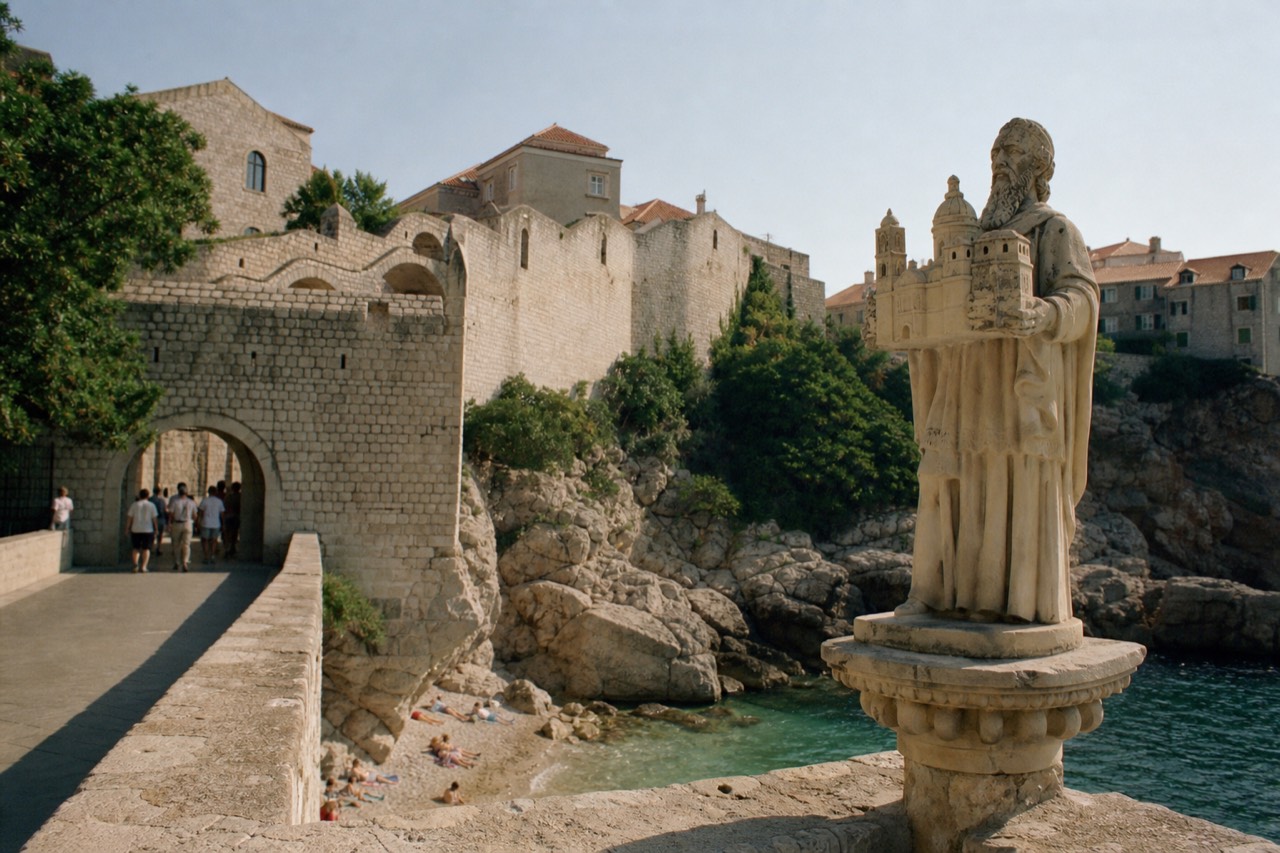
Walk through Pile Gate, look up, and a stone bishop looks back at you, holding a small model of the city in one hand. That is Sveti Vlaho, St. Blaise, and in Dubrovnik he is everywhere: carved over gates, set into fortress walls, painted on banners, cast in bronze above doors. Visitors photograph him constantly without knowing who he is. Locals do not need an introduction, because for them he is not decoration, he is the reason the city believes it still stands.
I have walked these streets with travellers since 2015, and the question of the city's protector comes up more often than you would expect, usually at the moment someone notices the same bearded figure for the fifth time in a single morning. The short answer involves a dream, a warning and a fleet that never took the city. The longer answer says a great deal about how Dubrovnik sees itself.
Why Is St. Blaise the Patron Saint of Dubrovnik?
Tradition holds that St. Blaise saved Dubrovnik by appearing in a vision to warn the city of a surprise attack by a Venetian fleet, and because that warning let the defenders prepare, the city took him as its heavenly protector and has kept him ever since. The story, as the city tells it, is that a local priest dreamed of a white-bearded old man in bishop's robes who identified himself as Blaise and said enemy ships were on their way. The priest reported the dream, the city readied itself, and the attack failed. A protector who had already proven himself once was not a figure you let go of.
Blaise himself was not a Dubrovnik man. He was venerated across the Adriatic and far beyond it as a bishop and healer, a saint of throats in much of the Christian world. What Dubrovnik added was the local chapter of the story: the guardian who speaks up precisely when the city cannot see danger coming. For a small republic that survived for centuries between larger powers by diplomacy, trade and nerve, that image fitted perfectly. A city that could not afford a large standing army could afford a powerful intercessor.
The devotion is not a dusty relic. His feast, the Festa sv. Vlaha, is the city's great winter celebration, a days-long event that fills the Stradun with processions, banners and people from the surrounding villages, and it has been recognized at a national level as living heritage. In a place that now measures its summer crowds in real time, a winter feast that still pulls the region into the Old Town is a genuine continuity. When you hear a guide say Dubrovnik has always lived from the sea and feared it in equal measure, the cult of Blaise is the emotional proof.
Once you know the story, the city reads differently. The model of the town in the saint's hand is not generic iconography: it is a statement that the city belongs to him and he to it, a contract renewed every time someone repaints a banner or restores a statue. Few cities anywhere have so visible a relationship with a single saint, and almost none keep the feast with this intensity.
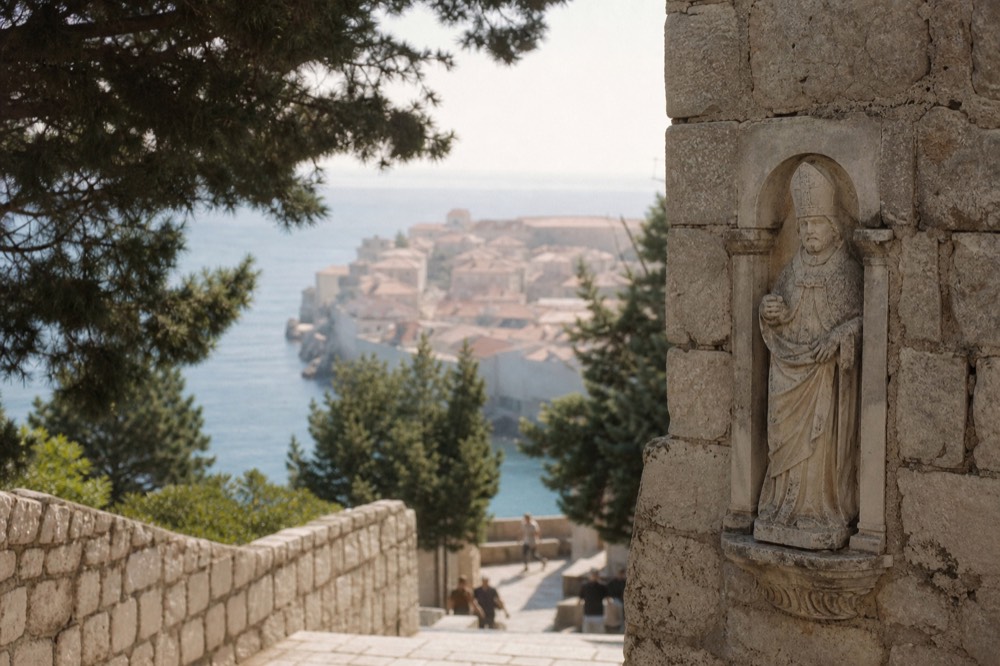
You do not need to be religious to enjoy this. The Blaise trail through the Old Town is one of the best free sightseeing games in the city, and it takes you past the main monuments without ever buying a ticket. If you want the walls themselves explained rather than just walked, the Old Town and walls combo walk below pairs the streets where Blaise watches with the fortifications he was believed to protect.
Where You See St. Blaise in the City Today
The quickest way to find St. Blaise is to look up at the city's gates and fortifications, where his statue watches over every main entrance, and then to check the main street and the great church that carries his name, where his image dominates the decoration. The stone figure above Pile Gate is the one most visitors meet first, and it sets the pattern: the saint stands between the outside world and the city, model of the town in hand, permanently on duty. Gate after gate repeats the idea, because a guardian you place at the door is a guardian you trust.
Inside the walls, the pattern continues. The Stradun, the 298-metre limestone street that forms the spine of the Old Town, runs between landmarks where Blaise appears again and again, and the church dedicated to him is the most important baroque building in the city after the cathedral complex. Statues of him flank grand portals, his face looks out from fountains and facades, and his banner appears the moment any civic ceremony needs one. The Dubrovnik Tourist Board's own pages on the city's monuments describe the fortress of Lovrijenac standing on its 37-metre sea rock, and even that independent fortress, built to face the sea, belongs to the same defensive world the saint was credited with protecting.
For a visitor, the practical takeaway is that the Blaise trail and the classic sightseeing route are the same route. You cannot walk from Pile Gate to the Rector's Palace, past the Sponza Palace and down to the old port, without passing him several times. The walls make the point most vividly of all: from the circuit you can see the whole defensive system at once, 1,940 metres of wall up to 25 metres high, studded with towers and bastions, exactly the kind of engineering whose success the legend credits to an early warning. The operator's own site, the Society of Friends of Dubrovnik Antiquities, gives the full structural inventory.
If you would rather have a guide connect the legend to the stones, the combo walk is the natural fit: about 3 hours 30 minutes, from $50.94 per person, rated 4.8 across 1,183 reviews, covering the Old Town streets and the walls circuit in one outing. Book it on the combo Old Town and walls tour page or Check availability for a date in your travel window.
One practical note before you commit. The combo walk includes the walls admission in its structure, so check what the operator's live listing covers for your date before buying a separate walls ticket, and remember that December pricing works differently: the standalone adult ticket drops to 20 euro and no pass tier is on sale at all. If you are visiting in main season, the combo saves you the queue at the gate as well as the guesswork.
What Is Dubrovnik Famous For?
Dubrovnik is famous for its complete medieval stone walls rising directly from the Adriatic, for a UNESCO-listed Old Town that survived both earthquakes and a modern siege, and, more recently, for serving as a filming location that put its streets in front of a global television audience. The walls come first because they are the city's defining image: 1,940 metres of fortification wrapping a car-free core of limestone streets, terracotta roofs and baroque churches, inscribed by UNESCO in 1979 under criteria (i), (iii) and (iv), covering a property area of 24.7 hectares with a 1,188.6-hectare buffer zone. Very few places on the Mediterranean coast kept a walled city of this scale intact and alive.
The second layer of fame is harder and more recent. The Old Town spent 1991 to 1998 on the List of World Heritage in Danger during the war that followed Croatia's independence, and the repaired roofs, a slightly different shade of orange from the originals, are the visible record of that. Visitors who ask about the shelling are often surprised at how openly the city discusses it; the war photography exhibitions in town are among the most visited museums. Fame built on beauty and fame built on survival sit side by side here, and the city does not pretend otherwise.
The third layer is fictional, and it changed everything. When a certain television series used the Old Town as a royal capital, Dubrovnik became a pilgrimage site for fans who could stand in the very streets they had watched. The filming-location walk is now one of the most booked products in the city, from $29 per person and rated 4.9 across 1,052 reviews on the walking-only version. If that is your route into the city, the Game of Thrones filming locations guide maps what you actually see.
| What Dubrovnik Is Known For | The Reality on the Ground | Verified Figure |
|---|---|---|
| The city walls | 1,940 m circuit, up to 25 m high, 16 towers, 3 fortresses, 6 bastions | Finished in 1660 with the Bastion of St Stephen |
| UNESCO Old Town | Inscribed 1979, criteria (i)(iii)(iv), reference C 95bis | 24.7 ha property, 1,188.6 ha buffer zone |
| Wartime survival | On the World Heritage in Danger list 1991 to 1998 | Repaired roofs visibly paler than the originals |
| Screen fame | Old Town used as a major fantasy-series capital | Filming-location walks from $29 per person |
What Is Dubrovnik Best Known For Among Travellers?
Among travellers, Dubrovnik is best known as a compact, walkable walled city that combines a serious swimming season with island boats, cable car panoramas and a reputation for summer crowds, which makes timing and ticket strategy the two things every visitor researches in advance. The city recorded about 4.2 million overnight stays in 2025, sharing first place among Croatian destinations with Rovinj, and the pressure of those numbers shapes everything about a visit, from the price of a walls ticket to the hour you should start walking.
The crowd picture is more interesting than the folklore suggests. The Port Authority's own data shows cruise passengers in 2025 peaked not in July or August but in September, at 101,246, with October close behind at 100,132, ahead of July's 96,072 and August's 87,385. The full-year total was 625,257 passengers against 582,499 the year before, and 461 cruise calls are scheduled for 2026. The Port Authority limits cruise passengers to 8,000 a day in most cases, and the Old Town's official carrying capacity, from the UNESCO carrying-capacity assessment, is 11,275 people, tracked by six counters at every entrance that update a headcount every 15 minutes. A real morning curve read on 8 September 2026 shows the mechanism at work: 5,419 people at 08:00, 7,297 at 09:00, a 7,739 peak at 10:00, then 7,205 at 11:00. Early morning is not a slogan here, it is arithmetic. The wider set of guides lives on Things to Do in Dubrovnik.
Beyond the crowds, the traveller-facing Dubrovnik is an outdoor city. The September average sea temperature on this coast is about 23.6 degrees, a long-run open-water average rather than a beach thermometer, and sheltered bays run warmer still. The cable car lifts you from a lower terminal at 38.0 metres to the Mount Srd station at 405.0 metres in 3 minutes 30 seconds, and the operator claims a view range of up to 60 km on a clear day. Boats leave the City Harbour for Lokrum at 09:00, then every 15 minutes from 10:00 to 18:00. None of this needs a car, which is why the walkability of Dubrovnik comes up in almost every planning conversation.
For more on the city's headline reputation, the companion piece what Dubrovnik is best known for goes deeper on each of these pillars.
Is Dubrovnik Worth Visiting?
Yes, for almost every traveller type, because the density of first-rank sights inside a walkable core is exceptional, but the value of the visit depends heavily on season, timing and whether you book the walls and key tickets in advance rather than arriving on spec. The honest case against Dubrovnik is cost and crowding in high summer: the adult walls ticket is 40 euro in main season, 1 March to 30 November, restaurants in the core price for a captive audience, and the 10:00 crush on the Stradun is real. The honest case for it is that almost nowhere else delivers a walled UNESCO city, island swimming, a mountain panorama and a working historic port within a 30-minute radius on foot and cable car.
The maths improves considerably with the Dubrovnik Pass. The one-day pass costs 40 euro, exactly the same as the standalone walls plus Lovrijenac ticket in main season, and adds ten more sights plus a 24-hour bus ticket; three-day and seven-day tiers cost 50 and 60 euro and add suburban bus coupons and House Bukovac in Cavtat. Every tier lists the City Walls plus Lovrijenac Fortress as its first inclusion, with a one-time visit to each institution. Note the season boundary: in December the standalone walls ticket drops to 20 euro and no pass tier is on sale at all, so the equivalence is a main-season claim only.
| Sight | Price | Season Notes |
|---|---|---|
| City Walls, adult | 40 euro | Main season, 1 March to 30 November; 20 euro in December |
| City Walls, child 7 to 18 | 15 euro | 5 euro in December; under 6 free; no family ticket sold |
| Dubrovnik Pass, 1 day | 40 euro | Same price as the walls ticket in main season, adds ten sights and a 24h bus ticket |
| Cable car, adult round trip | 30 euro | One way 17 euro; child 4 to 12 round trip 8 euro; under 4 free |
| Lokrum island | 30 euro | Covers reserve entry and return boat transfer |
Guided walks are the other lever on value. The cheapest paid Old Town walk starts at $20 per person, rated 4.8 across 5,826 reviews, and the walls-focused two-hour option runs from $29.58, rated 4.8 across 1,387 reviews.
For the sceptics, the fuller argument, including the winter case, is in whether the Old Town is worth visiting. My own view, after years of walking these streets in every month: the city earns its fame, but it rewards visitors who treat it as a place with rhythms rather than a backdrop.
What Not to Do in Dubrovnik?
The main mistakes are arriving in peak season without booked tickets, walking the walls at midday, driving into the Old Town area expecting to park, eating only on the Stradun, and assuming every day is a cruise crush when the data shows the pressure is predictable and largely avoidable with early starts. None of these are fatal, but each one costs money, comfort or both, and every one is easy to avoid with a little planning.
Start with the walls. The operator's stated hours at the time of check were 08:00 to 19:30, and the counter data explains why the first two hours matter: the Old Town sat at 5,419 people at 08:00 and peaked at 7,739 by 10:00. Walk early, and you share the ramparts with a fraction of the mid-morning crowd, in cooler air, with better light for photographs. Midday on the unshaded wall in July and August, when the long-run August sea average is 25.8 degrees and air temperatures run well above that, is the single most common way visitors ruin their own day. The walls ticket includes Fort Lovrijenac, the Western Outer Wall (closed December, January and February) and the Collection of Coins of the Republic of Ragusa, so buy once and use all of it.
Parking is the second trap. The Old Town is fully pedestrianised, and the practical options are the garages outside the core with a walk or bus ride in; the parking in Dubrovnik guide covers the lots and the trade-offs. Do not trust a rental car to the streets near Pile Gate. Third, food: the Stradun is beautiful and priced accordingly, and the side-street konobas two lanes in serve better food for less. The what to eat in Dubrovnik guide is the honest map.
A few more do-nots worth writing down. Do not write off September and October as "after season": the Port Authority's own figures show those are the two busiest cruise months of the year, so the same early-start rules apply. Do not swim off the rocks without checking where entry and exit are actually safe. Do not plan a Lokrum day around a late boat: departures run 09:00, then every 15 minutes from 10:00 to 18:00, and the ticket office at Luža works 08:00 to 18:00. And do not skip the feast if you are here in winter, because the Festa sv. Vlaha is the one moment the city belongs entirely to itself, and to the saint who, the story says, earned it.
If you take one booking from this page, make it the walk that ties the legend, the walls and the streets together:
Common Questions About St. Blaise and Dubrovnik
Why is St. Blaise the patron saint of Dubrovnik?
Tradition holds that Blaise appeared in a vision to a local priest and warned of a surprise attack by a Venetian fleet. The city prepared, the attack failed, and Dubrovnik took the bishop as its heavenly protector, placing his image over its gates and walls and honouring him each year with the Festa sv. Vlaha.
Where Can You See St. Blaise in Dubrovnik?
Look up at the city gates, where his statue holds a model of the town, then along the Stradun and around the church dedicated to him. His image recurs on facades, fountains and banners throughout the Old Town, and the classic sightseeing route passes him repeatedly.
What Is Dubrovnik Famous For?
A complete 1,940-metre circuit of medieval walls rising from the Adriatic, a UNESCO-listed Old Town inscribed in 1979, survival of the 1991 to 1998 war years on the World Heritage in Danger list, and more recently a major television filming location.
Is Dubrovnik Worth Visiting?
Yes, for nearly every traveller, provided you manage season and timing. The adult walls ticket is 40 euro in main season, 1 March to 30 November, and the one-day Dubrovnik Pass costs the same 40 euro while adding ten more sights and a 24-hour bus ticket. Early mornings beat the 10:00 crowd peak.
What Not to Do in Dubrovnik?
Do not walk the walls at midday in high summer, do not arrive without booked tickets in peak season, do not drive to the Old Town expecting to park nearby, and do not eat every meal on the Stradun when the side-street konobas are better value.
When Is Dubrovnik Most Crowded With Cruise Passengers?
Not in July or August. Port Authority data for 2025 shows cruise passengers peaked in September at 101,246 and October at 100,132, above July's 96,072 and August's 87,385, so the same early-start discipline applies well into autumn.