Why Are Hotels So Expensive in Dubrovnik?
Why hotel prices in Dubrovnik climb so high: a walled city of 24.7 hectares, 4.2 million overnight stays, a short season and limited beds, explained with verified figures.
Why Are Hotels So Expensive in Dubrovnik?
Hotels in Dubrovnik are expensive because demand vastly outruns supply: the city recorded about 4.2 million overnight stays in 2025, tied with Rovinj for first place in Croatia, while the historic core that most visitors want to sleep beside covers just 24.7 hectares and cannot grow. Add a concentrated summer season, a cruise port that alone handled 625,257 passengers in 2025, and strict building rules inside a UNESCO zone, and rates climb.
I get asked this question on almost every walk I lead, usually by a visitor holding a phone with a hotel confirmation on it and a slightly stunned expression. The honest answer has three layers, and none of them is "greed," at least not as the main driver.
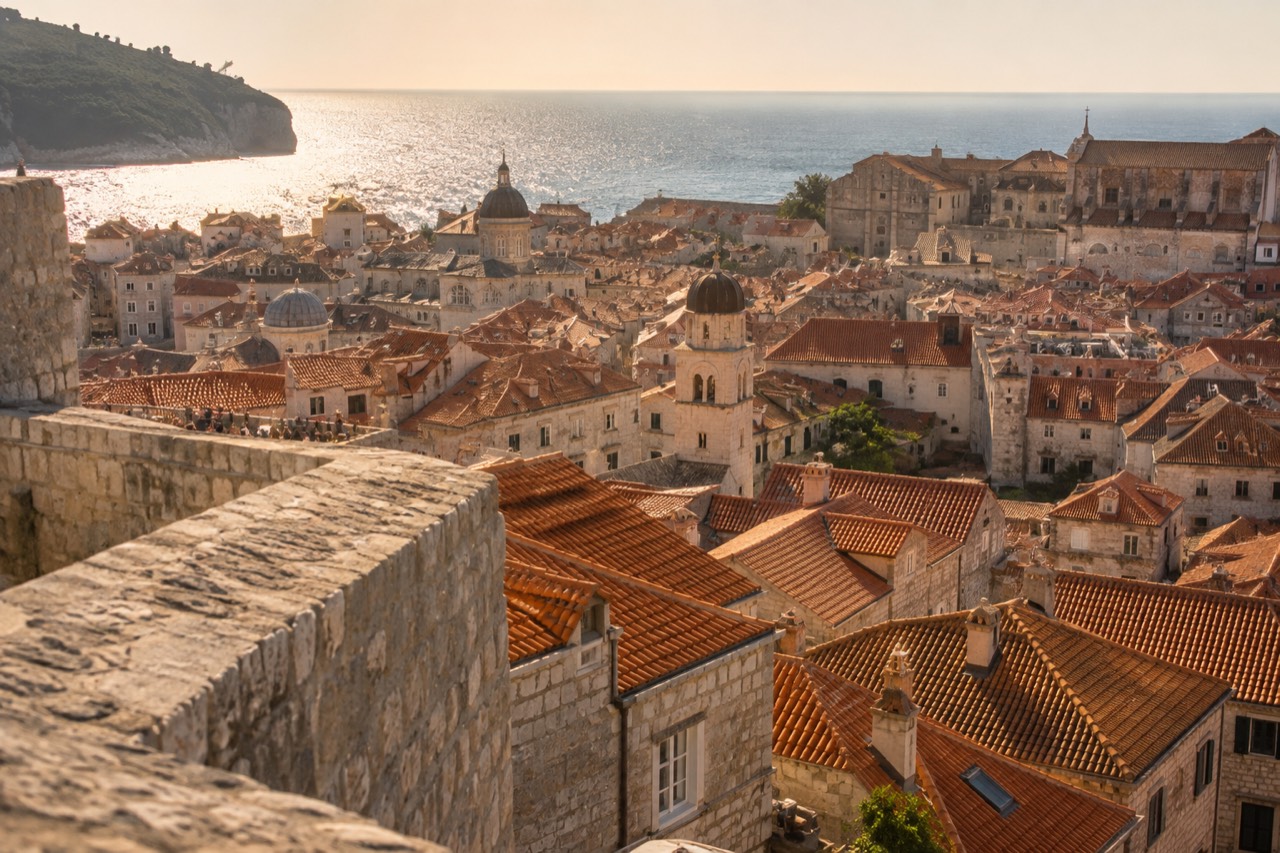
The first layer is geography. Dubrovnik's Old Town sits on a small peninsula wrapped in walls, inscribed on the UNESCO World Heritage List in 1979 under criteria (i), (iii) and (iv), with a property area of 24.7 hectares and a 1,188.6-hectare buffer zone. Nobody can build a new large hotel inside that footprint. The buildings that exist are protected, which means converting a townhouse into a hotel is slow, expensive and often refused outright. Supply is close to fixed, and it has been fixed for a very long time: the 1272 Statute determined the final plan of both the city and its main street, so the street pattern a hotel guest walks today is the one the Republic froze seven and a half centuries ago.
The second layer is demand, and the numbers are startling for a city whose entire population was 41,562 at the 2021 census. The Croatian Bureau of Statistics reports that Dubrovnik and Rovinj shared first place among Croatian destinations in 2025, each with about 4.2 million realised overnight stays. For context, Croatia as a whole took 20.7 million arrivals and 94.8 million nights in commercial accommodation that year, which means one small southern city carried a meaningful slice of the entire national tourism economy. That is a volume of visitor pressure a town this size was never designed for, and hotels price accordingly.
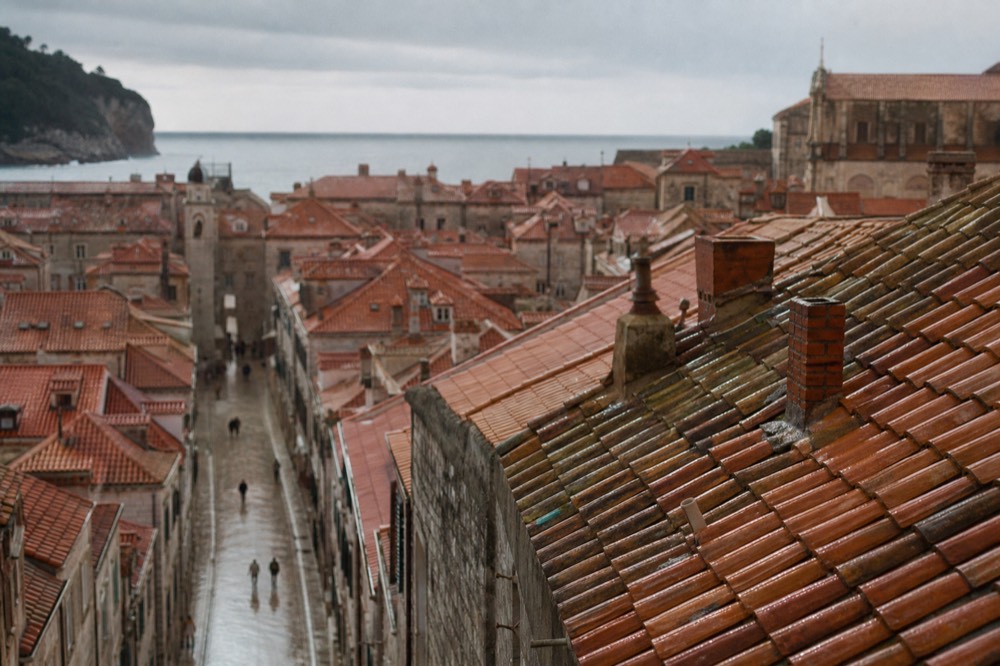
The third layer is the shape of the year. Demand is not spread evenly. It piles into June through September, with cruise traffic peaking in September at 101,246 passengers and October at 100,132, actually above July's 96,072 and August's 87,385. That surprises people who assume August is the wall-to-wall month, and it matters for hotel pricing, because September is when the sea is still warm, the evenings are still long, and the cruise calendar is at its absolute fullest. A hotel that must earn most of its annual revenue in roughly four months has to charge high summer rates to survive the winter, and the Things to Do in Dubrovnik crowd arrives right in that window.
The counting system deserves a sentence of its own, because it shows how seriously the city now manages its own pressure. Six counters installed at every entrance to the Old Town update a headcount every 15 minutes, and the official carrying capacity from the UNESCO assessment is 11,275 people. On a real September morning the curve read 1,200 people at 04:00, 5,419 at 08:00, a 7,739 peak at 10:00, then 7,205 by 11:00. A hotel room inside or beside that flow is a room with a measurable, published scarcity, and revenue managers read the same data the city does.
The practical takeaway is that the price you see is the market clearing a scarce good. That does not mean you have to pay it without thinking. Where you base yourself matters more here than in almost any Croatian city, and our guide to where to stay in Dubrovnik breaks the neighbourhoods down street by street.
Why Is Dubrovnik So Expensive?
Dubrovnik is expensive because it is a small, protected city absorbing mass-market demand: 4.2 million overnight stays in 2025, a fixed housing stock inside the walls, a labour market that must swell every spring, and a season compressed into a few months. Everything from restaurant prices to taxi fares follows the same squeeze that pushes hotel rates up.
Start with the fixed stock. The walled Old Town covers 24.7 hectares, less than a third the size of a typical airport, and every square metre of it is protected. The Stradun, the main street, is 298 metres long, and the 1272 Statute fixed the final plan of both the city and that street. You cannot widen it, tower over it or add a wing to a building on it. What exists is what there is, and what there is has to absorb everyone.
Then add the seasonal labour problem. A city of 41,562 residents (2021 census) must staff hotels, restaurants, tours and shops for a visitor flow measured in millions of nights. Workers have to be housed somewhere, in a rental market where every apartment handed to seasonal staff is an apartment taken off the visitor market, or vice versa. That competition alone lifts the floor under accommodation prices every summer, and it also explains why service in restaurants can feel stretched in the peak weeks: the city is running at a scale its resident workforce simply cannot supply alone.
The cruise economy amplifies everything. The Port Authority's own statistics show 625,257 cruise passengers in 2025, up from 582,499 in 2024, with 461 calls scheduled for 2026. Cruise visitors do not sleep in hotels, but they do compete for tables, taxis, walls tickets and sidewalk space, which pushes up the prices of everything around the hotels, and the hotels know their rooms sit inside the most sought-after square kilometre on the Adriatic. The Port Authority limits cruise passengers to 8,000 a day in most cases, and even so, of 243 cruise days a year only 18 exceed that number and only 4 exceed roughly 10,000. The pressure is managed, but it is relentless.
| Cost area | Typical pressure point | Why it is high |
|---|---|---|
| Hotels in or beside the Old Town | Highest rates in Croatia outside peak-island luxury | 24.7 ha of protected stock against 4.2 million nights of demand |
| Restaurants inside the walls | Prices well above inland Croatia | Rents and seasonal staffing in a fixed footprint |
| Attraction tickets | Walls at 40 euro in main season | Single operator, world-famous monument, heavy cruise-day demand |
| Taxis and transfers | High per-kilometre cost | Short season, limited licences, cruise-day surges |
There is a way to fight back on the hotel line specifically, and it is location. Staying in Lapad or along the Gruž side puts you a bus ride from the walls instead of five minutes' walk, and the savings are real. Hotel Komodor is the budget benchmark there, a three-star rated 7.8 out of 10 across 822 Expedia reviews, about a 29-minute walk from the Gruž cruise and ferry port, with the number 6 bus to Pile Gate instead of a walk. At the other end, Hotel Excelsior in Ploče shows what the top of the market looks like. Neither is cheap in August, but both cost meaningfully less than an equivalent bed pressed against the Stradun.
One more cost lever deserves a mention: how you spend your evenings. A guided walk is one of the few things in Dubrovnik that costs less than a dinner for two, and the right one can replace a whole day of paid wandering with ninety focused minutes. Our answer on how much money you need per day in Dubrovnik puts the full daily budget together.
Why Are Dubrovnik Walls So Expensive?
The city walls ticket costs 40 euro in main season, 1 March to 30 November, because a single non-profit operator maintains 1,940 metres of medieval structure up to 25 metres high, with 16 towers, 3 fortresses and 6 bastions, against visitor numbers the circuit was never built for. The price is a conservation levy dressed as a ticket.
That 40 euro is not a walls-only ticket, which is the detail most visitors miss. The operator's own webshop sells it as the walls plus Fort Lovrijenac combination, and it also covers the Western Outer Wall (closed December, January and February) and the Collection of Coins of the Republic of Ragusa. Fort Lovrijenac, standing on its 37-metre sea rock, bought alone is 15 euro. Children 7 to 18 pay 15 euro in main season, under 6 go free, and there is no family ticket, only adult and child. The operator's stated working hours at time of check were 08:00 to 19:30.
The maintenance arithmetic explains the rest. The Society of Friends of Dubrovnik Antiquities, which runs the circuit, looks after a structure whose final form was only reached in 1660 with the Bastion of St Stephen: 1,940 metres of wall, 4 to 6 metres thick on the land side and 1.5 to 3 metres on the sea side, plus the towers, bastions, moats and drawbridges. Limestone wears. Railings corrode. Stone staircases, thousands of them, need repointing. Every visitor fee feeds that work, and the operator's own site is candid about the structure it is funding.
| Ticket | Main season (1 Mar to 30 Nov) | December |
|---|---|---|
| Adult walls + Lovrijenac | 40 euro | 20 euro |
| Child 7 to 18 | 15 euro | 5 euro |
| Child under 6 | free | free |
| Lovrijenac alone | 15 euro | 15 euro |
The one move that genuinely beats the walls price is the Dubrovnik Pass, with a caveat that must travel with the comparison. In main season the one-day pass costs the same 40 euro as the walls ticket and adds ten more sights plus a 24-hour bus ticket; three days costs 50 euro and seven days 60 euro, both adding suburban bus coupons and House Bukovac in Cavtat. Every tier lists City Walls + Lovrijenac Fortress as its first inclusion, and every tier allows a one-time visit to each institution, the walls included. But that equivalence is a main-season fact only: in December the standalone walls ticket drops to 20 euro while no winter pass tier is on sale at all. Say "the pass costs the same as the walls" in December and you are simply wrong. The official pass site lists every inclusion.
If you would rather have the walls explained than merely walked, a guided circuit changes the value equation. The 2-Hour City Walls Walk runs about 2 hours from $29.58 per person, rated 4.8 across 1,387 reviews, and a guide turns 1,940 metres of stone into a story about sieges, diplomacy and a republic that bought its safety for centuries.
A guest review from linda_a on that same tour captures why the fee stings less with context: "This well organized tour helped put Dubrovnik's past (and present) into perspective. It's incredible that the city walls have withstood the test of time. Antun was a wonderful guide."
Why Is Flying to Dubrovnik So Expensive?
Flights to Dubrovnik are expensive because the airport is small, the season is short, and half of Europe wants the same week in July: airlines price scarce seats on a thin route network at its summer peak, and Dubrovnik has almost no off-season capacity to dilute the average fare.
Dubrovnik Airport is a single-runway regional hub at the end of a country with no domestic trunk routes feeding it. There is no train station in Dubrovnik at all, so the city cannot be reached cheaply by rail the way inland capitals can, and the airport effectively becomes the only practical gateway for anyone on a short trip. When one gateway serves a destination pulling 4.2 million overnight stays, the airlines holding the slots hold the pricing power too.
Seasonality does the rest. The flight schedule swells in late spring and shrinks after October, which means the aircraft, crews and airport capacity all have to be paid for across a compressed operating year. Carriers recover that in peak fares. The same seat that costs a modest sum in November costs several times more in late July, not because the plane burns more fuel but because the demand curve is vertical for a few weeks. The cable car up Mount Srd runs on exactly the same logic and shuts entirely from January to March, which tells you how seasonal the whole visitor economy at this latitude is.
The hotel connection is direct. People who pay high airfares to be here on specific dates are, by revealed behaviour, less price-sensitive on the hotel too, and revenue management systems on both sides of the transaction know it. A full flight arriving on a Friday in peak season lands into a hotel market that has already priced the weekend. The busiest remaining cruise days of the 2026 season tell the same story from the sea side: 6 October with 2 ships and up to 5,798 passengers by capacity, 29 September with 2 and 5,675, 30 September with 3 and 5,536. Those are scheduled capacities, not guaranteed crowds ashore, but the calendar is dense well past the school holidays.
What actually helps is flexibility of date and gateway. Flying midweek, flying in shoulder months, or flying into another Croatian airport and travelling on can cut the fare dramatically, and the sea and air temperatures make May, June, September and October genuinely pleasant here: the September average sea temperature is about 23.6 degrees, a long-run open-water average rather than a beach thermometer reading, and sheltered bays run warmer still. Our guide to the best time to visit maps the trade-offs month by month.
Is Dubrovnik Expensive to Visit?
**Yes, Dubrovnik is one of Croatia's most expensive destinations, but visiting it need not be: the walls at 40 euro and a hotel near the Stradun are the costly items.
The expensive version of Dubrovnik is easy to assemble: a walled-city hotel, dinner on the Stradun, the walls at 40 euro, the cable car at 30 euro round trip, a sunset cruise. Nothing there is a rip-off in the sense of a scam, each price reflects real costs and real demand, but stacked together they make a costly day.
The cheap version is equally easy, and it is not a lesser experience. Three of the best orientation walks in the city are free, pay-what-you-want tours on GuruWalk, including a 1 hour 45 minute Old City walk rated 4.87 across 2,242 reviews and a free Game of Thrones and history walk rated 4.74 across 444 reviews. You pay what you think the walk was worth, nothing is charged up front, and for a first evening in the city they are hard to beat. The Old Town itself, all 24.7 hectares of it, costs nothing to wander: the Stradun, Onofrio's Fountain, the harbour, the lanes climbing toward the walls. Lokrum is the one paid excursion that bundles everything: 30 euro per person covering both reserve entry and the return boat transfer, with departures from the City Harbour at 09:00, then every 15 minutes from 10:00 to 18:00.
| Item | Cost | Budget alternative |
|---|---|---|
| City walls, adult, main season | 40 euro | Dubrovnik Pass one-day at 40 euro adds ten sights and a bus ticket |
| Cable car, adult round trip | 30 euro | Walk the Srd path or a viewpoints walk for the price of water |
| Lokrum island | 30 euro including return boat | Combined Trsteno ticket at 42 euro if the arboretum appeals |
It is the tour I point budget-conscious visitors toward, because it delivers the history and the bearings in ninety minutes and leaves the rest of the day, and the rest of the wallet, for everything else.
The honest summary is this. Dubrovnik is expensive the way Venice and the old quarters of Europe's most loved cities are expensive: a small, beautiful, protected place that the world discovered. The prices on hotels, walls and flights all trace back to the same root, a fixed supply of everything facing a tidal demand. Once you accept that and shift your spending toward the things that are still cheap here, walking, swimming, viewpoints, pay-what-you-want tours, the city stops feeling like a trap and starts feeling like a bargain with a few expensive doorways.
Common Questions About Why Hotels Are Expensive in Dubrovnik
Why are hotels so expensive in Dubrovnik?
Hotels are expensive because demand vastly exceeds a fixed supply: about 4.2 million overnight stays in 2025 press on a protected city of 24.7 hectares whose building stock cannot grow, with demand concentrated into a few summer months and amplified by 625,257 cruise passengers arriving through the port in 2025.
Why Is Dubrovnik So Expensive Overall?
A city of 41,562 residents must staff an entire tourism economy for millions of visitor nights, inside a UNESCO footprint where nothing can be built or enlarged. Labour, rents and licences all price that squeeze, and every business in the walls passes it on.
Why Are Dubrovnik Walls So Expensive?
The 40 euro main-season ticket funds conservation of 1,940 metres of wall up to 25 metres high, with 16 towers, 3 fortresses and 6 bastions, run by a single non-profit operator. It also includes Fort Lovrijenac, the Western Outer Wall and the coin collection, and drops to 20 euro in December.
Why Is Flying to Dubrovnik So Expensive?
Dubrovnik Airport is a small seasonal gateway with no rail alternative anywhere in the city, so peak-week seats on a thin route network command peak fares. Midweek and shoulder-season dates cut the fare sharply.
Is Dubrovnik Expensive to Visit on a Budget?
It can be done.