What Souvenirs Should I Buy in Dubrovnik?
A Dubrovnik-based answer to what souvenirs are worth buying, from limestone keepsakes and chess sets to plavac mali wine, plus what not to miss while you shop.
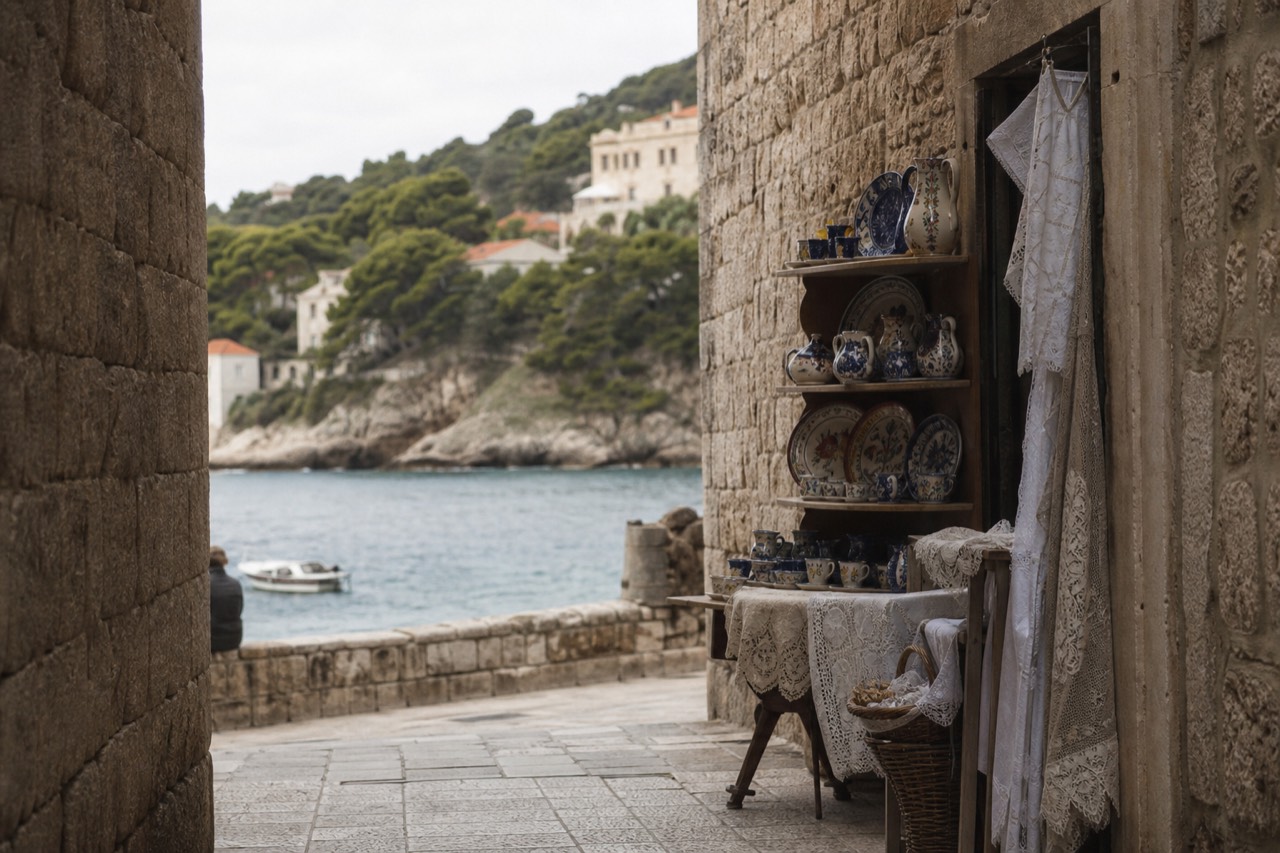
What Souvenirs Should I Buy in Dubrovnik?
Buy things made within a hundred kilometres of the city walls: limestone and marble carvings, a Ragusan chess set, plavac mali and dingač wine from the Pelješac peninsula, candied bitter orange products, honey, lavender, and salt from Ston. Skip the mass-printed magnets and generic Adriatic trinkets, which are imported and identical to what you would find in any coastal resort town between here and Split.
I have walked these streets with travellers since 2015, and the souvenir question always comes up on the second day, once people have seen the shops and realised how repetitive the lower half of the Stradun is. The good news is that Dubrovnik genuinely produces things worth carrying home, and most of them are small enough to fit in hand luggage. The limestone the city is built from is quarried locally and carved into everything from tiny replicas of the walls to jewellery boxes. The wine country begins barely an hour up the coast at Pelješac. The salt pans at Ston are the oldest in this part of Europe and still working. These are real local products, not imports with a Dubrovnik label glued on.
The other half of the answer is about how you shop. The Old Town is small, 24.7 hectares inside the walls per the UNESCO World Heritage listing, so everything is within a ten minute walk of everything else. That concentration works in your favour. You can compare three limestone carvers, two wine shops and a bookshop in a single morning, then decide. Prices for the genuinely local goods do not vary much between shops, but quality does, and the difference between a hand-carved piece and a resin cast is easy to spot once you have held both.
Before the shopping list, one practical note. The best souvenir mornings here start with understanding the city itself, and the fastest way to do that is a guided walk of the Old Town and the walls together. The combo option below does both in one outing, which leaves your afternoon free for the shops with a head full of context about what you are buying.
The Souvenirs Worth the Suitcase Space
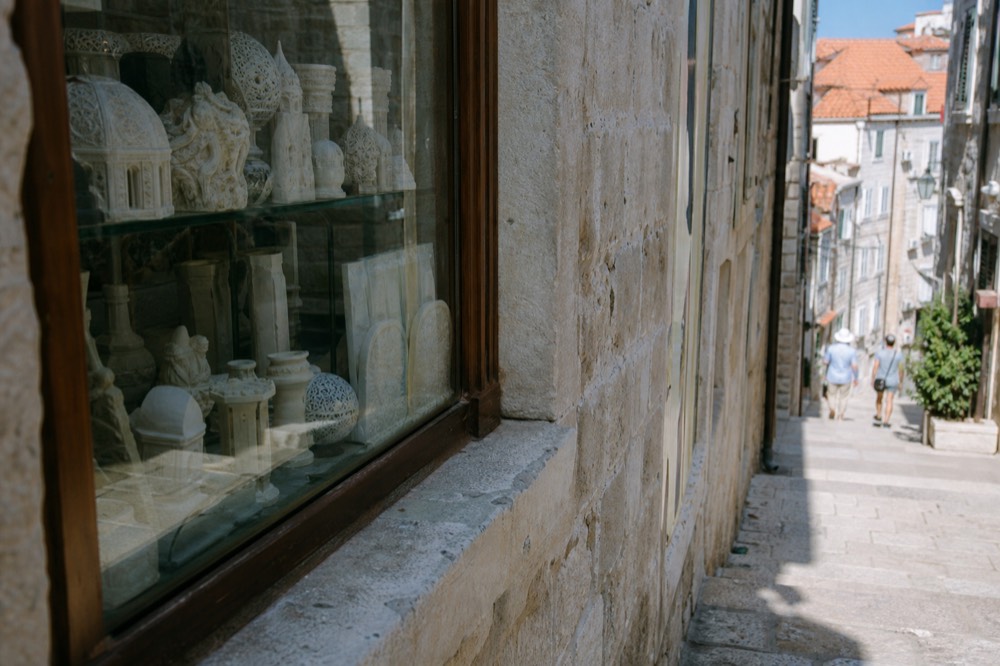
Start with stone. The city is built from local limestone, and small carved pieces are the most Dubrovnik thing you can take home. Our full guide to Dubrovnik shopping covers the streets shop by shop, but the short version is that the better carvers work in the side lanes off the Stradun rather than on the main street itself. Hold any piece up to the light: real limestone has a soft grain and slight irregularity, while resin casts feel light, warm quickly and have mould seams.
The chess set is the city's signature larger purchase. Dubrovnik has a documented chess tradition, and the design associated with the city, tall slender figures with clean geometric lines, is sold in several sizes and materials. Prices scale steeply with size and craftsmanship, so decide your budget before you start looking, and check the base of each piece for the maker's mark. Our Dubrovnik chess set guide goes deep on what distinguishes a proper set from a decorative imitation.
Wine travels well and is the souvenir I recommend most often to people who want something they will still be enjoying months later. Plavac mali is the flagship red grape of southern Dalmatia, and its most prized expression, dingač, comes from a specific steep slope on Pelješac. Both are covered in detail in our plavac mali guide and our dingač guide. A mid-range bottle from a small producer is a far better buy than a famous name at airport prices, and most wine shops in the Old Town will pack bottles in bubble wrap or cardboard sleeves for the flight.
Then there is food. Candied bitter orange peel, orange liqueur and bitter orange jam all come from a real local tradition, and the small jars travel fine in checked luggage. Lavender products, honey, and dried herbs come from the hinterland. Salt from Ston is cheap, genuinely local and beautifully packaged in some shops. Olive oil from Konavle and the coast is excellent, though heavy; buy the small tins.
A few words on timing and crowding, because when you shop matters almost as much as where. Cruise passenger numbers in 2025 peaked in September and October rather than July and August, which means the lanes around the Stradun stay busy well past the summer holidays. If you want the carvers' workshops and wine shops to yourself, go in the first hour after they open in the morning, or in the late afternoon once the day-trip groups have started flowing back toward the port. The Old Town's carrying capacity of 11,275 people is monitored by counters updating every 15 minutes, and on peak days you will feel every one of those bodies in the narrow lanes near the Pile Gate, where most visitors enter. Shopping your way east, deeper into the quieter grid of streets, tends to be calmer.
On packing, a little planning saves disappointment at the airport. Wine bottles packed by the shop in bubble wrap or cardboard sleeves should go into checked luggage, not hand luggage, since liquids over 100 millilitres are not allowed through security in carry-on. Small stone pieces are heavy for their size, so weigh your bag before you leave the hotel if you have bought several, and wrap each piece in clothing so they do not knock against each other. Jams, honey and liqueur also belong in checked luggage for the same liquid rules. If you are flying with only hand luggage, the safest souvenirs are the small carved stone pieces, lavender, dried herbs, and the salt from Ston, all of which pass through security without a second glance.
What Should I Not Miss in Dubrovnik?
Do not miss the City Walls, Fort Lovrijenac, the Stradun at dawn, the cable car view from Mount Srđ, and Lokrum Island. The walls are the single unmissable sight, 1,940 metres of circuit up to 25 metres high, and the 40 euro main season ticket includes Lovrijenac, the Western Outer Wall and the coin collection. Walk the walls early, before the midday heat and crowds.
The walls come first because everything else in the city is seen from them or understood through them. The circuit takes most people around two hours with photo stops, and the operator's stated hours are 08:00 to 19:30. Go at opening. The stone is polished smooth in places and there is almost no shade, so the difference between 08:00 and 11:00 is the difference between a pleasant walk and an ordeal. A guided version, the 2-Hour City Walls Walk from $29.58 per person, rated 4.8 across 1,387 reviews, adds the military history that the views alone do not explain.
Fort Lovrijenac stands on a 37-metre-high sea rock just outside the walls, according to the Dubrovnik Tourist Board's fortress page, and it is included in that same 40 euro walls ticket, or 15 euro on its own. The Stradun, 298 metres long, whose final plan was fixed by the 1272 Statute, is best experienced before 08:00, when the delivery vans have gone and the limestone paving glows. The cable car lifts you 367 metres to the Mount Srđ station in three and a half minutes, and the operator claims a view range of up to 60 km on a clear day; an adult round trip is 30 euro. Lokrum, a 30 euro ticket covering reserve entry and the return boat, with departures at 09:00 then every 15 minutes from 10:00 to 18:00, is the best half-day escape.
Here is the quick cost picture for the sights you will pass while shopping:
| Sight | Main season price | Notes |
|---|---|---|
| City Walls (adult) | 40 euro | Includes Lovrijenac, Western Outer Wall, coin collection; 20 euro in December |
| City Walls (child 7 to 18) | 15 euro | 5 euro in December; under 6 free; no family ticket exists |
| Dubrovnik Pass, 1 day | 40 euro | Same price as the walls ticket, adds ten sights plus 24h bus |
| Cable car (adult round trip) | 30 euro | 17 euro one way; child 4 to 12 round trip 8 euro |
| Lokrum Island | 30 euro | Includes reserve entry and return boat transfer |
That table is why the Dubrovnik Pass deserves a thought before you buy a single souvenir. In main season, 1 March to 30 November, the one-day pass costs the same 40 euro as the standalone walls ticket and adds ten more sights plus a 24-hour bus ticket. In December the walls ticket drops to 20 euro and no pass tier is on sale at all, so the comparison only holds in the main season. Our Dubrovnik Pass guide works through the arithmetic for every trip length.
What Should You Not Miss in Dubrovnik, Croatia?
Beyond the walls and the cable car, do not miss the Elaphiti Islands, a sea kayaking circuit around Lokrum and Betina Cave, the sunset from a boat, and the food: fresh fish, oysters from Ston, peka, and konoba cooking. If you have a spare day, Mostar and the Kravica waterfalls across the border in Bosnia and Herzegovina are the most requested day trip, from $35 per person.
This question usually comes from people with three or four days rather than one, and the honest answer is that the sea is half of what Dubrovnik is. The full-day Elaphite Islands cruise with lunch, from $59.16 per person and rated 4.9 across 10,312 reviews, is the most booked boat day out of the city and it doubles as a souvenir trip: you come back through the same harbour shops with a completely different sense of what the coastline you just saw produces. Sea kayaking around Lokrum and Betina Cave, from $35.49 per person, rated 4.9 across 1,518 reviews, is the two-hour version of the same idea.
Food is the other half. Oysters from Ston are served within hours of being harvested, and the Ston oysters guide explains why the same shellfish costs a fraction of what it would in a capital city. Peka, meat or octopus slow-cooked under a domed iron bell in embers, is the dish most worth planning a whole evening around, and a cooking lesson is one of the most memorable souvenirs you can take home, because you take the recipe with you. The Croatian Traditional Cuisine: Peka Cooking Lesson runs about four hours from $159.83 per person, and it teaches the technique rather than just serving you dinner.
For the sightseeing side of a longer stay, the combo walk below is the one I point people at, because it stitches the Old Town and the walls into a single narrative in three and a half hours, from $50.94 per person, rated 4.8 across 1,183 reviews. You finish at the top of the walls with the whole city laid out below you, which is exactly the moment you start deciding what to bring home from it.
If your stay stretches to a week, the day trips open up: Montenegro's Bay of Kotor from $58 per person, Korčula and Ston with wine tasting from $81.69, and Mljet National Park by boat from $153.99. Each of those is covered in full in our day trips guide.
Should I Go to Split or Dubrovnik First?
Fly into Split first, work your way down the coast, and finish in Dubrovnik. Split gives you Diocletian's Palace, cheaper hotels and faster access to islands like Hvar, while Dubrovnik is the more compact, more expensive and more spectacular finale. Doing Dubrovnik last means your holiday ends on the strongest image, and your suitcase fills with souvenirs on the final days, when you know exactly what you want.
The order question matters for shopping more than people expect. If Dubrovnik comes last, you have already seen Split's markets and Hvar's lavender stalls, so by the time you reach the Stradun you can tell the local stone carvings from the imported resin at a glance, and you will not waste money duplicating things you bought three towns earlier. If Dubrovnik comes first, the temptation is to buy everything on day two, then carry it through four more stops.
Practically, the two cities split the work of a Dalmatian trip cleanly:
| Factor | Split | Dubrovnik |
|---|---|---|
| Best role in a trip | Arrival hub and island base | Finale and souvenir stop |
| Old core | Diocletian's Palace, a living quarter | Walled city, 24.7 hectares, UNESCO since 1979 |
| Island access | Ferry hub for central Dalmatia | Elaphiti Islands, Lokrum, Mljet |
| Cost level | Lower for hotels and meals | Higher across the board |
| Time needed | Two days plus islands | Two to three days inside the walls |
The transport between them is easy whichever direction you go, and our Dubrovnik to Split transport guide compares bus, ferry and private transfer in detail. The comparison question also has a longer answer in Dubrovnik vs Split, which is worth reading before you book flights, because the right answer genuinely depends on whether your trip is about islands or about walls.
One more thing worth knowing if you are timing the whole trip around crowds: the Port Authority's own data shows cruise passengers peaked in September at 101,246 and October at 100,132 in 2025, above July and August, as the Port Authority statistics page records. The idea that the city empties the moment schools reopen is simply wrong. If you want quiet streets for shopping, come in April, May or late October, and note that cruise figures are ship capacity, not the number of people who actually walk ashore.
Where to Buy Each Souvenir Without Overpaying
Buy stone carvings from the side-lane workshops off the Stradun, wine from specialist shops rather than supermarkets, food souvenirs from the market at Gundulić Square, and salt and oyster products on a Ston day trip. Set a budget per person before you start, pay in euro, and keep receipts for anything over 100 euro if you plan to claim tax refunds at the airport.
The geography of shopping here is simple. The Stradun itself, all 298 metres of it, carries the highest rents and the most generic stock. The lanes running off it, particularly toward the Franciscan monastery on the west end, hold the smaller shops where the owners are behind the counter. Gundulić Square hosts the morning market where you find honey, herbs, candied orange and dried figs at prices locals actually pay, and our Gundulić market guide explains what is sold where. For the full picture of streets and stalls, the shopping guide is the cluster page for this whole topic.
Wine deserves a specialist stop. Look for shops that pour tastings, because a fifteen minute tasting of three plavac mali bottles will teach you more than any label, and the staff will pack for travel. If Pelješac itself is on your itinerary, buying at the winery door is cheaper and comes with the view; the Pelješac wine guide maps the route. The wine tasting guide covers options closer to the city for anyone without a car.
For the peka cooking lesson, if the food souvenir idea has grown on you, the four-hour class from $159.83 per person ends with you eating what you cooked, and you leave with a technique you can reproduce at home, which no fridge magnet can match. It is the priciest item on this page but the only one that lasts forever.
Finally, if you only do one paid activity while you are here and want to keep costs tight, the walls admission on its own, from $36.37 per person, rated 3.6 across 249 reviews, gets you onto the circuit with no guide. The rating reflects the ticket experience rather than the walls themselves, which are extraordinary either way; the combo walk above explains what you are looking at and is the better use of a first morning if you want the stories.
Whatever you buy, remember the point of it. The best souvenir from this city is something that carries a piece of the place: stone from the same quarries that built the walls, wine from the slopes you can see from the top of them, salt from the pans that funded the fleet. Everything else is just packaging. If you are still building your days around the shopping, the best things to do guide is the natural next stop, and Things to Do in Dubrovnik is the homepage for the whole site.
Common Questions About Souvenirs in Dubrovnik
What souvenirs should I buy in Dubrovnik?
Buy local limestone carvings, a Ragusan chess set, plavac mali or dingač wine from Pelješac, candied bitter orange products, honey, lavender, Ston salt and small tins of Konavle olive oil. Skip imported magnets and generic Adriatic trinkets, which are identical to what is sold all along the coast.
What should I not miss in Dubrovnik?
The City Walls above all, ideally at 08:00 opening, plus Fort Lovrijenac, the Stradun at dawn, the cable car to Mount Srđ and Lokrum Island. The 40 euro main season walls ticket includes Lovrijenac, the Western Outer Wall and the coin collection.
Should I go to Split or Dubrovnik first?
Most travellers do better arriving in Split, exploring the central Dalmatian islands, then finishing in Dubrovnik. It ends the trip on the most spectacular city, keeps costs lower at the start, and leaves souvenir buying to the final days when you know exactly what you want.
Is wine a practical souvenir to fly home with?
Yes, if it goes in checked luggage and is packed properly. Most Old Town wine shops will sleeve or bubble-wrap bottles, and a mid-range plavac mali from a small producer survives the flight better than a famous label bought at airport prices.
Where do locals actually shop for food souvenirs?
The morning market at Gundulić Square for honey, herbs, dried figs and candied orange, and the shops in the side lanes off the Stradun rather than the main street itself. Prices for genuinely local goods vary little between shops, but quality varies a lot.