What Is the Rainiest Month in Dubrovnik?
The rainiest stretch in Dubrovnik is late autumn and early winter, and here is what that means for planning, from sea temperatures and cruise crowds to what stays open when the showers arrive.
What Is the Rainiest Month in Dubrovnik?
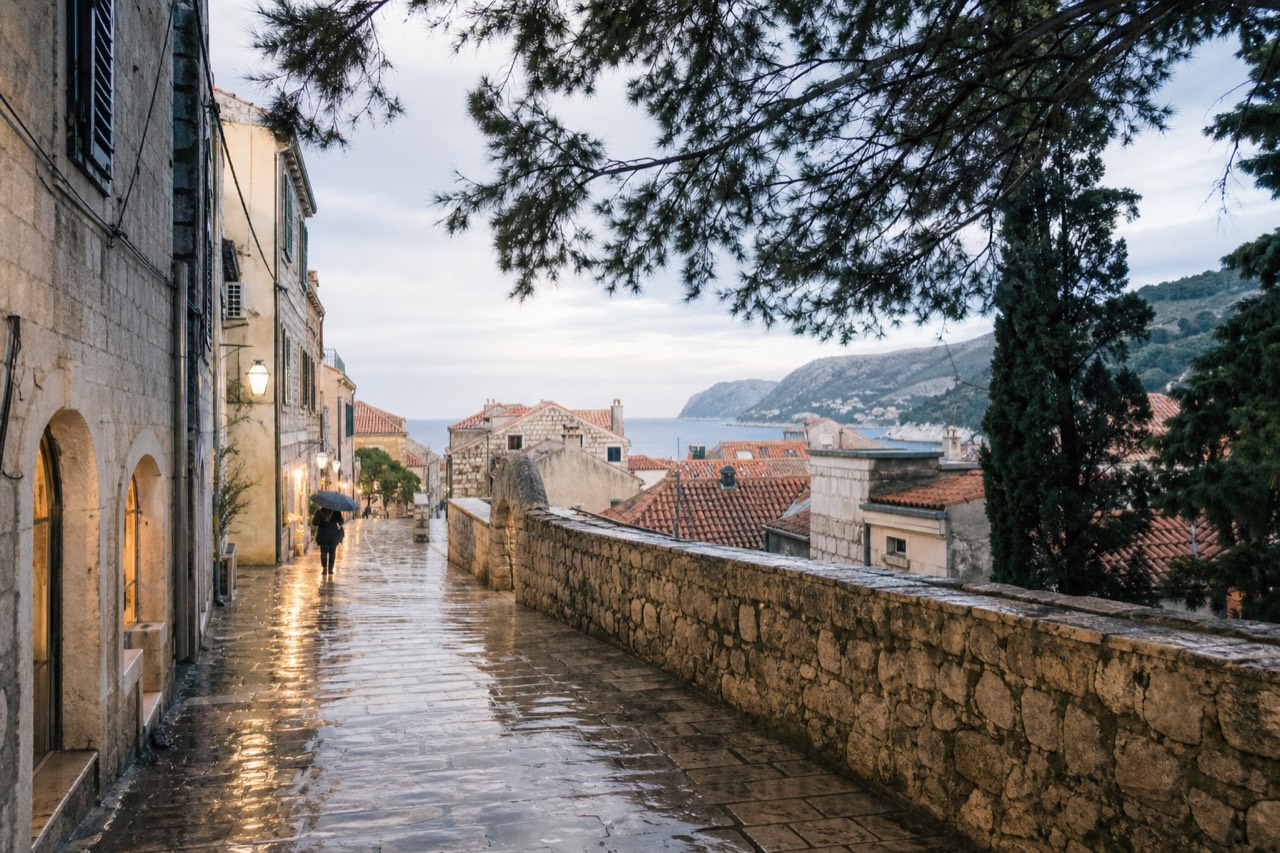
The rain in Dubrovnik falls overwhelmingly in the late autumn and early winter, with the wettest stretch running from late October through December, and November standing out as the single rainiest month in most years. Summer is the opposite: June, July and August are dry, hot and crowded, and rain is the exception rather than the rule. If dry weather is the priority, the sweet spot is the shoulder season.
That is the short answer, and it comes with a caveat I want to be honest about: I do not publish a month-by-month rainfall table here, because the verified primary sources behind this site cover crowds, sea temperature, prices and schedules rather than a Croatian meteorological rainfall series. What I can give you is the pattern every local knows, backed by the hard numbers that are verified: the sea temperature series, the cruise calendar, the cable car timetable and the winter price structure. Those tell the weather story indirectly but reliably.
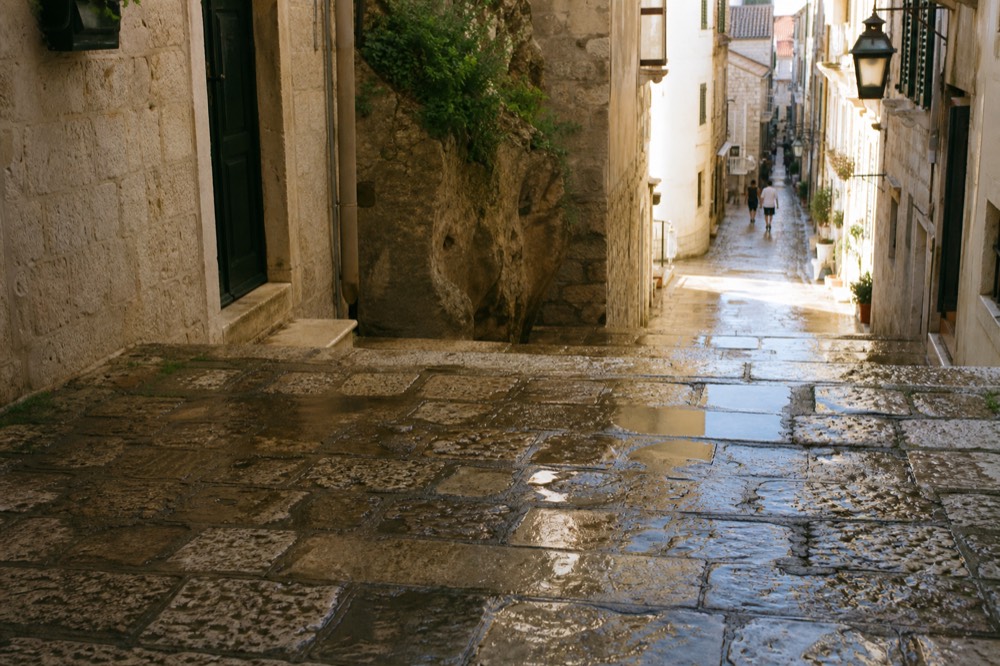
The pattern matters more than the millimetres anyway. Dubrovnik sits on the southernmost stretch of the Croatian coast, facing the Adriatic, and its climate is Mediterranean: a long, dry, fiercely sunny summer followed by a short, wet, mild winter. When the rain comes, it tends to arrive in heavy bursts rather than drizzle, and the famous limestone streets of the Old Town, polished to a shine by centuries of feet, turn genuinely slippery. That polished stone is the single biggest practical consequence of a rainy day here, and I will come back to it.
The indirect evidence for the wet season is easy to read once you know where to look. The Dubrovnik Cable Car, an all-weather attraction if ever there was one, simply closes from January to March, the operator's own timetable page confirms it, and that closure tracks the stretch of the year when fog, wind and rain make the summit unreliable. The City Walls drop their adult ticket from 40 euro in main season, 1 March to 30 November, to 20 euro in December, and the Western Outer Wall section closes entirely in December, January and February. Operators price and schedule around the weather, and their calendars all agree on when the rough months are.
The sea tells the same story from below. The September average for this coast is about 23.6 degrees, October falls to 21.0, November to 18.5 and December to 16.0, from the NOAA long-run 1991 to 2020 average for this stretch of open water. That cooling curve is the thermal signature of the same autumn that brings the rain: the sea gives up the summer's heat slowly, the first Atlantic-style systems start crossing the Balkans, and by November the swimming season is over for most people even though the air rarely feels truly cold.
If you are planning around this, the practical framing is simple. You are not choosing between "rainy" and "dry" months so much as choosing between three regimes: the dry, crowded, expensive summer; the warm, drier and still-swimmable shoulder months of May, June, September and early October; and the wet, quiet, cheap late autumn and winter. Each has a real audience, and the rest of this article works through what each one actually feels like, with the verified numbers attached.
What Is the Best Month to Go to Dubrovnik?
For most travellers the best month is September, followed closely by early October: the sea still averages about 23.6 degrees in September, the air has cooled from the August peak, and the summer crush has thinned. The counter-intuitive catch is that September and October are actually the two busiest cruise months of the year, with 101,246 and 100,132 cruise passengers in 2025, ahead of July and August.
That cruise figure surprises people, and it should, because every instinct says July and August are the busiest months in a Mediterranean destination. The Port Authority's own statistics say otherwise for cruise traffic: in 2025, September brought 101,246 cruise passengers and October 100,132, against July's 96,072 and August's 87,385. The reason is simple enough: the cruise lines stretch their Mediterranean season into the warm shoulder months, and Dubrovnik is a fixture on those itineraries. You can read the Port Authority's own statistics page for the full series at the Port Authority's traffic statistics.
So September gives you the best weather-to-crowd trade in the air but not necessarily on the quay. The way to play it is timing within the day. The Old Town runs a live counting system, six counters at every entrance updating a headcount every 15 minutes, and the official carrying capacity from the UNESCO assessment is 11,275 people. On a representative September day the curve runs 5,419 people at 08:00, 7,297 at 09:00, a 7,739 peak at 10:00, then 7,205 at 11:00. In other words, the town fills by mid-morning and stays full. Walk the walls at opening, or after four in the afternoon, and you share them with a fraction of the midday crowd.
May and June are the other strong candidates. The sea is cooler, 18.6 degrees on average in May and 22.5 in June, but the rain risk is low, the cruise calendar is lighter than the autumn peak, and the cable car runs long hours, 09:00 to 22:00 from 1 to 14 May and until 23:30 from 15 to 31 May, with June, July and August running to midnight. June is the month I point people toward when they want summer energy without August's heat and prices shoulder to shoulder.
| Month | Sea temperature (long-run average) | 2025 cruise passengers | Character |
|---|---|---|---|
| May | 18.6 °C | 84,107 | Warm, green, lighter crowds |
| June | 22.5 °C | 82,642 | Swimmable, long cable car hours |
| July | 24.9 °C | 96,072 | Hot, dry, peak land crowds |
| August | 25.8 °C | 87,385 | Hottest sea, busiest streets |
| September | 23.6 °C | 101,246 | Warm sea, busiest cruise month |
| October | 21.0 °C | 100,132 | Mild, quieter evenings, first rain possible |
| November | 18.5 °C | 28,480 | Wettest stretch begins, quiet |
One honest note on those sea temperatures: they are NOAA OISST v2.1 long-run averages for 1991 to 2020, open-water grid-cell figures, not this year's water and not a beach thermometer. Sheltered bays run warmer; the Croatian met service's own Dubrovnik buoy read 27.0 to 27.4 degrees on 8 September 2026 against that 23.6 September mean. Treat the table as a planning baseline, not a forecast.
The best month also depends on what you came for. If it is a boat day, the Elaphiti Islands Full-Day Cruise from Dubrovnik with Lunch, about 8 hours, from $74.58 per person and rated 4.8 across 6,751 reviews, is a fair-weather anchor worth building a day around, and it runs through the whole dry season. If it is the walls and the Old Town lanes, the shoulder months let you actually enjoy them. Our fuller month-by-month treatment lives in the best time to visit Dubrovnik guide, and the Things to Do in Dubrovnik homepage collects the whole year of options in one place.
A few practical readings of the numbers help you choose between the shoulder months. If swimming is the priority, the gap between June's 22.5-degree mean and September's 23.6 is small, but September sits closer to August's 25.8 peak, and the buoy reading of 27.0 to 27.4 on 8 September 2026 shows how much warmer real near-shore water can run than the open-water baseline. If avoiding cruise crowds matters more, June is the quieter quay: 82,642 cruise passengers against September's 101,246, a difference of nearly 19,000 arrivals in a single month. May is quieter still on land and sea alike, though its 18.6-degree water will feel brisk to most swimmers.
October rewards a different kind of traveller. The cruise calendar stays heavy at 100,132 passengers, so the mid-morning Old Town crush persists, but evenings turn mild and the first rain of the season becomes possible, which makes it a better pick for walkers and wall-lovers than for beach days. By November the picture flips completely: cruise traffic collapses to 28,480, the wettest stretch of the year begins, and the town is quiet. Anyone who values empty lanes over warm water, and who does not mind carrying a rain layer, will find November the closest thing Dubrovnik offers to having the place to themselves, with the sea still holding at 18.5 degrees for anyone brave enough to swim.
What Is the Coldest Month in Dubrovnik?
By sea temperature the coldest month is February, with a long-run average of 14.0 degrees, fractionally below January's 14.3 and March's 14.2. By air, the winter months cluster together mildly: Dubrovnik winters are wet and grey rather than harsh, and snow in the city is a rare event worth photographing. The practical cold is the bora wind, which can make an otherwise mild day feel sharp on the walls.
The sea series is the most reliable winter yardstick I have, because it is verified against two independent authorities: NOAA's 1991 to 2020 average and the EMODnet SeaDataNet climatology, which agree within about a degree in every month that matters. February's 14.0 is the floor of the year, and the water then is genuinely cold, not "refreshing". Nobody swims in February without a wetsuit and a reason.
The air is a different matter. Dubrovnik is the southernmost major destination on the Croatian coast, and its winter is closer to southern Italy than to inland Croatia. Daytime temperatures through the winter months are typically mild enough for a light jacket, and the city stays walkable year-round, which is exactly why a winter visit is a real option: the crowds vanish, the December walls ticket drops to 20 euro, and you can have the Stradun, 298 metres of it, almost to yourself between showers.
What closes, and what does not, defines the winter visit more than the thermometer. The cable car is shut from January to March, per the operator's own timetable at the cable car's timetable and prices page. The Western Outer Wall closes December through February. The Lokrum boats stop running their summer pattern, which in season is a departure at 09:00 and then every 15 minutes from 10:00 to 18:00 from the City Harbour. The museums and the Dubrovnik Pass system, 40 euro for one day, 50 for three days, 60 for seven days in the summer window, are sold as "SUMMER 2026, 01.03.2026 to 30.11.2026" with no winter tier on sale at all, so pass planning is a main-season exercise.
| Item | Main season (1 Mar to 30 Nov) | December | January to February |
|---|---|---|---|
| City Walls adult ticket | 40 euro | 20 euro | 20 euro |
| City Walls child 7 to 18 | 15 euro | 5 euro | 5 euro |
| Dubrovnik Pass (one day) | 40 euro | Not on sale | Not on sale |
| Cable car adult round trip | 30 euro | Running, reduced hours | Closed |
| Western Outer Wall | Open | Closed | Closed |
The 40-euro equivalence between the one-day pass and the standalone walls ticket is a main-season fact only, 1 March to 30 November: in December the walls ticket falls to 20 euro while no pass tier is on sale at all, so the comparison flips entirely. That is the kind of seasonal detail that saves real money if you are travelling at the edges of the year.
For a deeper look at the cold end of the calendar, the Dubrovnik in winter guide covers what stays open, and our piece on whether you can swim in Dubrovnik in September picks up the other edge of the swimming season.
What Is the Rainiest Month in Croatia?
Croatia's rain follows the same Mediterranean rhythm as Dubrovnik's, concentrated from late October through December, with November typically the wettest month across most of the coast. The continental interior, including Zagreb and Slavonia, gets a second rainy peak in late spring, and the Dalmatian islands and coast are the driest parts of the country overall.
The coastal pattern is the one that matters for a Dubrovnik trip. The Adriatic coast dries out almost completely from June through August, then the first serious systems arrive in October and the rain concentrates in November and December before tapering through winter. Dubrovnik, at the southern end, sits squarely in that pattern. The visitor-facing consequences are predictable: the boat season winds down, the island ferries thin out, and the tourism year pivots to city breaks and indoor sights.
What the wet months do not bring is a dead city. Dubrovnik recorded about 4.2 million overnight stays in 2025, sharing first place among Croatian destinations with Rovinj, and while the vast majority of those nights fall in the warm half of the year, the winter city is a living place, not a film set with the lights off. The Rector's Palace, the Maritime Museum, the Franciscan Monastery museum and the rest of the museum circuit carry the rainy days, and the konobas keep serving.
If you are travelling Croatia more widely, the geography of the rain matters. The coast and islands are driest; the mountainous hinterland behind them, including the areas around the Krka and Plitvice parks, is wetter; and the continental north and east get rain spread more evenly through the year with that late-spring secondary peak. For a Dubrovnik-centred trip, though, the practical rule is one sentence: after mid-October, pack a rain layer and do not bet a whole day on a boat.
What to Do When the Rain Comes
A rainy day in Dubrovnik is best spent indoors in the morning and on the polished streets once the showers pass, because the rain rarely lasts all day in the shoulder season. The museum circuit, the Rector's Palace, the cathedral treasury and a long konoba lunch absorb the wet hours, and the stone streets dry fast when the sun returns. The one real hazard is the limestone underfoot, which is treacherous when wet.
That limestone deserves its own paragraph, because it catches visitors out every year. The Old Town's paving and staircases are polished by centuries of foot traffic, and rain turns them into something closer to ice than stone. Flat-soled shoes with actual grip beat anything fashionable, and the staircases inside the walls, of which there are many, deserve slow feet. I have walked these streets in every month of the year, and the wet-stone rule never changes.
The indoor roster is deeper than most people expect. The Rector's Palace, the Maritime Museum, the Ethnographic Museum, the Museum of Modern Art, the Dominican and Franciscan monastery collections and the Natural History Museum together fill more than one wet afternoon, and in main season the Dubrovnik Pass bundles them with the walls. The walls themselves in light rain are an experience some travellers actively seek, empty and moody with the sea breaking below, but they close in thunderstorms and you should check the operator's stated hours, 08:00 to 19:30 at time of check, before committing.
For a full wet-weather plan, our rainy day Dubrovnik itinerary lays out a complete day. And if your rainy day falls in the shoulder season, remember that the forecast often clears by afternoon, which is exactly when a guided walk earns its keep: the 2-Hour City Walls Walk, from $29.58 per person and rated 4.8 across 1,387 reviews, fits neatly between showers.
This well organized tour helped put Dubrovnik's past (and present) into perspective. It's incredible that the city walls have withstood the test of time. Antun was a wonderful guide.
linda_a
The last word on timing: the rainiest month is not a month to avoid so much as a month to plan differently. November in Dubrovnik is quiet, green, cheap and atmospheric, with the museums open and the konobas warm. If your dates are fixed in late autumn, go anyway, pack the right shoes, and let the showers sort the crowds for you. The city that 4.2 million overnight stays pass through in a busy year is, in its wettest weeks, a place you can finally hear yourself think in.
Common Questions About the Rainiest Month in Dubrovnik
What is the rainiest month in Dubrovnik?
Late autumn and early winter bring the rain, with November standing out as the rainiest month in most years and the wet stretch running from late October through December. Summer, by contrast, is dry and sunny, and rain in June, July or August is the exception rather than the rule.
What Is the Best Month to Go to Dubrovnik?
September is the strongest all-round month: the sea still averages about 23.6 degrees, the air has cooled from the August peak, and the summer street crush has thinned. The catch is that September and October are the two busiest cruise months, 101,246 and 100,132 cruise passengers in 2025, so time your Old Town visits early or late in the day.
What Is the Coldest Month in Dubrovnik?
By sea temperature, February is the coldest month with a long-run average of 14.0 degrees, just below January's 14.3. The winter air stays mild by continental standards, and the practical cold is the bora wind rather than the thermometer.
What Is the Rainiest Month in Croatia?
The Croatian coast shares Dubrovnik's pattern, with November typically the wettest month from late October through December. The continental interior gets a second rainy peak in late spring, while the Dalmatian coast and islands are the driest parts of the country.
Is Dubrovnik Worth Visiting in the Rainy Season?
Yes, with the right expectations. The December walls ticket drops to 20 euro, the crowds vanish, and the museum circuit carries the wet hours. The cable car closes January to March and the winter pass tier is not on sale, so plan around those closures.
What Should I Pack for the Wet Months?
A rain layer, an umbrella you can fold away, and above all shoes with real grip. The Old Town's polished limestone streets and staircases become very slippery when wet, and that is the single most common rainy-day problem visitors report.