What Airports Fly Directly to Dubrovnik?
Which airports connect directly to Dubrovnik, what the flight question means for your arrival plan, and how to get from the airport into the Old Town without overpaying.
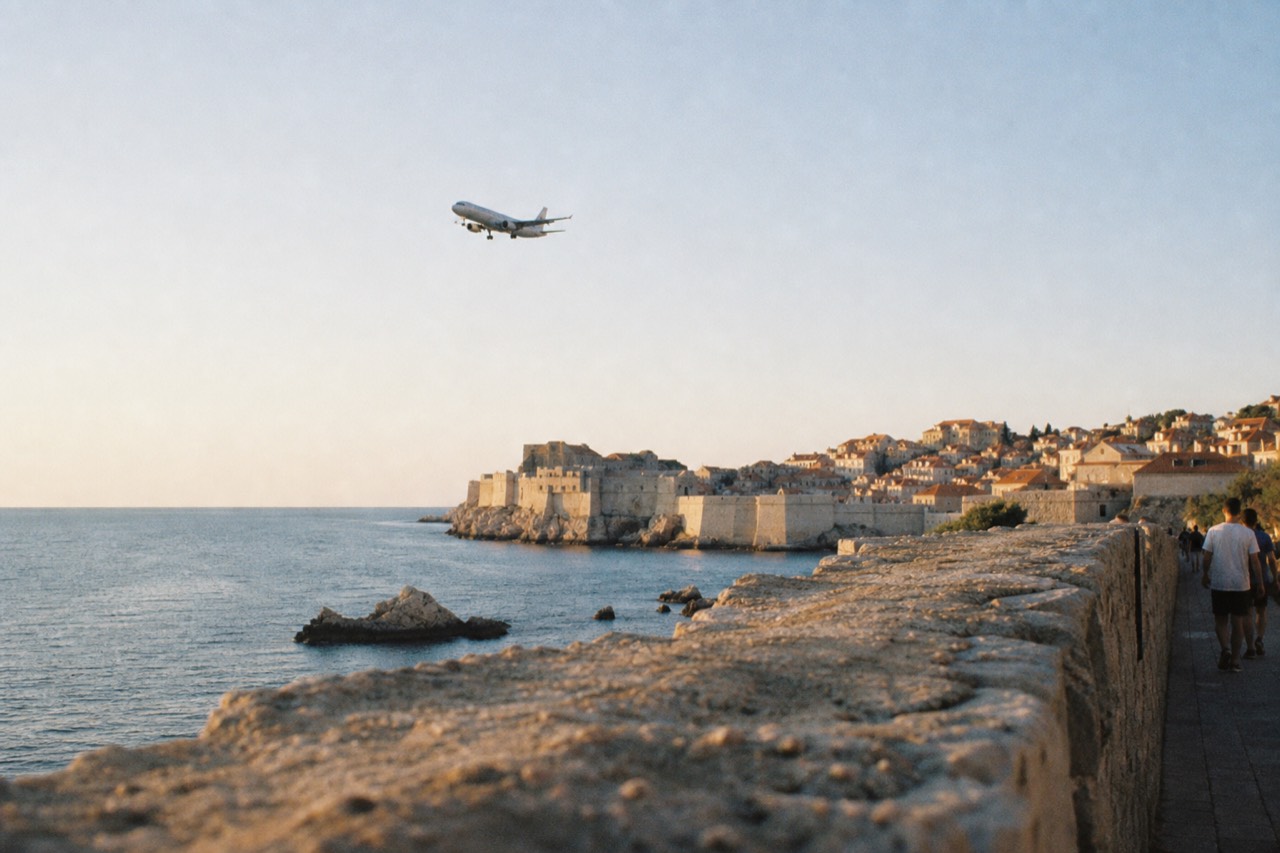
What Airports Fly Directly to Dubrovnik?
Dubrovnik has exactly one commercial airport, and every direct flight lands there, a short drive southeast of the Old Town toward Cavtat. In high season the route map widens to hubs across Europe, and in the shoulder months it narrows again, so the honest answer depends on when you fly. If your home airport has no nonstop service, the reliable pattern is one connection through a major European hub.
I get this question more often than almost any other, and I usually answer it the way I would for a friend landing for the first time. The city itself sits on a narrow strip of coast between a mountain and the sea, and there is only one place a jet of any size can put down nearby. That single-airport reality shapes everything about arriving here: the transfer you book, the time you leave the terminal, and even which day of the week you choose to fly.
What surprises most first-time visitors is not the airport itself but how quickly the season changes the picture. In July and August the arrivals board fills with flights from across the continent, and the small terminal hums from early morning until late evening. Come November, or between January and March when the cable car up Mount Srđ is closed for its winter break, the schedule thins dramatically, and some weeks the same route runs two or three times instead of daily. Anyone planning a winter visit should read the winter guide before locking dates.

The other half of the question is what happens after the wheels touch down. The airport is not walking distance from anything, so every traveller makes a choice: a shared transfer, a taxi, a pre-booked private car, or the local bus. That choice matters more here than in most cities, because the final stretch of road into town runs along the coast and through a tunnel, and in peak weeks it carries cruise-shuttle traffic too. The Port Authority counted 625,257 cruise passengers across 2025, and 461 cruise calls are scheduled for 2026, so on the busiest days the road from the airport shares its lanes with a lot of other arrivals.
If you want the deep dive on the terminal itself, the Dubrovnik Airport guide covers arrivals, departures and the practicalities in detail. For the wider picture of moving around once you are here, start with getting around Dubrovnik, which explains the buses, taxis and walking routes in plain terms.
Before the route details, here are three services that solve the most common arrival problems, from the shared transfer into town to two ways to see the city on your first day:
Where Can You Fly Directly From Dubrovnik?
The direct destinations from Dubrovnik mirror the arrivals map almost exactly: seasonal routes to cities across Europe, concentrated in the summer months, plus year-round service to the Croatian capital Zagreb, which is the one domestic link you can count on in almost any month. Return flights out of Dubrovnik follow the same seasonal rhythm, thinning sharply from late October. If a nonstop home matters to you, book the outbound leg before you commit to dates.
The symmetry is worth understanding because it affects how you plan. An airline that flies a plane into Dubrovnik in the morning almost always flies it back out the same day, so the list of places you can reach nonstop from here is essentially the same list you can reach here from. In August that list is long: major hubs and secondary cities across the United Kingdom, Ireland, Germany, France, the Nordic countries, Poland, the Netherlands, Austria, Italy, Spain and elsewhere. In February it contracts to a hardy core, and travellers from most of those countries connect through a hub, often Zagreb, Frankfurt, Vienna, Munich, Paris, London, Amsterdam, Rome or Warsaw.
I always tell people to think of the schedule as a tide rather than a fixed map. The first big wave arrives in April, ahead of Easter and the opening of the walls season on 1 March, when the adult City Walls ticket is 40 euro including Fort Lovrijenac. The tide is fully in from June through September, which is also when the sea is at its warmest: the long-run September average for this coast is about 23.6 degrees, and August runs warmer still at 25.8. Then October eases off, November quiets down, and the winter months belong to city-break travellers and people visiting family.
One planning detail that catches people out: the day of the week matters almost as much as the month. Several seasonal routes do not run daily, especially in the shoulders of the season, so a Saturday arrival might have three nonstop options from your hub while a Tuesday has one or none. If your dates are flexible, search a few days either side before concluding there is no direct flight. And if you are combining Dubrovnik with elsewhere in Croatia, the Dubrovnik to Split transport guide compares the bus, the ferry and the flight options for the country's most travelled coastal corridor.
The counterweight to all of this is that a connection is rarely painful here. The final hop into Dubrovnik is short, and on a clear day the descent along the Dalmatian coast is one of the better approaches in Europe, with the Elaphiti islands and the walled city sliding past the window. Many travellers deliberately book a window seat for the last thirty minutes.
Which Airports Fly Direct to Dubrovnik?
In practice the airports with nonstop service to Dubrovnik fall into three groups: Croatian hubs led by Zagreb, the big Western European hubs such as London, Paris, Frankfurt, Amsterdam, Vienna, Munich, Rome and Warsaw, and a wide seasonal ring of secondary airports in the UK, Ireland, Germany, Scandinavia and Central Europe that fill up between April and October. Which group serves you depends on your month of travel.
That three-group framing is the most useful way I know to hold the map in your head. The first group, the domestic one, is the anchor. Zagreb connects Dubrovnik to the Croatian network and, through it, to the national carrier's wider partners, and it is the link that keeps running when almost everything else pauses. The second group is the trunk of the system: the large hubs that fly here year-round or nearly so, and where most long-haul travellers make their single connection. If you are coming from North America or Asia, your itinerary will almost certainly route through one of these. More of these guides are collected on Things to Do in Dubrovnik.
The third group is the seasonal ring, and it is where the answer changes most from month to month. Regional airports that have no reason to serve a small Adriatic city in February absolutely do in August, when holiday demand supports nonstop flights. This is why two people can give you opposite answers to the direct-flight question and both be right: one flew in July, the other in November. The best time to visit Dubrovnik guide unpacks the trade-offs month by month, including the September and October sweet spot, when the sea is still swimmable, the September average sits around 23.6 degrees, and the cruise calendar is actually at its annual peak rather than winding down.
Here is the honest caveat that goes with any list of routes: airline schedules are among the most volatile facts in travel. Routes are added each spring, trimmed each autumn, and occasionally dropped mid-season. Rather than treat any published list as permanent, check your own dates on a search engine or with the airline directly. What stays true is the structure: one airport, a domestic anchor, a set of major hubs, and a seasonal ring that breathes with the calendar.
What also stays true is what happens on the ground after landing, and that part you can plan with confidence. The shared departure transfer from Dubrovnik and Cavtat to the airport runs about an hour, starts at $20 per person, and is rated 4.5 across 57 reviews. For travellers who prefer to sort the last leg before the first one, it removes the single most common arrival-day stress.
A useful way to compare your first-day options once you have landed, all three of which can be booked ahead:
| Service | Type | Length | From (per person) | Rating |
|---|---|---|---|---|
| Shared Airport Transfer | Transfer, Dubrovnik and Cavtat to the airport | About 1 hour | $20 | 4.5 across 57 reviews |
| Cable Car and Museums Multipass | Cable car ride plus museum entries | 10 minutes to 3 hours | $24 | 4 across 101 reviews |
| E-Tuk Tuk Panorama Ride | Guided panorama tour | About 1 hour 45 minutes | $59.24 | 5 across 1,799 reviews |
The pattern I recommend for a first afternoon: get into town, drop the bags, then do something low-effort with a view. The multipass combines the cable car up Mount Srđ with museum entries and is the cheapest structured orientation on offer, while the e-tuk-tuk ride, rated a perfect 5 across 1,799 reviews, sweeps the panorama roads above the city for an hour and three quarters without a single staircase. Both are gentler introductions than attacking the 1,940 metres of city walls on day one, an effort better saved for a cooler morning hour.
Where Can I Fly Direct to Dubrovnik?
If you are asking from a specific city, the fastest honest answer is to search your own dates, because the direct-flight map is seasonal. Broadly: most major Western and Central European capitals and hubs have nonstop service in summer, Zagreb flies year-round, and long-haul travellers from North America, Asia or Australia connect once through Europe. From within Croatia, Zagreb is the dependable domestic link.
I want to be straight about why I keep hedging on route lists. During the research behind this site I watched how quickly a route table can go stale: a schedule that was true in spring can change by autumn, and a confident list printed today can mislead someone reading it in February. The facts I will stand behind are the structural ones, and the seasonal ones I will always frame with their season. That is the same discipline this site applies everywhere else, from the 40 euro main-season walls ticket, valid 1 March to 30 November, to the Dubrovnik Pass, which costs the same 40 euro for one day in that window and adds ten more sights plus a 24-hour bus ticket.
For long-haul travellers the practical advice is simple. Book the long leg into whichever major hub gives you the best connection, then a separate short hop to Dubrovnik, ideally on one ticket so the airline owns the misconnect risk. London, Frankfurt, Vienna, Munich, Paris, Amsterdam, Rome and Warsaw all work well as final gateways in season. Leave at least two hours for the connection if the tickets are separate, because the Dubrovnik leg is short and the aircraft are often smaller than you expect after a widebody across an ocean.
Once you are down, the geography is kind. The airport sits close to Cavtat, the pretty small town on the peninsula south of the city, and the drive north into Dubrovnik is one of the better airport transfers anywhere on the Adriatic, hugging the coast before diving through the hill into the Župa valley. The shared transfer covers both Dubrovnik and Cavtat on its route, which is why it suits almost every arrival pattern: hotel in the Old Town, apartment in Lapad, or a few nights in Cavtat first.
The transfer question also runs in reverse, and it is worth booking the outbound leg with the same care. Departure days at a small airport concentrate: several flights leave within the same morning window, and the shared transfer fills accordingly. The airport to Old Town cost guide breaks down the options and prices, and the shared transfer at $20 per person is usually the number that anchors the comparison.
One last note for anyone flying out in the evening: do not waste the final day. Bag storage aside, an afternoon cable car ride or a slow lunch on the Stradun, the 298-metre limestone street that has been the city's spine since the plan was fixed in 1272, beats four hours in a departure lounge. The terminal is small and quick, and the city is right there.
Can You Fly Directly to Croatia?
Yes, and Dubrovnik is one of the country's main international gateways, alongside Zagreb and Split. Croatia has several commercial airports, but the three that matter for most visitors are Zagreb in the north, Split in the middle of the coast and Dubrovnik at the southern end. Zagreb offers the most year-round international service; Split and Dubrovnik are strongly seasonal, peaking with the summer timetable.
The choice between Split and Dubrovnik as your entry airport is a real one for many travellers, and it usually comes down to itinerary. If your trip is Dubrovnik-centred, fly straight in: the transfer is short, and starting in the south saves you a three-hour bus or a ferry ride at the end of a long travel day. If you are touring the coast, flying into Split and out of Dubrovnik, or the reverse, is the classic open-jaw, and the Dubrovnik vs Split comparison lays out the differences between the two cities honestly, including which one suits a first visit better.
Croatia's arrival numbers give the scale of the machine you are joining. The Croatian Bureau of Statistics counted 20.7 million arrivals and 94.8 million overnight stays in commercial accommodation across the country in 2025, and Dubrovnik alone recorded about 4.2 million nights, tied with Rovinj for first place among Croatian destinations. Every one of those people arrived by air, road or sea, and the city's systems are built for the flow: the airport, the cruise port at Gruž with its 461 scheduled calls for 2026, and the ferry terminals that link the mainland to the islands.
| Month (2025) | Cruise Passengers at the Port of Dubrovnik |
|---|---|
| July | 96,072 |
| August | 87,385 |
| September | 101,246 |
| October | 100,132 |
That table carries the single most useful counter-intuitive fact on this site, straight from the Port Authority's own statistics: September and October, not July and August, are the busiest cruise months in Dubrovnik. The port's figures show it plainly, and it matters for two reasons. First, if you are flying in during early autumn expecting empty streets, adjust the expectation: the sea is warm, the schedule is full and the Old Town is busy, tracked by counters that update every 15 minutes against an official carrying capacity of 11,275. Second, it means the airport is at its busiest exactly when many travellers assume the season is over, so book transfers and first-night dinners ahead even in late September.
For the flight itself, the practical summary is this: yes, you can fly directly to Croatia from a wide ring of European airports, Dubrovnik is a well-served seasonal gateway with a year-round Zagreb link, and the airport-to-city leg is a solved problem. Sort the transfer, pick a first afternoon that does not involve stairs, and let the arrival be the easy part of the trip.
Before the practical questions, one more look at the three services that cover the arrival-day basics, from the shared ride in from the terminal to two very different ways to meet the city:
Common Questions About Flying Directly to Dubrovnik
What airports fly directly to Dubrovnik?
Dubrovnik has one commercial airport, and every direct flight lands there. In summer it is served nonstop from major European hubs including London, Paris, Frankfurt, Amsterdam, Vienna, Munich, Rome and Warsaw, plus a wide seasonal ring of airports across the UK, Ireland, Germany, Scandinavia and Central Europe. Zagreb is the dependable year-round domestic link. In winter the map narrows sharply, so check your own dates rather than trusting any fixed list.
Can You Fly Directly to Croatia?
Yes. Croatia has several commercial airports, with Zagreb, Split and Dubrovnik the three that matter to most visitors. Zagreb carries the most year-round international service, while Split and Dubrovnik are strongly seasonal, filling with nonstop European routes between spring and autumn. Long-haul travellers connect once through a European hub.
Where Can You Fly Directly From Dubrovnik?
Roughly the same places you can fly to. Airlines turn their aircraft around the same day, so the outbound nonstop map mirrors the arrivals map: broad in summer, narrow in winter, with Zagreb as the constant. Book the outbound leg early if a nonstop home matters to you, because seasonal frequencies drop fast after October.
How Do I Get From the Airport to the Old Town?
The airport is a short drive from the city, and your options are a shared transfer, a taxi, a pre-booked private car or the local bus. The shared transfer from Dubrovnik and Cavtat runs about an hour, starts at $20 per person and is rated 4.5 across 57 reviews. The full cost comparison is in the airport-to-Old-Town guide.
Is September a Quiet Time to Arrive?
Quieter than August on the streets, but not at the port. Port Authority data shows cruise passengers peaked in September 2025 at 101,246 and October at 100,132, ahead of July and August. The sea is still warm, with a long-run September average of about 23.6 degrees, so it is a lovely month to arrive, just not an empty one.