Kayaking in Dubrovnik: Routes, Tours, Water Temperature and Safety
Kayaking is one of the best ways to see Dubrovnik: from the water, the walls look the way they did to the Venetian galleys. This guide covers the routes, the tours, the water temperature month by month, and the safety and etiquette points that matter.
Short answer
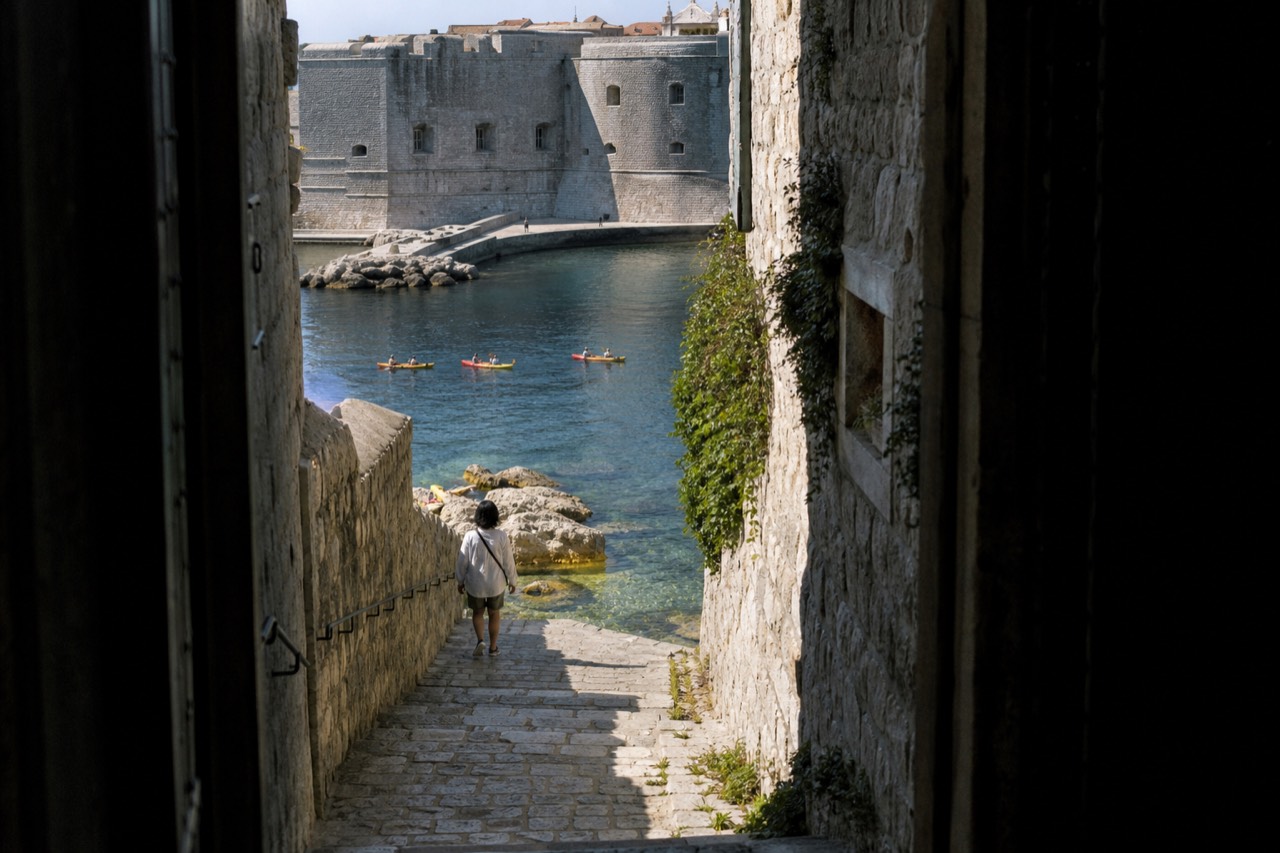
Yes, kayaking in Dubrovnik is worth it. Guided tours start at $35 per person, the best-reviewed run at 4.9 across 4,286 reviews, and the water is warm enough to swim from roughly June through September, with a September average of about 23.6 degrees. The classic route paddles below the city walls to Betina Cave and around Lokrum.
Kayaking in Dubrovnik is the rare activity that doubles as sightseeing. You launch from a beach beside the old city, paddle under Fort Lovrijenac standing on its 37-metre sea rock, drift past swimming spots cut into the cliff, and look up at the walls from the water. I have walked this coastline for a decade and the water-level view still surprises people: the fortifications that feel overwhelming from the Stradun look engineered and almost fragile from below.
This guide answers the four questions readers ask most, in order: whether kayaking here is worth the money, how warm the sea actually is, whether swimming is safe, and what not to do in Dubrovnik generally. Along the way it covers the specific routes, what the guided tours cost and include, and how to pick between them.
Is Kayaking in Dubrovnik Worth It?
For almost every visitor, yes: it is the single best-value way to see the walls, it gets you to a cave beach no vehicle reaches, and the guided tours start at $35 per person with the top-rated option at 4.9 across 4,286 reviews. The only travellers who should skip it are those who cannot swim comfortably or who get seasick in a light swell, and even they have a boat alternative.
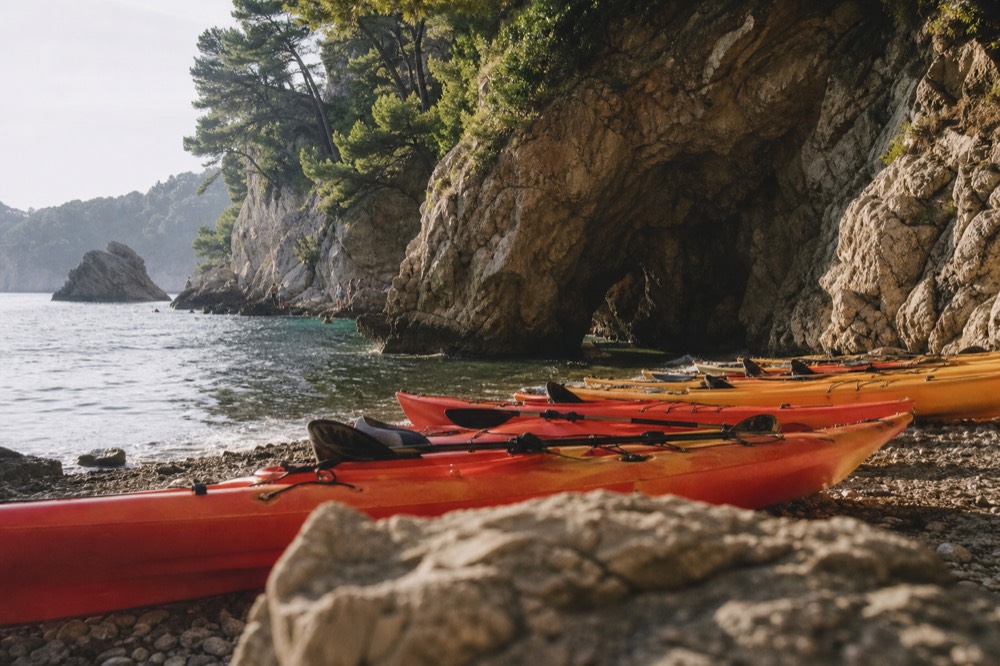
The case for kayaking is partly geography. Dubrovnik's old city sits on a peninsula, so a paddler leaving the small beach at Pile or Betina Cave reaches city-wall scenery within minutes, no transfer needed. The standard circuit runs from Pile Beach past St John's Fortress and around the southern cliffs to Betina Cave, a sea cave with a small pebble beach inside that can only be entered by water. Most tours stop there for a swim and a snorkel.
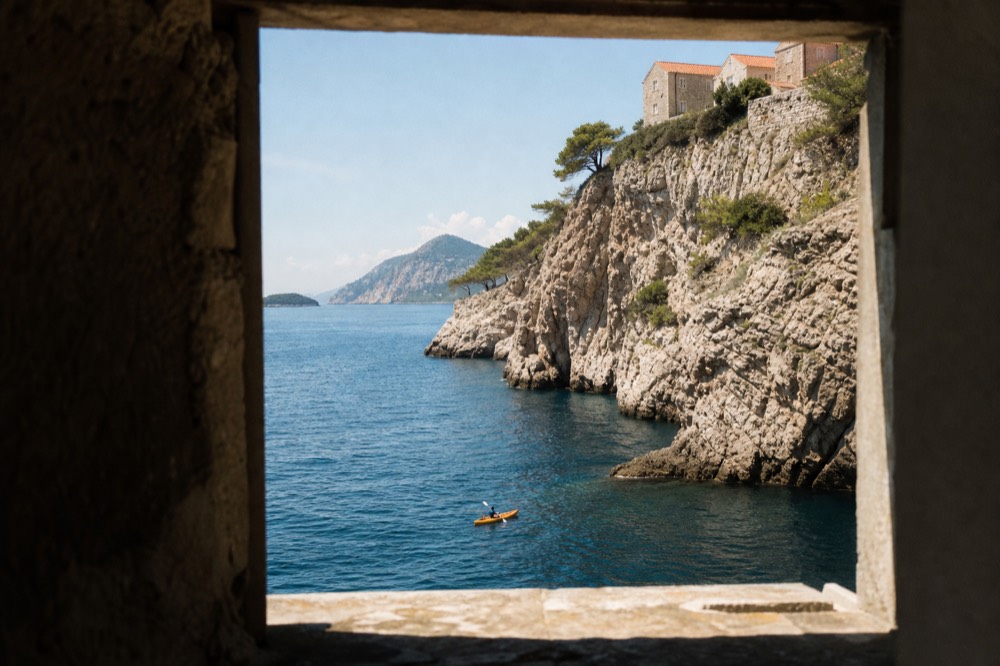
The second classic route crosses to Lokrum, the forested island visible from every terrace in town. Paddlers round the island's rocky south shore, pass the small salt lake and the monastery, and usually stop at a sheltered cove on the way back. A Lokrum entry ticket is 30 euro per person, and the reserve's official schedule runs boats from the City Harbour at 09:00, then every 15 minutes from 10:00 to 18:00, so kayaking there is a way to see the island on your own terms rather than the ferry's.
What you get for your money on a guided tour is equipment, a guide, and local knowledge of wind and swell. The Adriatic here is usually calm in the morning, but the afternoon maestral wind can raise a chop that turns a pleasant paddle into a slog, and guides time the crossings around it. If you would rather go alone, rental operators exist on the Lapad and Pile beaches, but a guided tour is the safer choice for a first visit, and it is often barely more expensive.
| Tour | Length | From (per person) | Rating |
|---|---|---|---|
| Kayak & Snorkel, Day or Sunset | day or sunset departure | $36.50 | 4.9 across 4,286 reviews |
| 2h 30m Kayak & Snorkel Tour | 2 hours 30 minutes | $35 | 4.9 across 3,619 reviews |
| 2-Hour Kayak, Lokrum & Betina | 2 hours | $35.49 | 4.9 across 1,518 reviews |
| Full-Day Elaphite Islands Cruise | 8 hours, boat not kayak | $59.16 | 4.9 across 10,312 reviews |
If you are weighing kayaking against other water activities, start with the two kayak formats and keep the boat cruise as a contrast: the kayak is intimacy and exercise, the boat is distance and lunch. Our overview of the best things to do in Dubrovnik places kayaking in the wider context of a first trip.
The headline tour in that band is the day-or-sunset kayak and snorkel option. It is the most reviewed kayak product in the city, it runs from $36.50 per person, and the sunset departure in particular is one of the three bestselling experiences in Dubrovnik, which matters for planning: in July and August the evening slots fill days ahead. The day version paddles the walls and cave route with a snorkelling stop; the sunset version times the same coastline for golden light on Lokrum.
Is the Sea Warm in Dubrovnik?
Yes, in summer. The long-run average for this coast is 24.9 degrees in July, 25.8 in August and 23.6 in September, from the NOAA OISST 1991 to 2020 climatology. Those are open-water averages, not beach readings: sheltered bays and caves run warmer, and the Croatian met service's own Dubrovnik buoy read 27.0 to 27.4 degrees on 8 September 2026 against that 23.6 September mean.
The honest framing matters here because most websites print one number and call it "the sea temperature". What the verified data actually gives you is a 30-year open-water average for the grid cell containing Dubrovnik, cross-checked against an independent EU dataset that agrees within about one degree (August 24.90, September 23.15). It is a planning figure, not a thermometer promise for your holiday week.
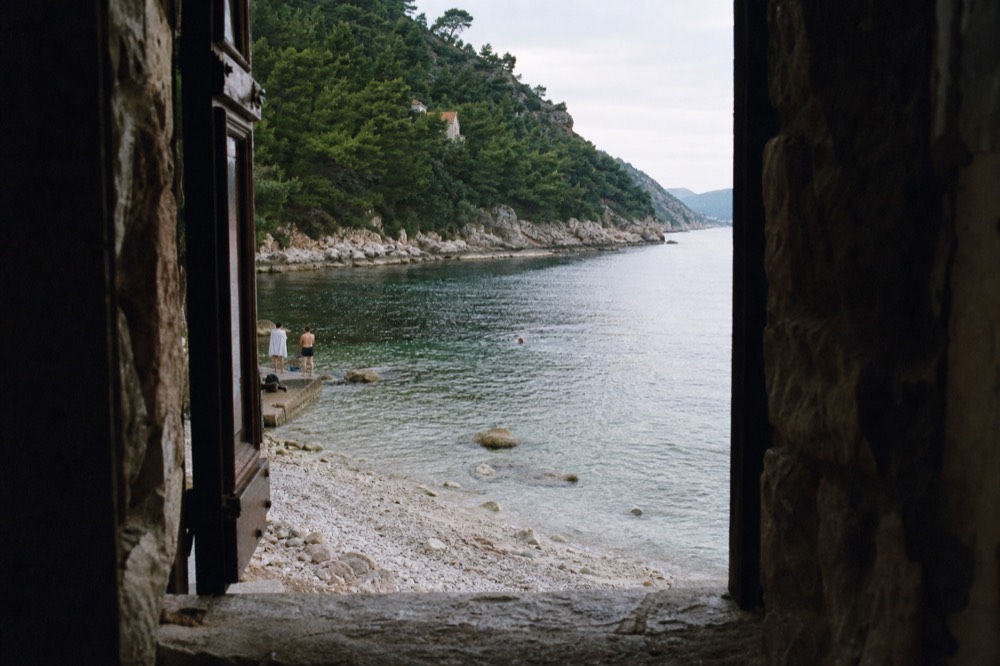
For kayaking the practical reading is this: June through September are comfortable swimming months, May is bearable and bracing, and October at about 21.0 degrees is still fine for a quick dip on a sunny afternoon. The kayak season runs longer than the swimming season because you generate heat paddling; morning tours in late October are often calm, empty and mild even when nobody is swimming.
| Month | Average sea temperature | Kayak and swim verdict |
|---|---|---|
| May | 18.6 | Paddle yes, swim briefly |
| June | 22.5 | Full season begins |
| July | 24.9 | Peak water, peak crowds |
| August | 25.8 | Warmest average of the year |
| September | 23.6 | Best balance of warm water and thinner crowds |
| October | 21.0 | Paddle comfortably, swim on sunny days |
September deserves a special mention, because it quietly beats August for a kayak trip. The water is barely a degree cooler on average, the sea is at its calmest before the autumn winds, and the crush of peak season has passed. There is a second, counter-intuitive reason: cruise passengers in Dubrovnik peaked in September (101,246) and October (100,132) in 2025, above July's 96,072 and August's 87,385, per Port Authority data, but those passengers concentrate inside the walls. On the water, September mornings feel emptier than August mornings.
Is It Safe to Swim in the Sea in Dubrovnik?
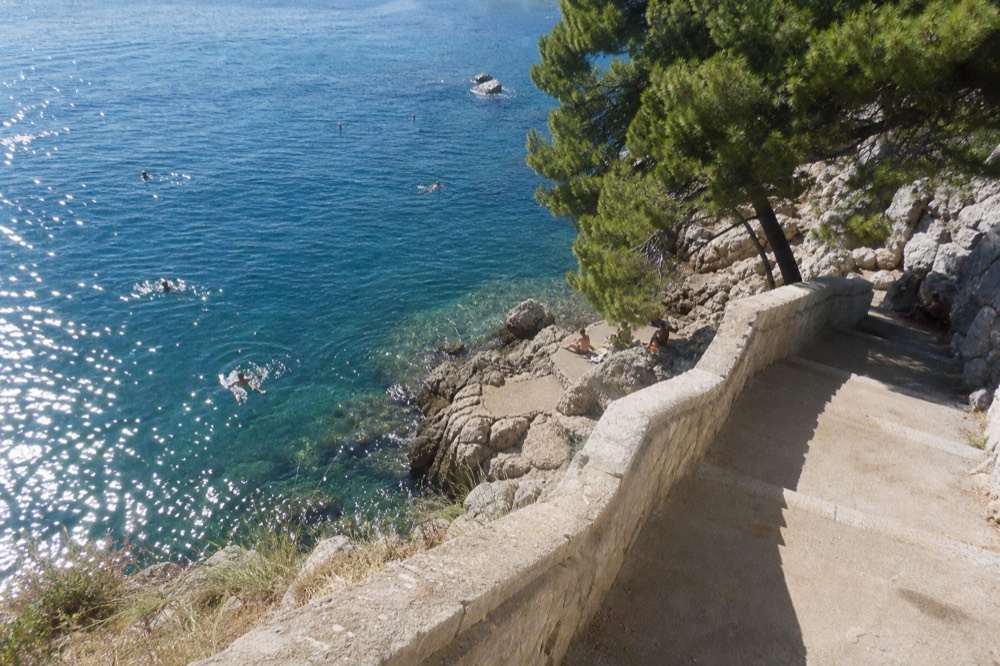
Yes, swimming here is safe for competent swimmers: the water is clean, there is no significant current inside the sheltered bays, and jellyfish are occasional rather than routine. The real risks are smaller and avoidable: sea urchins on rocky bottoms, jet-ski traffic outside the swim zones, cliff jumping at Betina Cave, and afternoon wind pushing an inflatable or a tired swimmer offshore.
Let me take those one at a time, because each has a specific fix. Urchins cluster on rocks and stones rather than sand, so water shoes or simply looking before you step solves almost every case. Jet skis and boats are kept out of the marked swimming areas at the main beaches, but the rule reverses outside them: never swim beyond the buoys, and never assume a boat has seen you. Cliff jumping is the one that sends people to hospital, usually at the caves, where the ledges are higher than they look and the water depth shifts with swell.
For kayakers specifically, the safety picture is about wind and distance, not water quality. The morning is almost always the calmest window; the maestral builds through the afternoon and is strongest in July and August; and the bura, a cold northerly, can arrive fast outside summer and close crossings to Lokrum entirely. Guided tours make the go-or-no-go call for you, which is a genuine part of what you are paying for. If you rent independently, check the forecast, stay close to shore on the crossing legs, and wear the life vest rather than sitting on it.
Swimming from a kayak is one of the best parts of the day, and the cave stops are chosen precisely because they are sheltered and shallow enough to stand in places. The general swimming-season picture, month by month, is covered in detail in our guide to the swimming season in Dubrovnik.
One point on supervision: children are welcome on most kayak tours, typically in a double kayak with an adult, and the operators provide child-size vests. The 2-hour Lokrum and Betina Cave route is the gentlest introduction, since most of it stays in sheltered water and the swim stop is inside the cave. The tour runs from $35.49 per person and is rated 4.9 across 1,518 reviews, and one recent review captures exactly what families find:
Loved this kayaking experience. Had an amazing time as a family and enjoyed the swimming break at Betina Cave very much. The views were amazing, water was crystal clear, the guide was excellent and we learnt a lot about Dubrovnik.
Imara_D
Where Exactly Do the Kayak Routes Go?
There are three main routes: the walls-and-cave circuit from Pile Beach to Betina Cave and back, roughly a half-day; the Lokrum crossing from the old port or a Lapad beach around the island's south shore; and longer coastal paddles west toward the Babin Kuk peninsula and Copacabana Beach. Almost every guided tour is a version of the first two.
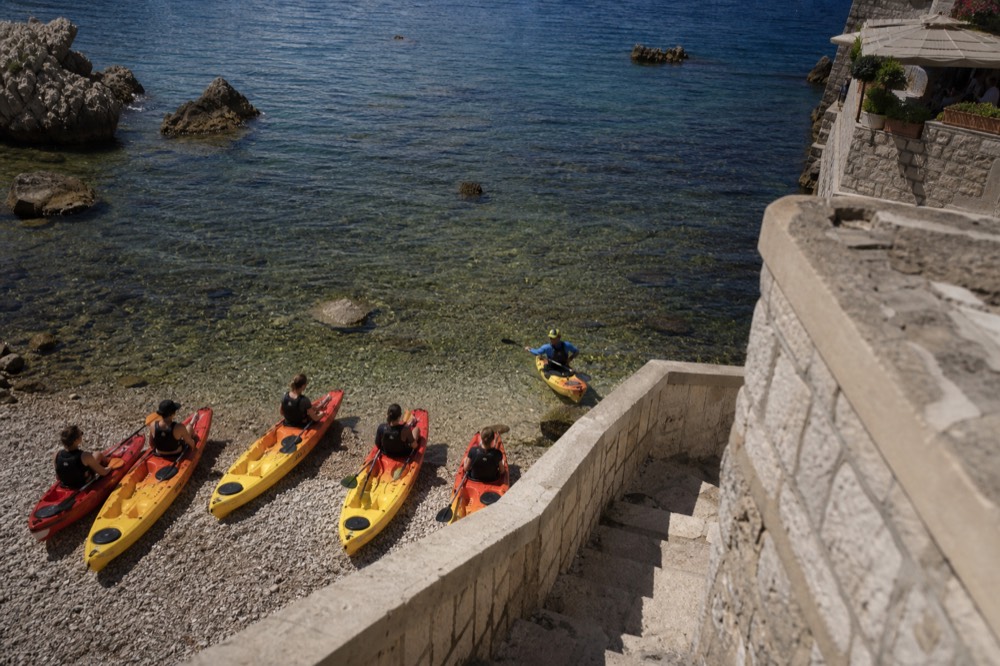
The walls circuit is the signature. You launch at Pile, underneath the Lovrijenac side, and paddle east along the city walls, past the Buža bar's cliff terrace and St John's Fortress, then continue around the southern cliffs to Betina Cave. The cave's interior beach is small and fills with tour groups by late morning, which is why the first departures of the day are the pleasant ones. The return leg hugs the same cliffs with the old city behind you.
The Lokrum route starts from the old city port or from the beaches east of Ploče and crosses open water to the island. The crossing is the part that demands respect: it is exposed to any wind from the south, and the return leg is usually into whatever has built up by afternoon. Guided versions time it for the morning, circle the island, stop at a cove, and come back before the wind arrives. Independent paddlers should do the same. Our full Lokrum Island guide covers what is on the island itself, from the botanical gardens to the fortress viewpoint.
| Route | Start point | Highlights | Best conditions |
|---|---|---|---|
| Walls and Betina Cave | Pile Beach | Walls from the water, St John's Fortress, cave swim | Morning calm, any month May to October |
| Lokrum circuit | Old port or Ploče beaches | Open-water crossing, island cliffs, cove swim | Early start, light maestral only |
| West coast paddle | Lapad Bay | Pine-backed coves, Copacabana Beach, calm shallows | Beginner-friendly, family route |
The west coast option is underrated. Lapad Bay and the peninsula beyond it hold the calmest, shallowest water near the city, backed by pine shade, and a paddle from there toward Copacabana Beach is the route I would point a nervous beginner or a family with small children toward. You trade the walls backdrop for quiet water and easy swimming, and on a hot August afternoon that is often the better trade.
How Much Does a Kayak Tour Cost and What Is Included?
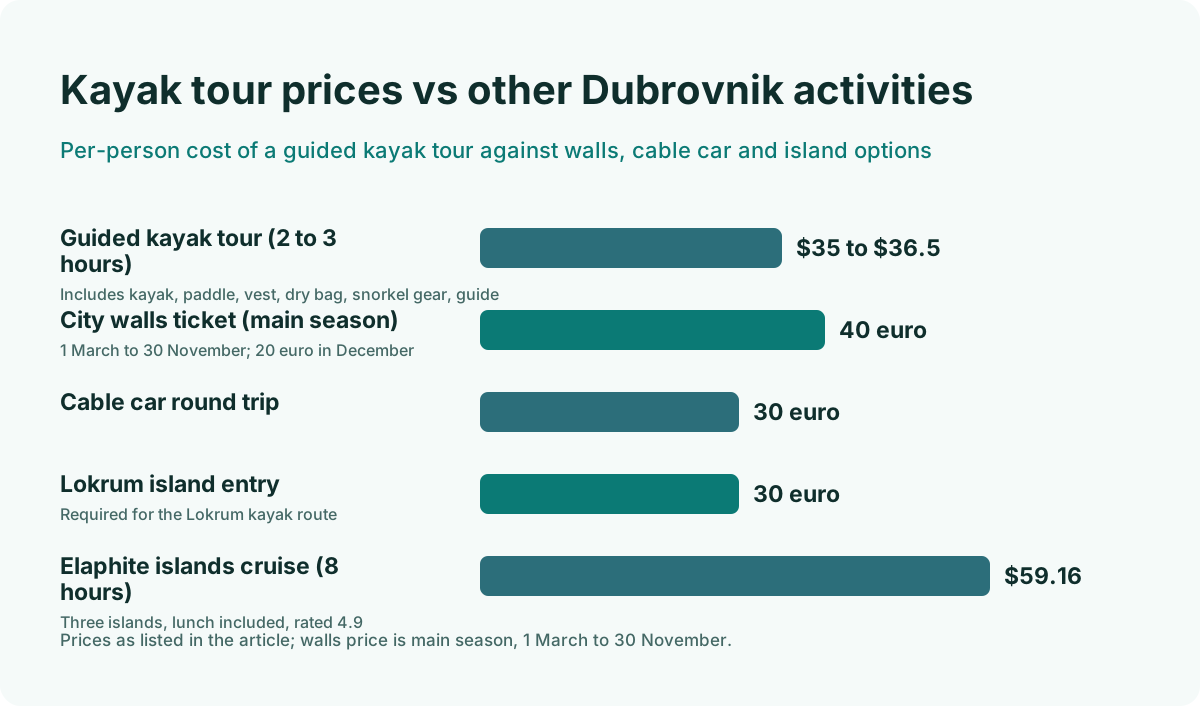
Guided kayak tours in Dubrovnik run from $35 to $36.50 per person for the standard two-to-three-hour circuits, all of them including the kayak, paddle, life vest, dry bag, snorkelling gear and a guide. That price band is tight because the product is commoditised: the differences that matter are departure time, group size and route, not price.
What you should check on the live listing before booking is three things. First, the departure window: day tours leave mid-morning, sunset tours leave in the late afternoon, and they are genuinely different experiences rather than the same trip at a different hour. Second, group size: some operators run 20-plus kayaks in a flotilla, others cap at a dozen, and the smaller trips cost the same on paper but feel completely different on the water. Third, the swim stop: some itineraries include it, some make it weather-dependent, and if swimming in Betina Cave is the reason you are booking, say so in advance.
Against the cost of everything else in Dubrovnik, the kayak tour is one of the few mid-priced activities that delivers scenery you cannot otherwise reach. For comparison, the adult city walls ticket is 40 euro in main season, 1 March to 30 November, and drops to 20 euro in December; the cable car round trip is 30 euro; a Lokrum ticket is 30 euro. A kayak tour that shows you the walls, the cave and Lokrum's shoreline in one morning sits right in that band, with a swim included.
| Item | Price | Notes |
|---|---|---|
| Guided kayak tour, standard circuit | from $35 to $36.50 | Equipment, guide and snorkel stop included |
| City walls adult ticket | 40 euro | Main season, 1 March to 30 November; 20 euro in December |
| Cable car adult round trip | 30 euro | Child 4 to 12 round trip 8 euro |
| Lokrum ticket | 30 euro | Includes reserve entry and return boat transfer |
If your budget stretches further and you want a full day on the water rather than two hours of it, the crossover product is the Elaphite islands cruise: eight hours, three islands, lunch included, from $59.16 per person, rated 4.9 across 10,312 reviews. It is not kayaking, but it answers the same urge, and a review from a recent guest describes the trade well:
This was a wonderful day. Nice and shaded on the boat as we cruised on the cool adriatic. Loved seeing the neat Elphiti Islands and a wonderful way to get out the the heat and large crowds for a bit. They kept the drinks flowing and lunch was phenomenal and a generous portion. This is the way to cruise the Adriatic.
Shelby_S
What Not to Do in Dubrovnik?
The mistakes that cost visitors most: walking the walls at midday in July, booking nothing in advance in high season, swimming outside marked zones near boat traffic, stepping barefoot on rocky coves, and assuming August is the busiest month. September and October actually lead for cruise passengers, and the old city's official carrying capacity is 11,275 people, counted by six entrance counters updating every 15 minutes.
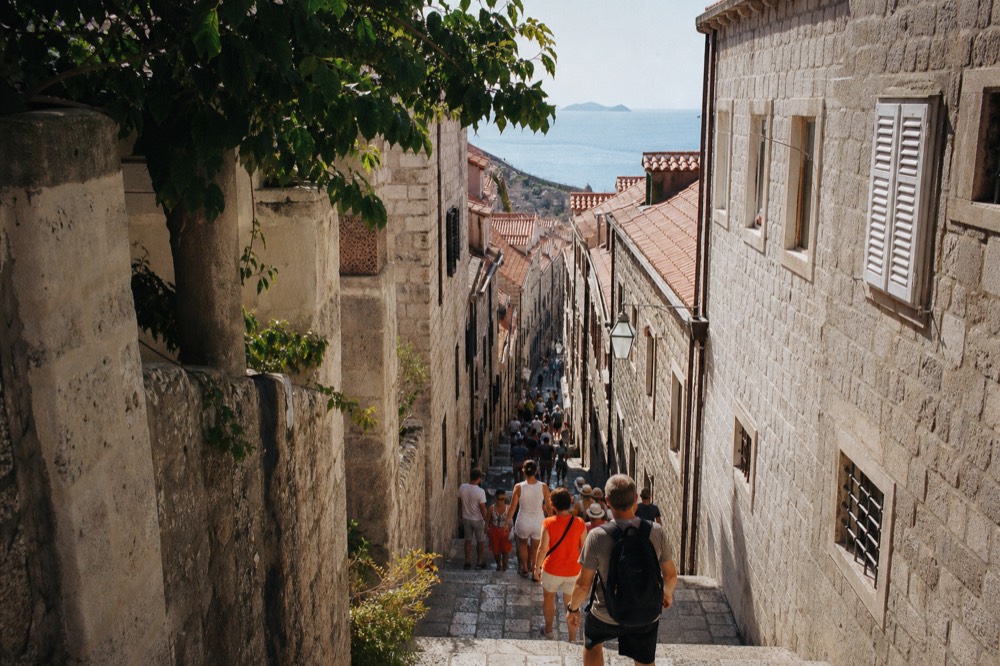
Some of these deserve a plain explanation. The walls walk is exposed stone with almost no shade, and the operator's stated hours run 08:00 to 19:30, so the first and last two hours are the humane ones. Midday in July and August, the stone radiates heat and the queue at the Pile entrance moves slowly. The same logic applies to kayaking: morning calm beats afternoon heat and wind on every count.
Booking late is the second expensive mistake. Sunset kayak slots, the walls time slots and the best small-group tours are the things that sell out first, and in peak weeks they sell out days ahead. The free-cancellation terms on most live listings mean early booking costs you nothing if plans change, which is why I tell people to reserve the two or three headline activities before they fly and leave the rest to mood.
The third group of mistakes is water etiquette. Do not feed fish or leave litter at the caves, do not anchor or beach a kayak inside the cave when a tour group is swimming, and do not touch or stand on the coral and urchin-covered rocks barefoot. On land, the equivalent mistakes are eating on the Stradun at peak prices when the side streets ten minutes away are better and cheaper, and treating the whole city as a photo set: the Old Town is a UNESCO World Heritage Site, inscribed in 1979, covering 24.7 hectares, and it is also where people live and work.
| Mistake | Why it hurts | Do this instead |
|---|---|---|
| Walls or kayaking at midday in July and August | Exposed stone, heat, biggest crowds | First slot after 08:00 or the evening slot |
| Booking tours on arrival in high season | Sunset kayak and small-group tours sell out days ahead | Reserve headline activities before flying, free cancellation applies |
| Swimming past the buoys | Jet ski and boat traffic outside marked zones | Stay inside the markers, use a bright swim cap on crossings |
| Barefoot entry on rocky coves | Sea urchins cluster on stone | Water shoes, or look before stepping |
| Cliff jumping at the caves | Ledges higher than they look, depth shifts with swell | Swim and snorkel instead |
A note on the crowd numbers, because they reshape itineraries. The official carrying capacity for the old city is 11,275 people, from the UNESCO carrying-capacity assessment, and a real half-hourly curve read on 8 September 2026 shows how the day builds: 5,419 people at 08:00, 7,297 at 09:00, a 7,739 peak at 10:00, then 7,205 by 11:00. The old city is emptiest before 09:00 and after 18:00, which is exactly when the water is calmest too. The official visitors platform publishes the live counts, and checking it the evening before is the single best planning habit you can adopt.
When Is the Best Time of Day and Year to Kayak?
Morning, almost without exception: the sea is calmest before the maestral wind builds, the caves are emptiest before the tour flotillas arrive, and the light on the walls is best before noon. For the time of year, late June and September are the sweet spots, combining water at 22.5 and 23.6 degrees respectively with smaller crowds than August.
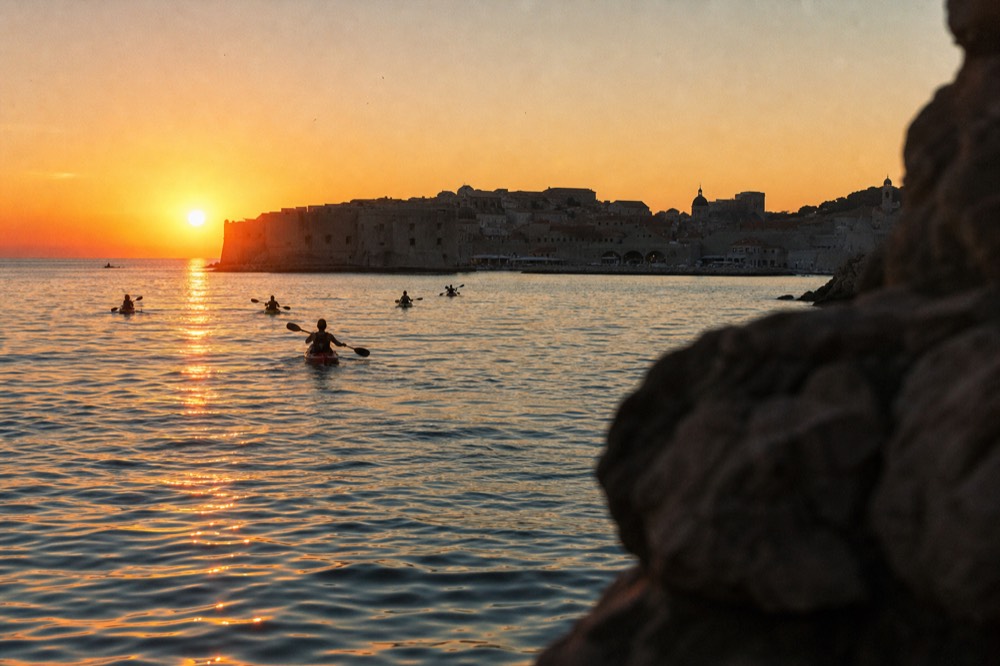
The sunset departure is the exception that proves the morning rule. It works because the wind that makes afternoon paddling hard typically eases again in the last hour before dusk, and the operators time the route so the hard legs happen before the golden hour. You trade the cave swim's clarity for the sight of the walls going orange, and for many people that is the better trade; sunset kayak tours sit in the top three bestselling experiences in Dubrovnik for a reason.
Month by month, the choice looks like this. May is calm and quiet with water at 18.6 degrees, fine for paddling, brisk for swimming. June at 22.5 is the first full-comfort month. July and August are the warmest water of the year at 24.9 and 25.8, but also the busiest launch beaches and the strongest afternoon wind. September at 23.6 is the month I would choose myself: warm water, calm mornings, thinner crowds, and the whole city still fully open. October at 21.0 still gives good paddling, especially in the first half of the month, with empty coves and mild air.
If kayaking is one part of a bigger water plan, the choice surface is wider than it first looks: the kayak routes for intimacy, the boat cruises for distance, the zipline for the view from above. Our overview of the best things to do in Dubrovnik sorts them all, and the deeper planning questions, from how many days to stay to how the pieces fit together, are covered across Things to Do in Dubrovnik.
Common Questions About Kayaking in Dubrovnik
Is Kayaking in Dubrovnik Worth It?
Yes. Guided tours start at $35 per person, the best-reviewed option is rated 4.9 across 4,286 reviews, and kayaking is the only way to reach Betina Cave's interior beach and see the walls from the water. It suits most fitness levels since the standard circuits are short and sheltered.
Is the Sea Warm in Dubrovnik?
In summer, yes. The long-run averages are 24.9 degrees in July, 25.8 in August and 23.6 in September, from the NOAA 1991 to 2020 climatology. These are open-water averages rather than beach readings, and sheltered bays and caves run warmer: the Dubrovnik buoy read 27.0 to 27.4 degrees on 8 September 2026 against a 23.6 September mean.
Is It Safe to Swim in the Sea in Dubrovnik?
Yes for competent swimmers. The water is clean and the marked bays have no significant current. The avoidable risks are sea urchins on rocky bottoms, boat and jet-ski traffic outside the buoys, cliff jumping at the caves, and afternoon wind pushing tired swimmers or inflatables offshore.
What Not to Do in Dubrovnik?
Do not walk the walls or kayak at midday in July and August, do not leave headline tours unbooked in high season, do not swim outside marked zones, and do not assume August is the peak: cruise passengers actually peaked in September (101,246) and October (100,132) in 2025, ahead of July and August.
Do You Need Experience to Join a Kayak Tour?
No. The standard tours use stable sit-on-top doubles and singles, brief everyone on shore first, and stay in sheltered water with a guide leading. The 2-hour Lokrum and Betina route is the gentlest option, and children normally ride in a double with an adult.
What Should You Bring on a Kayak Tour?
Swimwear worn under quick-drying clothes, a hat, sunglasses with a strap, reef-safe sunscreen applied before launch, water shoes for rocky entries, and a dry bag if you have one, though operators provide one. Bring a bottle of water; the afternoon departures are hot work even with a swim stop.