What Local Food Should I Try in Dubrovnik?
The local dishes, wines and street food worth eating in Dubrovnik, from black risotto and peka to Ston oysters and Plavac Mali, with where to find each one.
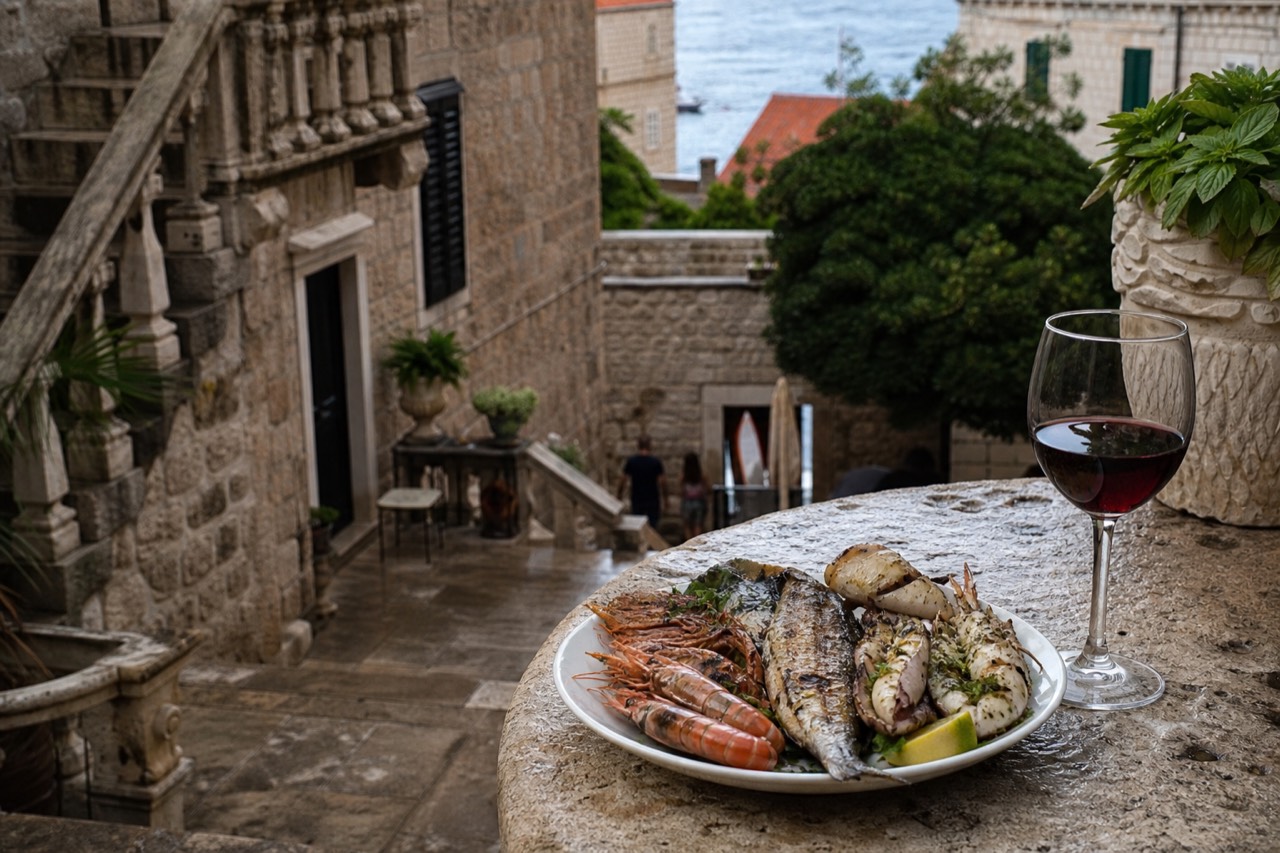
What Local Food Should I Try in Dubrovnik?
The short list is black cuttlefish risotto, grilled white fish, peka (meat or octopus slow-cooked under a baking bell), Ston oysters, Dalmatian prosciutto and cheese with olives, rozata for dessert, and a glass of Plavac Mali or Dingač red alongside. That is the core of the local table, and every one of those items is findable within a short walk of the Stradun.
I have walked these streets with travellers since 2015, and the question I get most often after "where is the wall entrance" is "what should I actually eat here." The honest answer is that Dubrovnik rewards ordering the way locals order: whatever the boat brought in that morning, cooked simply, with olive oil and salt and not much else. The city sits at the southern end of Dalmatia, close enough to the Pelješac peninsula and the oyster beds of Ston that its kitchen borrows from both, and its restaurant scene is built around a walled Old Town of just 24.7 hectares, so the good kitchens are dense and walkable rather than scattered.
The one mistake I see repeatedly is visitors defaulting to the terrace restaurants nearest the gates at peak dinner hour, paying premium prices for grilled meat platters that could be anywhere on the Mediterranean. Walk two streets in from the Stradun, the 298-metre limestone main street whose final plan was fixed by the 1272 Statute, and the character of the menus changes fast. Konoba names appear, the word "jela ispod peke" shows up on specials boards, and the wine lists start naming villages rather than grapes.
There is also a rhythm to eating here that is worth learning on your first evening. Lunch is the lighter meal of the day, often a plate of prosciutto and cheese or a simple pasta, and dinner starts late, with kitchens filling from 20:00 onward and staying busy past 22:00. Bakeries open early and sell out of the good savory pastries by mid-morning, and the fish market at Gruž is at its best before 09:00, when the day's catch is still being laid out. Plan around those rhythms rather than against them and the food gets better without spending more.
Food is also the one part of a Dubrovnik trip where a guided experience genuinely changes what you notice afterwards. A guide who knows the back streets will point out which bakeries locals actually queue at, which konoba makes its own olive oil, and why the same dish tastes different two streets apart. The three options below are the strongest food and wine experiences on the roster, and they cover three different formats: a walking food tour of the Old Town, a half-day wine tasting in the Konavle valley, and a full oyster-and-mussels lunch up the coast in Ston.
If you would rather plan it yourself, the rest of this page walks through the dishes one by one: what each one is, when to order it, and what a fair version tastes like. Start with the question underneath all the others.
Is the Food in Dubrovnik Good?
Yes, genuinely good, with one large caveat about price. The raw materials are excellent: daily-caught Adriatic fish, shellfish from nearby beds, olive oil and wine from the surrounding region, and a tradition of cooking them simply. The variable is not the kitchen, it is which table you pick, because the highest-rent terraces nearest the gates do not have to be great to stay full.
The baseline quality here is high because the supply chain is short. Fish comes off boats into the market at Gruž and onto grills the same day, and the olive oil on a decent table is usually pressed within an hour's drive. Dalmatian cooking is deliberately restrained: fish grilled over olive wood or vine cuttings, salt, parsley, lemon, chard or Swiss chard with potatoes blitva style, and almost no sauce anywhere. If that style suits you, Dubrovnik eats very well. If you want complex sauces and elaborate plating, this is the wrong city for it.
That restraint is a philosophy, not laziness. The reasoning in every good kitchen here is that the fish spent years in clean Adriatic water and the oil came off a family's own trees, so the cook's job is to stay out of the way. It also means the gap between a great meal and a mediocre one is smaller than in sauce-driven cuisines: the ingredients are the same, and what varies is freshness, the fire, and whether the kitchen bothered to source properly. Which is exactly why the choice of address matters so much here.
The price complaint is real, and it is worth being blunt about. Dubrovnik recorded about 4.2 million overnight stays in 2025, sharing first place among Croatian destinations with Rovinj, according to the Croatian Bureau of Statistics. That volume, packed into a small walled city with a resident population of 41,562 at the 2021 census, pushes restaurant rents and menu prices to some of the highest in Croatia. A fish main in the Old Town can cost double what the same plate costs in a Konavle village. The food is good; the value is something you manage by choosing streets and meal times carefully.
Timing matters almost as much as location. The Old Town's foot traffic is counted by six counters at every entrance, updating every 15 minutes, and on a sample September day the count climbed from 5,419 at 08:00 to a 7,739 peak at 10:00. Dinner crowds thin after 21:00, and kitchens are calmer, so eating slightly late is the single easiest way to get better service and a table away from the thoroughfare. The Things to Do in Dubrovnik homepage covers crowd timing in more depth if you are planning around it.
For travellers who want the shortcut, the food tour is the most efficient way to taste a lot of this in one evening, and the reviews are unusually strong: rated 5 across 704 reviews, from $165.64 per person, running about 3 hours with a local guide.
What Food Is Dubrovnik Known For?
Dubrovnik is known for fresh grilled Adriatic fish, black cuttlefish risotto, Ston oysters, Dalmatian prosciutto and sheep cheese, peka cooked under a bell, and the Plavac Mali and Dingač red wines of nearby Pelješac. Seafood leads, but the cured meats, olive oil and desserts hold their own, and the oyster beds at Ston are close enough for a lunch trip.
Here is the dish-by-dish version, the list I would hand a friend arriving tomorrow. Each of these is a local staple, not a tourist invention, and each appears on menus across the city.
| Dish or drink | What it is | How to order it well |
|---|---|---|
| Black risotto (crni rižot) | Rice cooked with cuttlefish and its ink, deep black, savory and slightly sweet | Ask if the cuttlefish is fresh; a good version takes 25 minutes or more to cook |
| Grilled fish | Whole white fish, usually priced per kilogram, grilled with olive oil, lemon and parsley | Check the per-kilo price before ordering; sea bass, sea bream and dentex are the staples |
| Peka | Meat, octopus or lamb slow-cooked under a domed baking bell with potatoes and vegetables | Almost always needs ordering hours ahead or the day before, since it cooks for hours |
| Ston oysters | European flat oysters farmed in the beds at Ston on the Pelješac peninsula | Best eaten raw with lemon, within a day of being harvested |
| Dalmatian prosciutto and cheese | Air-dried ham with sheep cheese, olives and olive oil, the standard starter plate | The plate should be simple; heavy garnish is a sign of a kitchen trying too hard |
| Blitva | Swiss chard stewed with potatoes and olive oil, the standard fish side | Order it instead of chips with any grilled fish |
| Rozata | A local custard pudding with caramel, the classic Dubrovnik dessert | Best in old-school konoba kitchens rather than gelaterias |
| Plavac Mali and Dingač | Full-bodied red wines from the Pelješac slopes; Dingač comes from the steepest protected vineyards | Order by the glass at dinner or visit a tasting room; both are covered in our guide to Plavac Mali wine |
A few of these deserve expansion. Peka is the dish most visitors regret not planning for, because it cannot be cooked to order in twenty minutes. The bell is set over coals, the food cooks for hours, and a konoba that offers it will usually ask you to commit the day before. The version with octopus is the coastal classic, but lamb peka is the celebration dish locals order for family Sundays. If your accommodation is self-catering, some operators will even cook one for you at a village house, and there is a proper cooking lesson on the roster too: the Croatian Traditional Cuisine Peka Cooking Lesson runs about 4 hours from $159.83 per person.
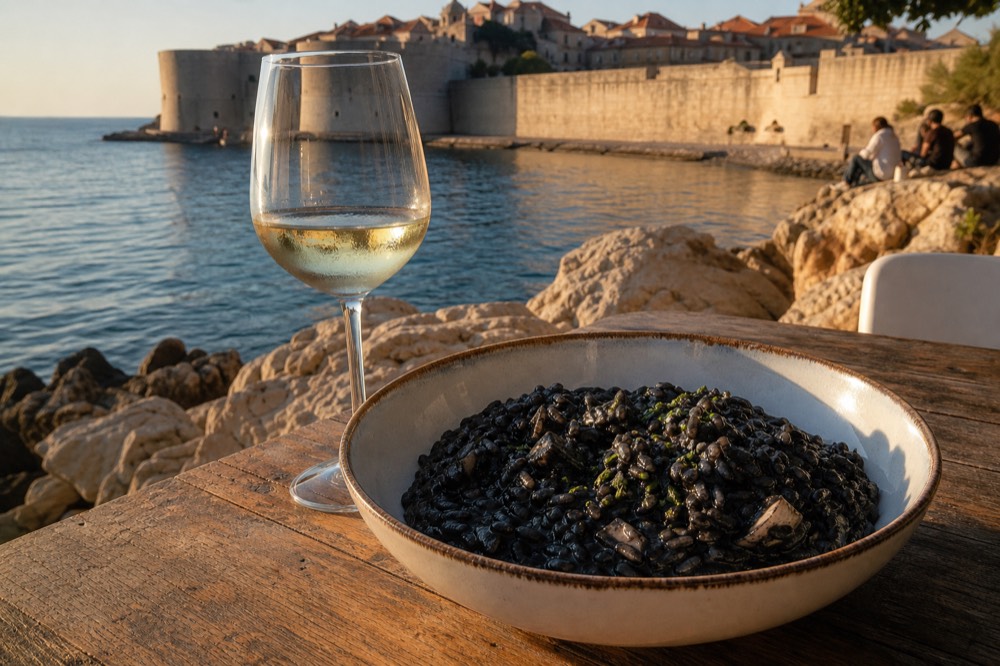
Black risotto is the other dish worth understanding before you order it. The colour comes entirely from the cuttlefish's own ink, released during cooking, and there is no shortcut version that tastes right. A kitchen using fresh cuttlefish will happily tell you the risotto takes longer, because the rice needs to absorb the stock slowly. If a place promises black risotto in ten minutes, the ink came from a packet and you are in the wrong restaurant. Order it with a glass of the local white and a view of the harbour and you have the definitive Dubrovnik lunch.
The oysters deserve their own sentence or three. Ston sits on the Pelješac peninsula, and its beds have supplied this coast for as long as anyone here can point to. Oysters there are eaten standing at the quay, shucked in front of you, with nothing but lemon, and the difference between one shucked an hour after harvest and one that travelled is the difference between two different foods. Our Ston oysters guide covers the trip in detail, and there is also a bookable version: the oyster, mussels and wine tasting tour in Ston with lunch runs from $157 per person, rated 4.9 across 111 reviews.
For the Old Town itself, the food and drink walking tour remains the best single introduction, because it stitches five or six of these dishes into one evening with the stories behind them.
One guest review captures the format well:
Amazing food tour! Marija was a great guide, full of stories and facts that really brought Dubrovnik to life. The food was delicious, and generous. Wines at every stop. Would highly recommend this tour to anyone visiting Dubrovnik, especially to help get your bearings of the city and know where to go for dinner!
Bryan_M
What Food Is Dubrovnik Famous For?
The items with genuine fame beyond Croatia are Ston oysters, black risotto, peka, and the wine names Dingač and Plavac Mali, plus the konoba tradition of family-run stone taverns. Dubrovnik's fame is really regional fame: the city is the dining room for the produce of Pelješac, Konavle and the Adriatic, and the famous items all come from within an hour of the walls.
Fame and known-for overlap, but they are not the same thing. Black risotto is what everyone orders because it photographs dramatically; peka is what locals order for celebrations; the oysters are what food writers travel for. The wines are the quiet one. Dingač, from the steep southern slopes of Pelješac, is Croatia's most historically protected red wine name, made from Plavac Mali grapes grown on terraces so steep that a century ago the harvest was hauled up by rope and pulley, and it pairs with the grilled fish and lamb here better than most visitors expect a big red to.
The konoba is the institution that ties it together. The word means tavern, and a real konoba is family-run, often with the family's own olive oil and wine on the table, stone walls, check cloths optional, and a menu that changes with the catch. Some of the best are a bus or short drive outside the walls, in Lapad, Konavle or up the coast, which is exactly why our konoba guide is worth a read before you book anything. Inside the walls, expect konoba-style kitchens with higher prices and the same core dishes.
| Where to eat | Typical strength | Trade-off |
|---|---|---|
| Old Town konoba, two streets off the Stradun | Walkable, atmospheric, full dish range | Highest prices in the region |
| Gruž and the market area | Local pricing, freshest supply chain | Less atmosphere, few tourist menus in English |
| Lapad bay restaurants | Seafront tables, good grilled fish | A bus or 30-minute walk from the walls |
| Konavle valley taverns | Own-produce oil, wine and peka | Needs a car, taxi or booked tour |
| Ston and Pelješac | Oysters at the source, wine cellars | A day trip, about an hour each way |
Wine deserves more than a table row. The Konavle valley, the green agricultural plain just southeast of the city, is where Dubrovnik's restaurants get much of their produce, and its family wineries pour for visitors daily. Our wine tasting guide covers the full regional picture if you want to go deeper on Pelješac and Dingač.
Olive oil is the third pillar and the one nobody plans for. Konavle and Pelješac both press excellent oil, and many konoba tables will have a bottle of the family's own in front of you before you order. Taste it on its own with bread before it meets anything else: a good local oil is grassy and peppery at the back of the throat, and once you can recognise it, you will notice which kitchens are pouring supermarket oil and which are pouring their own. It is the cheapest possible way to raise your standards for the rest of the meal.
What Should I Not Miss in Dubrovnik?
Food-wise, do not miss oysters at Ston, one peka ordered in advance, black risotto made from fresh cuttlefish, a glass of Dingač with a view, and a morning coffee on the Stradun before the crowds build. Beyond food, the city walls, Fort Lovrijenac on its 37-metre sea rock, and a boat out to the Elaphiti islands are the essentials, and the food and the sights combine naturally into one or two days.
The coffee ritual is the one thing visitors skip and locals never do. Mornings on the Stradun before 09:00 are a different city: the count on a sample September day read 3,139 at 07:00 against a 7,739 peak at 10:00, and the difference is audible. Order a coffee, take the paper or the phone, watch the stone wake up, and you have done the most local thing on this page. The Dubrovnik Tourist Board's page on the Placa has the history of the street if you want it.
For the not-miss list with forks involved, I would rank it: oysters at the source in Ston, because the trip is short and the payoff is the single best bite on this coast; a peka booked a day ahead, because you cannot improvise it; and a proper konoba dinner with grilled fish and blitva, because that is the everyday table. Layer the walls walk on top, ideally at 08:00 opening when the operator's stated hours run 08:00 to 19:30, and you have the core of a perfect two days. Our two days in Dubrovnik itinerary sequences exactly this, and the what to eat guide goes deeper on ordering.
One timing note that surprises almost everyone: September and October are the busiest cruise months, not July and August. Port Authority data shows cruise passengers peaked in September at 101,246 and October at 100,132 in 2025, above July's 96,072 and August's 87,385. If you are eating your way through the Old Town in early autumn, book the dinner table and the food tour ahead rather than walking in. The same applies to the Ston oyster quay on days when several ships are in port, because the excursion buses head up the coast too.
That tour is the most complete single food day available from the city: oysters and mussels at the beds, wine alongside, and lunch built in, from $157 per person and rated 4.9 across 111 reviews. If wine rather than shellfish is your priority, the Konavle tasting is the shorter, softer option.
Common Questions About Local Food in Dubrovnik
What local food should I try in Dubrovnik?
Black cuttlefish risotto, grilled whole fish with blitva, peka ordered a day ahead, Ston oysters, Dalmatian prosciutto and sheep cheese, rozata for dessert, and a Plavac Mali or Dingač red wine alongside. That list covers the whole local table, and every item is available within the Old Town or a short trip from it.
Is the Food in Dubrovnik Good?
Yes. The raw ingredients, daily fish, local olive oil and nearby wine, are excellent and cooked simply. The variable is price and table choice: restaurants nearest the gates charge the most, so walk two streets in and eat slightly later for the best balance of quality and value.
What Food Is Dubrovnik Known For?
Grilled Adriatic fish, black risotto, peka under a baking bell, Ston oysters, Dalmatian prosciutto and cheese, blitva as the standard side, rozata as the classic dessert, and the Plavac Mali and Dingač red wines of Pelješac.
What Food Is Dubrovnik Famous For?
Ston oysters carry the widest fame, followed by black risotto, peka, and the Dingač wine name. The konoba tradition of family-run stone taverns serving their own oil and wine is the institution behind all of them.
Do I Need to Book Restaurants in Dubrovnik?
In the main season, yes, for any dinner table you specifically want, especially in September and October, which are the busiest cruise months of the year. For peka, booking a day ahead is not a recommendation, it is a requirement, because the dish cooks for hours under the bell.
What Should I Eat on a Budget in Dubrovnik?
Bakery pastries in the morning, a prosciutto and cheese plate as a light lunch, and konoba kitchens away from the Stradun for dinner. The Gruž market area prices like a local city rather than a world-famous one, and eating your main meal at lunch rather than dinner often saves money on the same dishes.