How Long Does It Take to Walk Around Dubrovnik Old Town?
A quick guide to walking times in Dubrovnik's Old Town, from a 45-minute stroll to a 2-hour city walls circuit, plus practical tips on crowds, passes, and the best routes.
How Long Does It Take to Walk Around Dubrovnik Old Town?
You can walk the full loop of the Old Town's main streets and alleys in about 45 minutes to an hour at a leisurely pace, but that is a passing glance, and the real experience of the Old Town, including stops at squares, monuments, a coffee break, and a wander through the side streets, easily fills two to three hours and rewards anyone who slows down enough to look up at the stone carvings above the doorways.
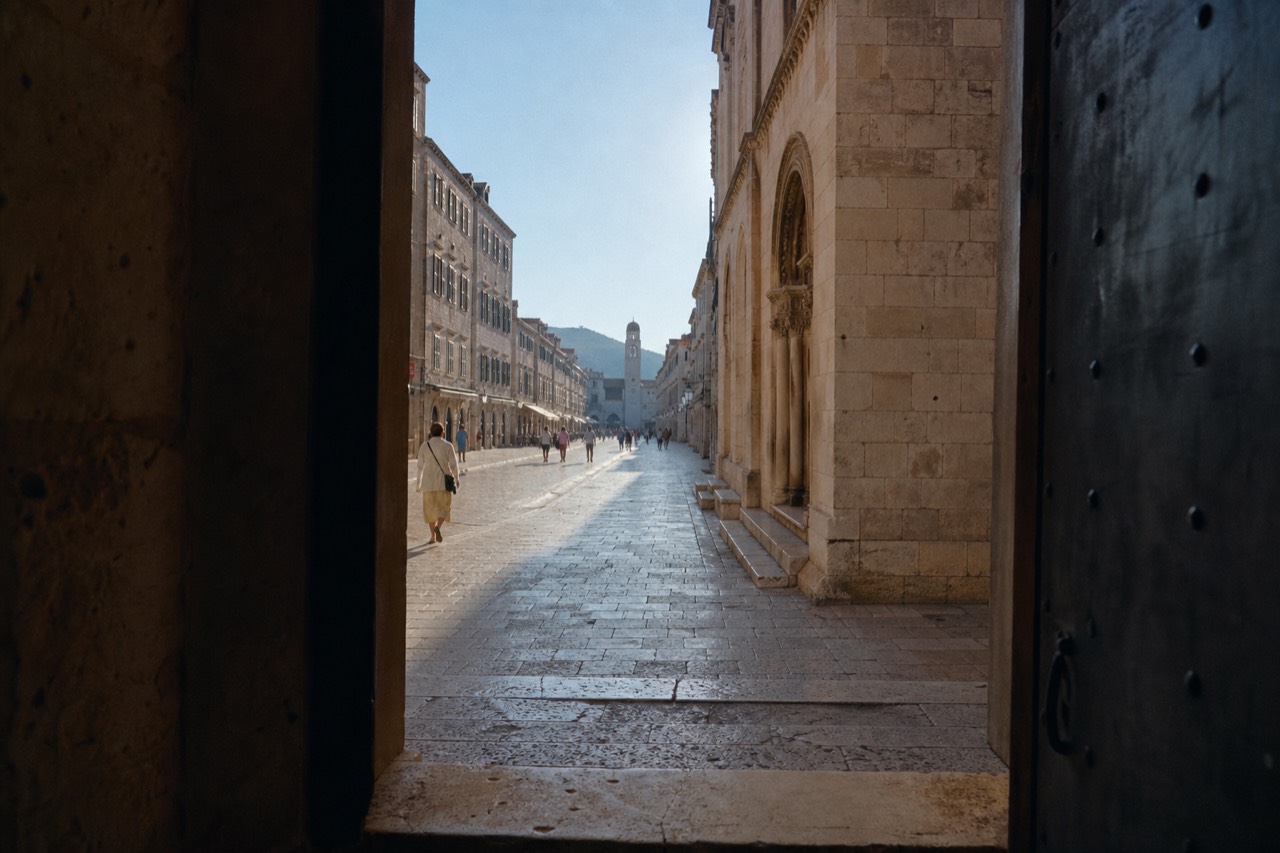
The Old Town is only 24.7 hectares, a UNESCO World Heritage site enclosed by a 1,940-metre ribbon of stone walls. The main pedestrian artery, the Stradun, runs 298 metres from Pile Gate to Luža Square, and you can cover that stretch in about five minutes. But Dubrovnik's Old Town is not a single straight line. It is a grid of narrow limestone alleys, steep staircases, and hidden courtyards that reward whoever slows down. Most first-time visitors spend at least two hours walking the Old Town without ever climbing the walls, and that is before you factor in a stop at a café, a museum, or a look inside the Rector's Palace. The limestone paving, polished smooth by centuries of footsteps, is part of the experience itself, and the way the light shifts across the Stradun in the early morning is one of the quiet pleasures of being here before the crowds arrive.
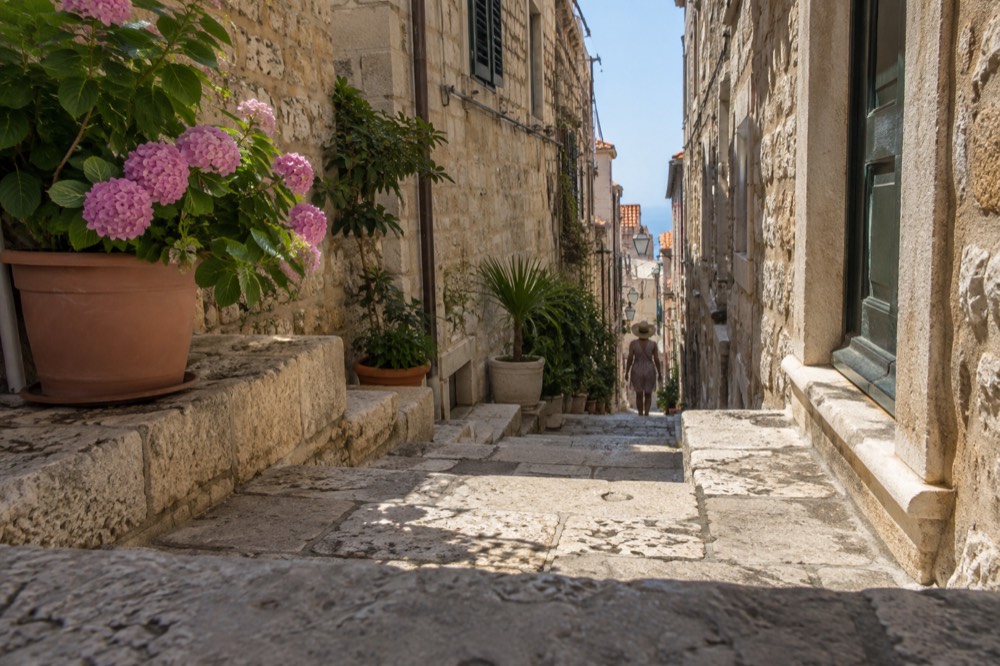
The quickest way to experience the Old Town on foot is to enter at Pile Gate, walk the Stradun to Luža, loop back through the parallel Prijeko Street, and exit at Ploče Gate. That circuit takes about 25 to 30 minutes at a normal pace, but you will have seen almost nothing of the smaller churches, the staircases that lead to residential quarters, and the workshops tucked behind unmarked doors. A more honest walking loop that touches the major landmarks, the Onofrio Fountain, the Cathedral, the Rector's Palace, the Sponza Palace, and the harbour, takes about 45 minutes to an hour, assuming you stop for a few photos and a look inside the church. If you add a climb up to the Buža Bar for a view of the sea, a detour through the Gundulić Square market, and a slow walk along the outer edge of the Old Port, you are looking at two hours. The real joy of walking the Old Town is not the main route but the side streets, where you can stand in a doorway and watch a cat cross the alley or hear a piano drifting from an open window above.
| Walking route | Approximate time | What you see |
|---|---|---|
| Stradun end to end | 5 to 10 minutes | Main street, shops, Onofrio Fountain, bell tower |
| Quick loop (Pile, Stradun, Luža, Prijeko, Ploče) | 25 to 30 minutes | Highlights at speed, minimum stops |
| Full Old Town streets (major landmarks, harbour, squares) | 45 to 60 minutes | Cathedral, Rector's Palace, Sponza, Old Port, market |
| In-depth walk (side streets, staircases, hidden courtyards, Buža Bar) | 2 to 3 hours | Local neighbourhoods, lesser-known churches, viewpoints |
| City Walls full circuit | 1.5 to 2 hours | Fortresses, panoramic views, sea side, Lovrijenac |
The Old Town's stone streets are slippery when wet, and the staircases are uneven, so your pace naturally slows after rain. In July and August, the heat can be punishing, and it is wise to walk the streets early in the morning or late in the afternoon, when the limestone bounces less glare. The Old Town is effectively car-free, so walking is the only way to experience it, and by the time you have walked the main loop twice you will have earned your gelato. The streets are not just a route from one sight to the next; they are the sight, and the rhythm of the city reveals itself only when you walk it slowly enough to notice the small things, like the carved lion of St Mark above a doorway or the way the stone changes colour as the sun moves across the sky.
How Long Does It Take to Walk Around the Old Town of Dubrovnik?
Walking the full circuit of the City Walls, which encircle the Old Town, takes most visitors between 1.5 and 2 hours at a steady pace with stops for photos, covering the 1,940-metre defensive ring that climbs to 25 metres high and offers 16 towers, 3 fortresses, and a view of the Adriatic that changes at every turn, from the red rooftops on the land side to the open sea on the other.
The question "how long does it take to walk around the Old Town" is often asking about the walls, not the streets inside them. The walls are a separate experience, accessible only with a ticket, and the full circuit is a one-way loop with no shortcuts. The operator's stated working hours are 08:00 to 19:30, and the recommended direction is counterclockwise, starting at the entrance near Pile Gate. The stretch from Pile to the Minceta Fortress includes the steepest climb, and after that the path flattens out along the sea side, where you can look down on the Buža Bar and the kayakers far below. The land side, from the Ploče Gate back to Pile, offers a different perspective over the red rooftops and the mountains. The walls are 4 to 6 metres thick on the land side and 1.5 to 3 metres on the sea side, and the engineering that went into building them over four centuries is still visible in the stonework.
Most people spend about 1.5 hours on the walls, but that can stretch to two hours if you stop to read the interpretive panels, wait for a clear shot at the popular photo points, or simply pause to let other walkers pass. The walls are narrow in places, and in summer the midday sun is relentless. The best times to walk the walls are the first hour after opening and the last hour before closing, when the light is golden and the crowds are thinner. The walls are not suitable for anyone with mobility issues, as there are over 1,000 steps along the circuit, and the path is uneven. The walls reached their final shape in the 13th century and were completed in 1660 with the Bastion of St Stephen, and the sense of walking through a living fortification is something no photograph can capture.
| Walls segment | Approximate time | Highlights |
|---|---|---|
| Pile to Minceta Fortress | 20 to 30 minutes | Steep steps, highest point, view over Stradun |
| Minceta to Ploče Gate | 25 to 35 minutes | Sea side, fortresses, Lokrum Island views |
| Ploče to Pile | 30 to 40 minutes | Land side, red rooftops, old town interior |
| Full circuit | 1.5 to 2 hours | All 16 towers, Lovrijenac viewpoint, 360-degree panorama |
The ticket for the walls is €40 for adults in the main season, 1 March to 30 November, and that ticket also includes Fort Lovrijenac, across the little bay. In December the adult ticket drops to €20, and there is no winter pass on sale. Children 7 to 18 pay €15 in main season and €5 in December, while children under 6 are free. There is no family ticket. The one-day Dubrovnik Pass costs the same €40 as the walls ticket in main season and adds ten more sights plus a 24-hour bus ticket, so it is a better deal if you plan to visit museums as well. The pass allows a one-time visit to each institution, including the walls, and the three-day pass at €50 adds House Bukovac in Cavtat plus suburban bus coupons.
The walking tour that covers the walls with a local historian is the City Walls & Wars Walking Tour, a 2-hour guided circuit that explains the sieges, the Republic's defence system, and the stories behind each fortress. The guide takes you through the same 1,940-metre loop but adds the context that turns a walk into a narrative. Rated 4.8 across 1,387 reviews on the live listing, from $29.58 per person.
The value of a guide on the walls is not just the stories, it is the pacing. A guide knows where to stop for shade, which angles give the best photos, and when to let the group rest, which can make a 2-hour walk feel like half that time.Can You Walk Around Dubrovnik Old Town?
Yes, you can walk around the entire Old Town both inside the streets and along the encircling city walls, and walking is the only way to experience the historic core because it is entirely pedestrianised with the only vehicles being the occasional delivery cart in the early morning, making it one of the most walkable UNESCO sites in Europe.
The Old Town is a compact maze of interconnected alleys, and you can walk from one end to the other in about 10 minutes. The perimeter of the walls traces the coastline and the original harbour, so you can also walk a loop that follows the outer edge of the Old Town from the Pile Bay to the Old Port, though that is a lower circuit that does not require a ticket. The lower sea walk takes you past Fort Lovrijenac, the small beach at the base of the walls, and the Lazareti complex, and it takes about 25 minutes at a gentle pace. The walk along the sea gives you a completely different sense of the walls than the view from the top, and the perspective from below, looking up at the sheer stone face rising from the water, is one of the best ways to appreciate the scale of the fortifications.
Walking inside the Old Town is free, and you can enter through any of the gates: Pile Gate in the west, Ploče Gate in the east, or the smaller Buža Gate on the north side. The gates are open 24 hours, so you can walk the streets at dawn when the limestone is still cool and the only people around are the cleaners and the bakers. The Old Town's carrying capacity, according to the UNESCO assessment, is 11,275 people, and six counters at every entrance update a headcount every 15 minutes. On a typical day in September, the numbers climb from about 1,725 at 06:00 to 7,739 at 10:00, with a reading of 5,419 at 08:00 and 3,139 at 07:00, so the window between 06:00 and 08:00 is the quietest time to walk the streets. The counters give you a real-time picture of how busy the town is, and the pattern is consistent: the town fills up fast after 08:00 and stays busy until late afternoon.
The Old Town is accessible, but the stone streets are uneven and there are many steps. A wheelchair user can manage the Stradun and the main squares, but the side streets and the walls are not accessible. The best way to walk the Old Town if you have limited mobility is to enter at Pile Gate, stay on the main street, and use the side ramps where they exist. The Dubrovnik Pass, which includes the walls and six other museums, can be a good way to plan a walking route that balances indoor and outdoor stops. The museums are air-conditioned, and the Ethnographic Museum and the Maritime Museum are both worth a visit, especially in the middle of a hot day when the streets are at their busiest.
How Long Does It Take to Walk the Fortress in Dubrovnik?
Fort Lovrijenac, the standalone fortress perched on a 37-metre sea rock to the west of the Old Town, takes about 30 to 45 minutes to explore from the base of the stairs to the top of the ramparts, including the steep climb, a walk around the terraces, and time to take in the view of the walls and the Adriatic.
The fortress is not large, but the approach is steep, and the interior is a series of open terraces and a small courtyard. The ticket is included with the city walls admission, so you can walk the walls in the morning and visit Lovrijenac in the afternoon on the same ticket. The fortress is often used as a theatre venue, and the views from the top are some of the best in Dubrovnik, looking directly at the Pile Gate and the sweep of the walls. The inscription above the entrance, "Non Bene Pro Toto Libertas Venditur Auro" or "Freedom is not sold for all the gold in the world," is a reminder of the Republic's values, and standing on the ramparts with that phrase behind you and the sea in front of you is one of the most memorable moments in the city.
The climb from the road up to the fortress entrance takes about five minutes, and once inside you can walk the full circuit of the ramparts in about 20 minutes. The steps are steep and there is no handrail in places, so it is not suitable for anyone with vertigo. The fortress is open the same hours as the walls, and the ticket is checked at the entrance. Fort Lovrijenac is also the setting for the Red Keep in Game of Thrones, and the view from the top is the one that appears in the series' opening credits. If you are visiting the fortress on its own, the standalone ticket is €15, but it is included in the €40 walls ticket and in every tier of the Dubrovnik Pass, so most visitors see it as part of a larger walk.
The combination tour that bundles the Old Town streets with the city walls and includes the guided walk of the fortresses is the Old Town & Walls Combo Walk, a 3.5-hour guided tour that covers the Stradun, the side streets, the walls, and the fortresses. Rated 4.8 across 1,183 reviews, from $50.94 per person.
If you want to add the cable car to your walking day, the Cable Car & Museums Multipass gives you a round-trip ride to Mount Srđ and entry to the museums, from $24 per person. The cable car rises 367 metres in 3 minutes 30 seconds, and the view from the top stretches up to 60 km on a clear day. The cable car is closed January to March, and in September it runs until midnight, so you can time your walk to end with a sunset view from the mountain. The upper terminal sits at 405 metres above sea level, and the Old Town looks like a model from that height, every rooftop and tower laid out beneath you.
Making the Most of Your Walk
The Old Town rewards an early start, and the single best piece of advice for anyone walking Dubrovnik's streets is to set an alarm for before 07:00, because the hour between dawn and the first wave of visitors is when the limestone is cool, the light is soft, and the only sounds are the bells and the broom of the street cleaners, and that experience is worth every minute of lost sleep.
The Old Town before 08:00 is a different place from the Old Town at 10:00. The counters read 3,139 at 07:00 and 5,419 at 08:00 on a typical September day, so the difference between a 07:30 start and an 08:30 start is the difference between having the Stradun almost to yourself and sharing it with several thousand people. The Things to Do in Dubrovnik advice is to walk the streets first, then head to the walls as soon as they open at 08:00. The city walls are hottest between 11:00 and 15:00, so if you walk the walls first thing you can finish by 10:00 and spend the rest of the morning in the shade of the side streets, visiting the museums and the churches when the sun is at its strongest.
The walk from the Old Town to the cable car station is about 10 minutes, and the cable car opens at 09:00 in April and earlier in the summer months, so you can walk the streets, do the walls, and then ride the cable car all before the midday heat. The Dubrovnik Pass is a practical choice if you plan to visit the walls, the Rector's Palace, the Maritime Museum, and the other museums, because the one-day pass costs the same €40 as the walls ticket in main season and includes the museum entries and a 24-hour bus ticket. The three-day pass at €50 adds House Bukovac in Cavtat and suburban bus coupons, and the seven-day pass at €60 gives you unlimited bus travel alongside the museums. The pass is sold only in the summer season, from 1 March to 30 November, and there is no winter tier, so a December visitor should buy the walls ticket separately.
The crowd patterns in Dubrovnik are counter-intuitive: September and October are the busiest cruise months, not July and August, so a September walk requires more planning than a mid-summer one. The Port Authority's 2025 figures show 101,246 cruise passengers in September and 100,132 in October, compared to 96,072 in July and 87,385 in August. The city's own cruise schedule for 2026 holds 461 calls, and the busiest days in the remaining season carry up to 5,798 passengers on a single day. The 8,000-passenger daily cap is in place most days, and only 18 days a year exceed that number. Of those 18 days, only 4 exceed roughly 10,000 passengers. The practical takeaway is that a September walk is not quieter than a July walk, and the best strategy is the same regardless of the month: go early, book the walls for the first slot, and leave the afternoons for the museums, the cable car, and the shady side streets.
Common Questions About How Long It Takes to Walk Around Dubrovnik Old Town
How long does it take to walk around Dubrovnik Old Town?
You can walk a quick loop of the main streets in about 30 minutes, but a proper visit that includes the squares, harbour, and a coffee break takes 2 to 3 hours. The city walls circuit takes 1.5 to 2 hours.
How long does it take to walk the city walls?
The full 1,940-metre circuit takes most visitors between 1.5 and 2 hours, depending on how often you stop for photos and how crowded the path is.
Can you walk around Dubrovnik Old Town for free?
Yes, walking the streets and alleys is free and open 24 hours. The city walls require a ticket, which is €40 for adults in main season and €20 in December.
How long does it take to walk the fortress in Dubrovnik?
Fort Lovrijenac takes about 30 to 45 minutes to explore, including the climb up the steep stairs and a walk around the ramparts.
What is the best time to walk the Old Town to avoid crowds?
The quietest time is between 06:00 and 08:00, when the counters show fewer than 5,500 people inside the walls. The walls are quietest in the first hour after opening and the last hour before closing.
Is the Dubrovnik Pass worth it for walking the walls and museums?
In main season the one-day pass costs €40, the same as the walls ticket, and includes ten more sights plus a 24-hour bus ticket, so it is a good deal if you plan to visit museums.