Best Viewpoints in Dubrovnik: Every Angle Worth Climbing For
Dubrovnik earns its postcards from above. Here is where to stand to see the Old Town, the sea and the islands, what each view costs, and when the crowds will be sharing it with you.
Short answer
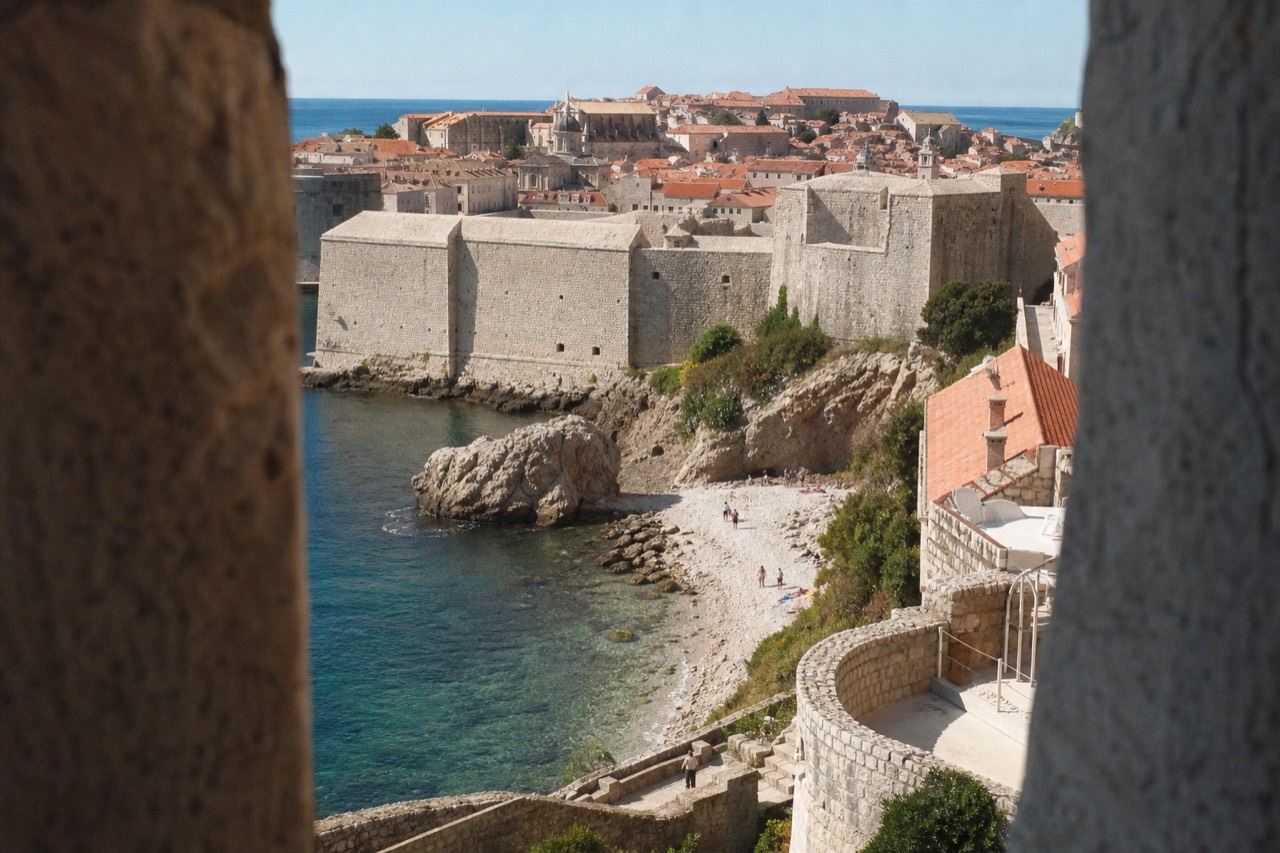
The two headline viewpoints are the cable car to Mount Srd, 30 euro round trip, and the city walls, 40 euro in main season, both with the full red-roof panorama. Free alternatives include the Srđ pathway approach and the Lovrijenac side of the 40 euro walls ticket, while a one-day Dubrovnik Pass at 40 euro covers the walls plus ten more sights.
Where Are the Best Viewpoints in Dubrovnik?
The best viewpoints in Dubrovnik split into three rings: the city walls themselves at 1,940 metres around the Old Town, the heights of Mount Srd reached by the cable car at 405 metres above sea level, and a handful of free or cheap terraces and headlands on the edges of the pedestrian core. Each ring gives a different photograph, and most visitors who only walk the walls leave without realising what they missed.
I have walked every one of these routes more times than I can count, in every month of the year, and the honest answer is that there is no single best view. The walls give you the intimate view, rooftops close enough to touch, church towers at eye level. The cable car gives you the epic one, the whole walled city as a single shape against the sea, with the Elaphiti Islands strung out behind it. The free terraces give you something rarer, a view you can hold for an hour without a queue.
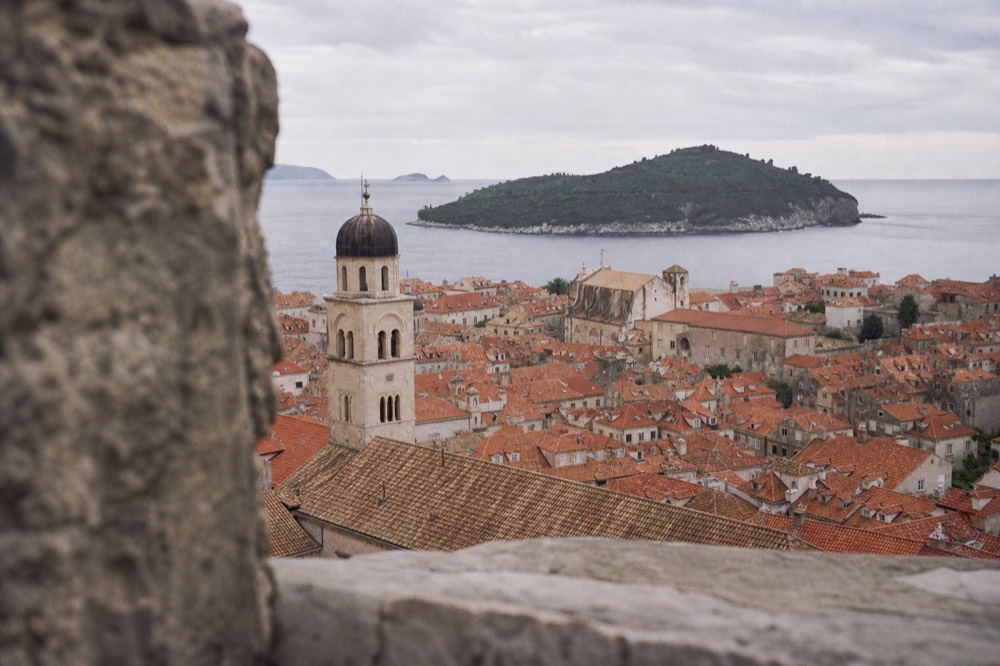
The Old Town itself is small, 24.7 hectares inside the walls, inscribed by UNESCO in 1979 under criteria (i)(iii)(iv). That compactness is what makes the viewpoints work: from almost any elevated spot you get the entire city in one frame. The Stradun runs 298 metres through the middle, and from above it reads as a bright limestone seam cutting the roofscape in half.
What follows is a practical tour of the rings, in the order I would send a first-time visitor. Start high in the morning, walk the walls in the late afternoon, and save the sea-level angles for sunset. If you are planning the whole trip around angles and light, the broader Things to Do in Dubrovnik guide pulls the viewpoints together with everything else the city offers.
Is the Cable Car the Best View in Dubrovnik?
Yes, for sheer scale. The cable car lifts you from 38.0 metres to 405.0 metres above sea level in 3 minutes 30 seconds, a 367.0 metre rise over a 778.2 metre track, and the operator states a view range of up to 60 km on a clear day. No other viewpoint puts the whole walled city, the Lokrum island silhouette and the Elaphiti chain in a single frame, which is why it is the one photographers pay for first.
The station sits just outside the Ploče side of the Old Town, a short steep walk from the Ploče Gate. Two cabins carry 32 plus 1 passengers each at 6.5 metres per second, and the line was built in 1969. At its highest the track runs 40 metres above the ground, so the ride itself is part of the view. Up top you get the Panorama restaurant terrace, the Imperial Fort, and open stone ground you can wander freely.
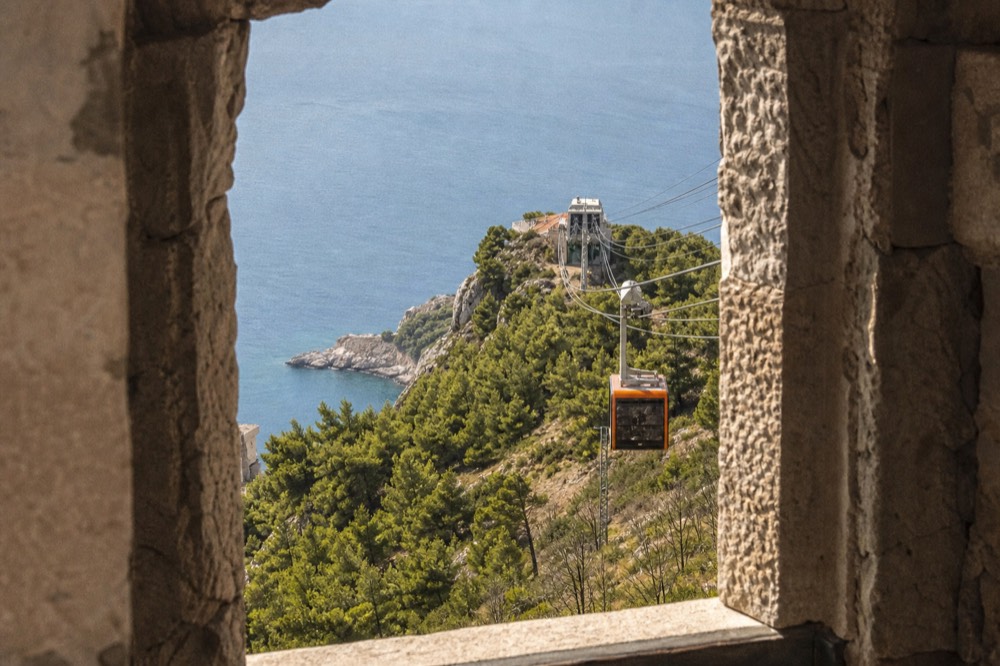
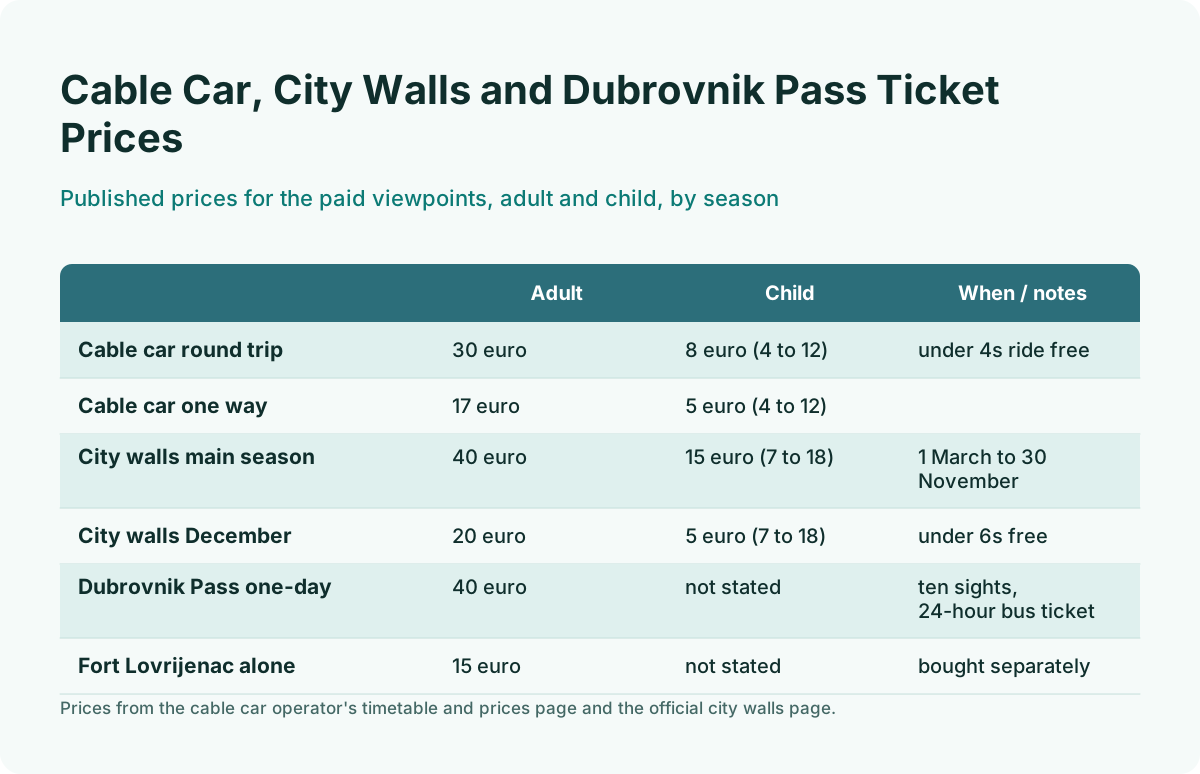
The pricing is simple and the operator publishes it plainly on its own timetable and prices page: an adult round trip is 30 euro, one way 17 euro, a child 4 to 12 pays 8 euro round trip or 5 euro one way, and under 4s ride free. Walking down instead of riding back is a real option for anyone with good knees and two hours, and the one-way ticket exists exactly for that.
| Cable car ticket | Price |
|---|---|
| Adult round trip | 30 euro |
| Adult one way | 17 euro |
| Child 4 to 12 round trip | 8 euro |
| Child 4 to 12 one way | 5 euro |
| Under 4 | free |
Timing matters more here than at any other viewpoint. The cable car runs from 09:00, and in June, July, August and the first half of September it runs until midnight, with 15 to 30 September until 23:00 and reduced hours from October. It is closed January to March entirely, which surprises a lot of winter visitors. Go in the first hour for empty terraces and clean morning light over the Old Town, or in the last two hours for the sunset that gives the mountain its name in every brochure.
If your day is built around views rather than one summit, three products cover the panorama angles with different trade-offs:
The deeper comparison of prices, queues and the walk-down option lives in the cable car guide, and the ticketing details are broken out separately in cable car tickets.
Can You Get Great Views From the City Walls?
Yes, and in a different register: the walls are 1,940 metres long, up to 25 metres high, 4 to 6 metres thick on the land side and 1.5 to 3 metres on the sea side, and every metre of the circuit is a moving viewpoint over the rooftops, the Stradun and the Adriatic. The walls are less a single view than a two-hour sequence of them, which is why photographers who know the city often skip the cable car entirely and just walk the circuit twice.
The ticket is 40 euro in main season, 1 March to 30 November, and 20 euro in December, with children 7 to 18 at 15 euro then 5 euro and under 6s free. That 40 euro ticket is actually a combination: it covers the walls, Fort Lovrijenac, the Western Outer Wall (closed December, January and February) and the Collection of Coins of the Republic of Ragusa. Lovrijenac alone, bought separately, is 15 euro, and it is a viewpoint in its own right, standing on a 37-metre-high sea rock directly opposite the walled city.
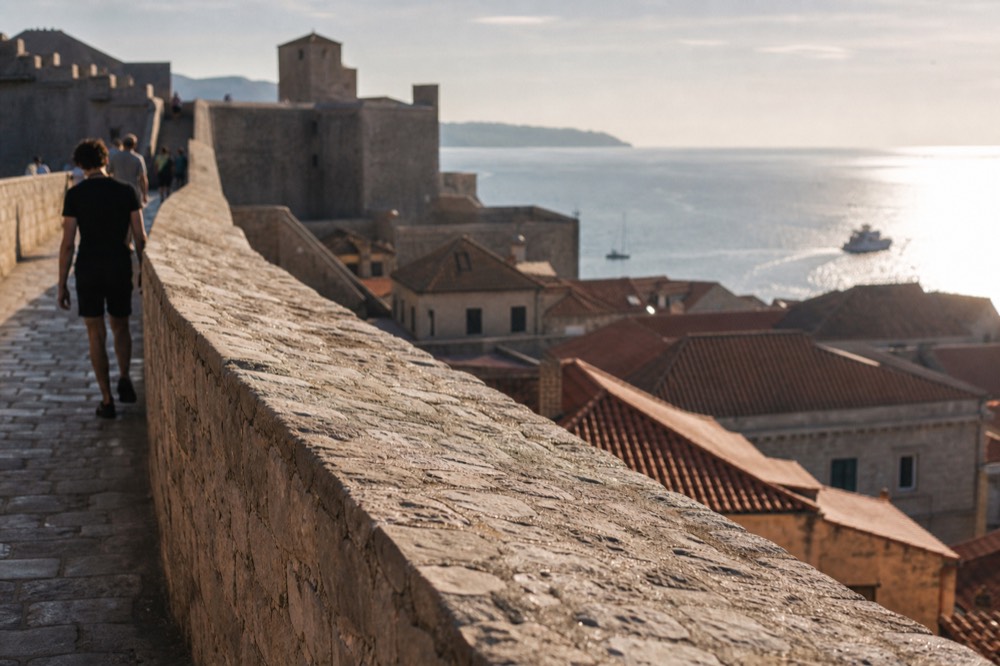
The operator, the Society of Friends of Dubrovnik Antiquities, states working hours of 08:00 to 19:30, and the official walls page is the source for the circuit's structure: 16 towers, 3 fortresses, 6 bastions, 2 corner fortifications, 3 bulwarks, 3 moats, 2 flank fortresses, 1 breakwater and 2 drawbridges. The shape was reached in the 13th century and the last bastion, St Stephen's, was finished in 1660. You will feel all of that history underfoot, because the paving is polished limestone and unforgiving in wet shoes.
| Walls ticket | Main season (1 Mar to 30 Nov) | December |
|---|---|---|
| Adult | 40 euro | 20 euro |
| Child 7 to 18 | 15 euro | 5 euro |
| Under 6 | free | free |
Direction matters. The standard advice is to enter near the Pile side and walk clockwise, which puts the sea on your left and gives you the Lovrijenac and Bokar bay views early while your legs are fresh. The staircases are steep and there is almost no shade, so the first hour after the 08:00 opening and the last two hours before closing are the humane windows. Midday in July the stone radiates heat and the narrow sections jam behind slow groups.
One comparison every visitor should understand before buying: in main season the one-day Dubrovnik Pass costs the same 40 euro as the standalone walls ticket and adds ten more sights plus a 24-hour bus ticket. In December the walls ticket drops to 20 euro and no pass tier is on sale at all, so the equivalence is a main-season fact only. The full breakdown is in the Dubrovnik Pass guide.
If you would rather have the walls explained than just walked, a guided circuit does exactly that:
What Are the Best Free Viewpoints in Dubrovnik?
The best free viewpoints in Dubrovnik include the Jesuit Stairs in the Old Town, the high path above the Pile gate approach, the coastline walk toward the Sveti Jakov beach headland, and the far side of Gruž harbour at sunset. Each spot costs nothing to visit and rewards you with memorable views of the city, its walls, and the Adriatic. None of them charges anything at all, none has a queue, and two of them give angles the paid viewpoints physically cannot, because they sit inside the roofscape rather than above it.
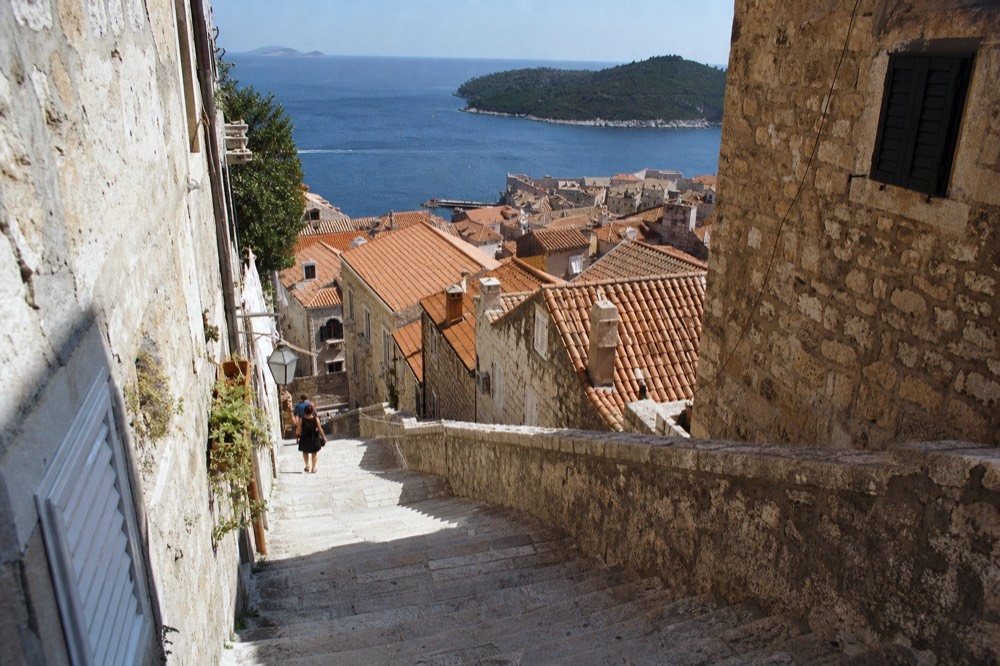
The Jesuit Stairs are the view most visitors photograph without knowing they are doing it: the broad Baroque flight that sweeps down toward the church, rooftops stacked on either side. From the top of the stairs you look straight down the stone cascade with the polished pavement gleaming, and in early morning the light comes in almost sideways. It is a five-minute stop and it costs nothing.
The path above Pile is the local shortcut I send photographers to when the walls queue is long. Walk up from the Pile gate toward the parking terraces and you find a series of ledges where the western wall face and the Bokar fortress fill the frame with the sea behind them. You are standing just above the wall line, close enough to hear the walkers on the circuit, and it costs nothing but the climb.
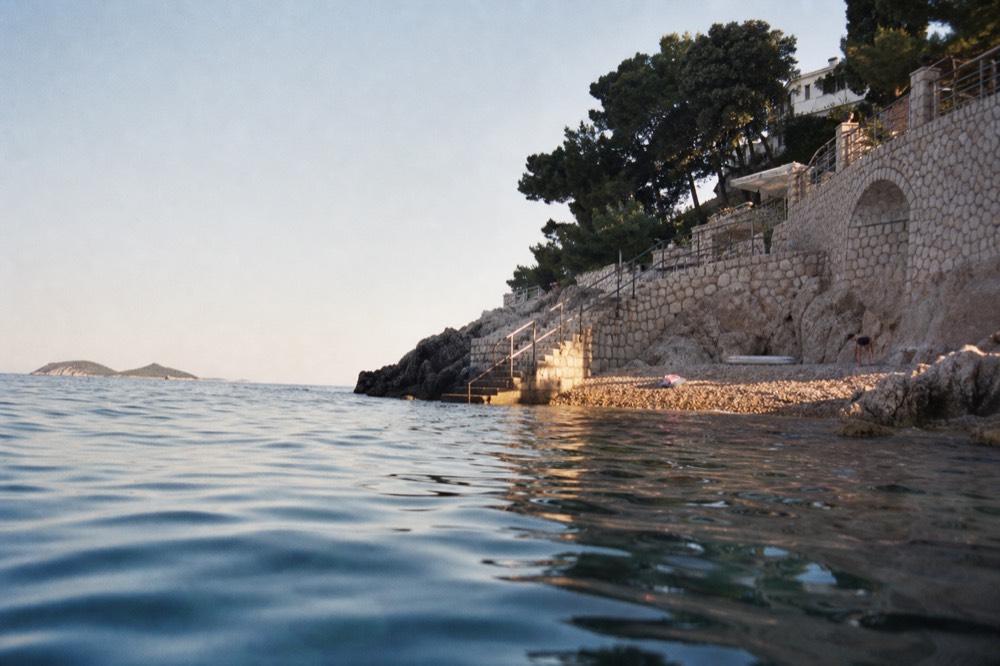
For the sea-level angle, the path toward Sveti Jakov beach gives you the classic reverse view: the entire walled city seen from the southeast across the water, with the cathedral dome and the wall towers stacked along the shoreline. It is a twenty-minute walk from the Ploče side and the beach itself, backed by a small chapel, is one of the finest in the area, covered separately in the Sveti Jakov guide. Go late in the day and the whole facade turns gold.
If walking between viewpoints in summer heat does not appeal, a panorama bus tour does the climbing for you:
The convertible bus panorama tour runs about an hour and a half, from $34.77 per person, rated 4.6 across 796 reviews, with an audio guide doing the explaining while you do the looking. It is the cheap way to get the high road above the city without a cable car ticket.
Where to Watch the Sunset From Above the Adriatic?
The two best spots to watch the sunset from above the Adriatic are the cable car terrace at 405 metres, where the sun drops behind the Elaphiti Islands, and the western walls around the Bokar fortress, where it sets directly over Lovrijenac and the open sea. Both positions sit high enough above the water to give you a clear, unobstructed view of the horizon. For something quieter still, the sea itself becomes the viewpoint: a boat off the coast at sunset frames the entire floodlit city against a darkening evening sky.
From the cable car terrace the sunset works because of the geometry: you are looking west along the island chain, so the sun sets into the sea rather than behind hills, and the Old Town below you shifts from terracotta to amber to blue as the floodlights come on. In high summer the last cabins run until midnight, so there is no need to race the clock, but the terrace itself fills an hour before the nominal sunset time in July and August.
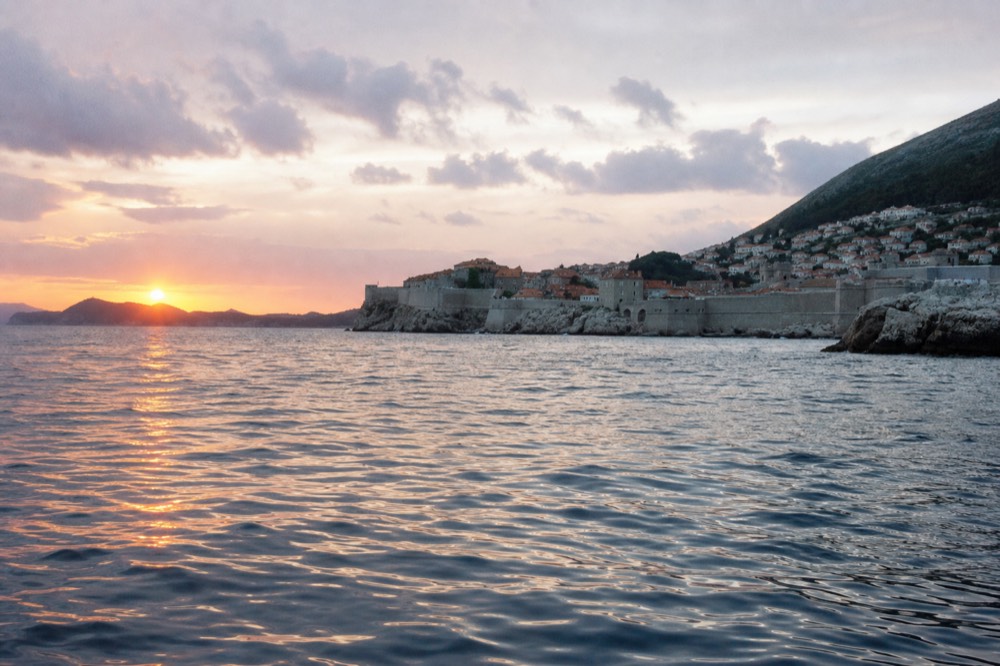
The walls at sunset are a different pleasure. The circuit's western stretch faces Lovrijenac and the open water, and the low sun turns the fort's stone face orange while the sea goes flat and silver. The operator's stated hours run to 19:30, which in midsummer means the last entry still gives you a golden-hour walk, though the actual sunset comes later than closing in June and July. In September the timing aligns almost perfectly.
The third option is to make the sea your platform. A short evening cruise puts the whole walled skyline in one frame with the sun behind it, and one of the best-value versions runs down the coast to Cavtat:
The Cavtat sunset cruise runs about an hour, from $23.66 per person, rated 4.9 across 203 reviews, with a cold platter and drinks included as the coastline slides past. More sunset positions, including the cliffside bar angle, are collected in the sunset spots guide.
What Not to Do in Dubrovnik?
The three mistakes that ruin a viewpoints day: walking the walls at midday in July or August, showing up at the cable car in the same hour as four cruise tenders, and trying to see the Old Town, the walls and the mountain in one summer afternoon. Each one is avoidable with a clock, and each one is made by thousands of visitors every week.
The midday walls walk is the worst of them. There is no shade on the circuit, the limestone reflects heat, and the narrow sections between the towers become single-file queues behind anyone who stops to rest. The operator opens at 08:00 and states hours to 19:30, so the first hour and the last two are always available. In August the sea temperature averages 25.8 degrees on the long-run NOAA series, and the stone feels hotter than the water looks.
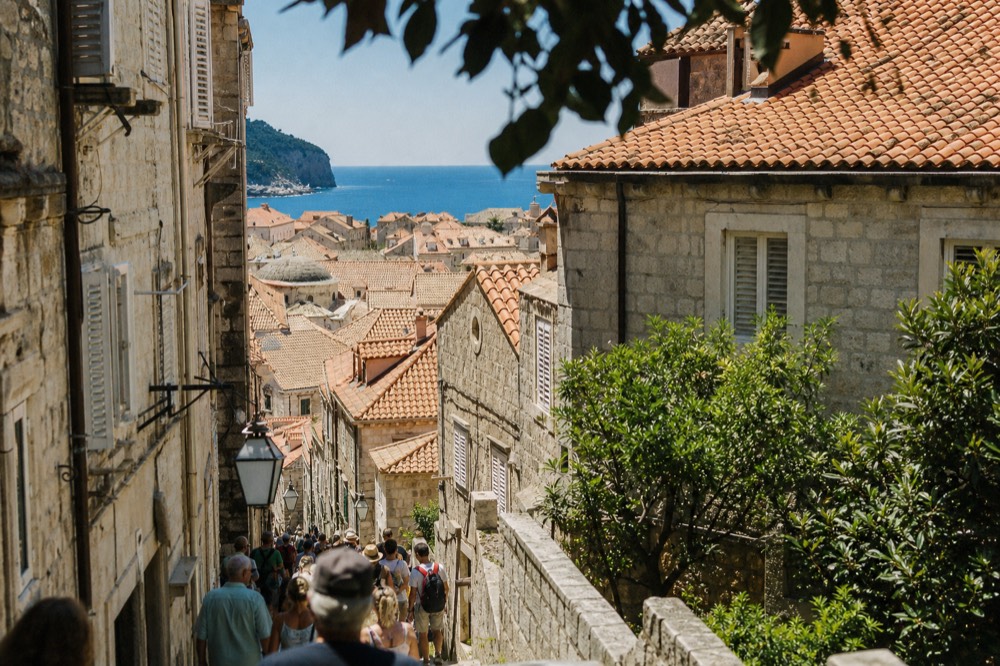
The cruise-timing mistake is subtler because the intuition is wrong. Cruise passengers at the Port of Dubrovnik peaked in September 2025 at 101,246 and October at 100,132, above July's 96,072 and August's 87,385. September and October, not July and August, are the heaviest cruise months, and the busiest remaining days in the 2026 schedule include 6 October with 2 ships and up to 5,798 passengers by capacity and 15 September with 4 ships and up to 5,273. Check the schedule before you plan a quiet morning.
The third mistake is scheduling. The Old Town is 24.7 hectares and walkable in an hour, but the walls circuit alone takes most people two hours with stairs and heat, and the cable car adds a half-day done properly. Anyone trying all three between noon and six will remember queues, not views. A sensible split is walls at opening, Old Town in the shade at midday, cable car in the late afternoon.
For the days when your legs have surrendered, the hop-on hop-off bus connects the viewpoint stops above the city with an audio guide:
The hop-on hop-off yellow bus runs about an hour and a half per circuit, from $35.46 per person, rated 4.9 across 1,147 reviews. It is the one product that lets you rest between angles.
Is Dubrovnik Worth Visiting Just for the Views?
Yes, and that is not a casual claim: Dubrovnik recorded about 4.2 million overnight stays in 2025, sharing first place among Croatian destinations with Rovinj, and the view from the walls or the mountain is the single most cited reason travellers give for the trip. Few cities of 41,562 residents are photographed from as many angles by as many people.**
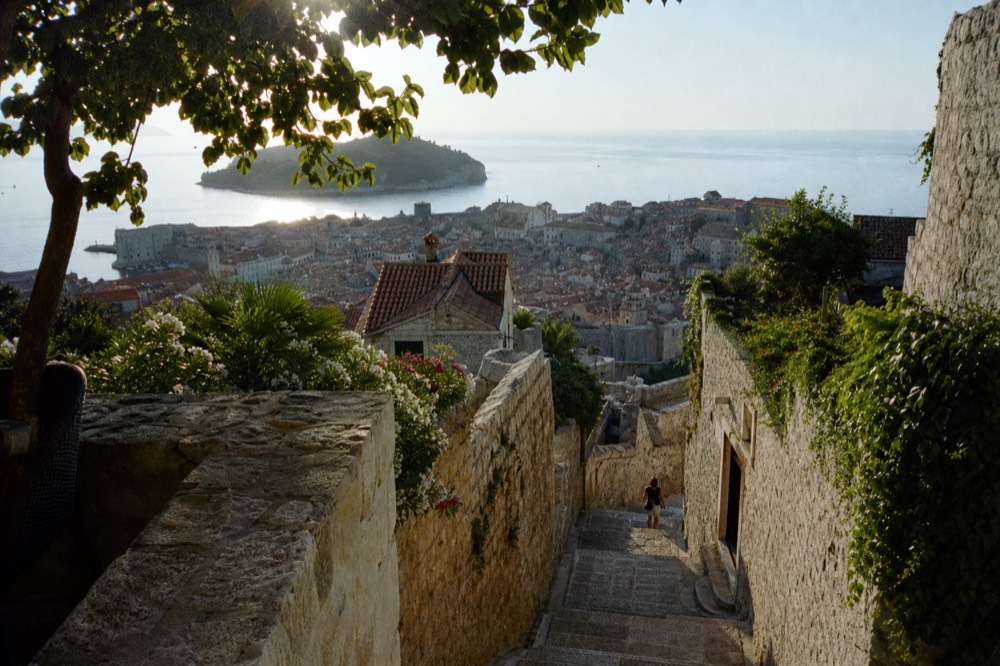
I say this as someone who has watched the light on these walls in every month: the view is not a static postcard. The roofscape is a patchwork, and if you know what you are looking at you can read history in it, older terracotta beside newer tiles laid after the siege, a period when UNESCO kept the Old City on the World Heritage in Danger list from 1991 to 1998. The city you photograph is a survivor, and the viewpoints are where that reads most clearly.
The practical case is strong too. The city is compact enough that a viewpoints-focused visit needs only two or three days: one for the walls and the Old Town, one for the cable car and the coast path, and an evening for the sunset angle. The how many days guide works through the arithmetic, and the honest floor is two full days if views are the priority.
| Viewpoint | Cost | Best time |
|---|---|---|
| Cable car, Mount Srd | 30 euro round trip | First hour or sunset |
| City walls circuit | 40 euro main season | 08:00 opening |
| Fort Lovrijenac alone | 15 euro | Late afternoon |
| Jesuit Stairs | free | Early morning |
| Path above Pile | free | Morning |
| Sveti Jakov headland | free | Sunset |
When Not to Visit Dubrovnik for Photography?
Do not plan a viewpoints trip around January to March, when the cable car is closed entirely, and be careful with December, when the walls ticket drops to 20 euro but the Western Outer Wall section is shut and the light gives you only a few usable hours. The strongest photography months are May, June, September and October, when the light is low, the sea is warm and the cruise calendar, though heavy in autumn, spreads its arrivals across the day.**
The cable car closure is the hard constraint. The operator's own timetable page lists January, February and March as closed, April at 09:00 to 21:00, and the long summer evenings running to midnight from June through 14 September. A winter visitor who arrives expecting the mountain view finds a stationary cabin and a closed station, and no amount of walking replaces a 405-metre elevation.
The crowd calendar is the other constraint, and it inverts the summer instinct. The Port Authority's own crowd-management page explains that cruise passengers are limited to 8,000 a day in most cases, and that of 243 cruise days a year only 18 exceed 8,000 and only 4 exceed roughly 10,000. The city counts visitors with six counters at every Old Town entrance, updating every 15 minutes, against an official carrying capacity of 11,275 people from the UNESCO carrying-capacity assessment. On a real September morning the count read 1,200 at 04:00, 5,419 at 08:00, a 7,739 peak at 10:00, then 7,205 at 11:00. The lesson is simple: the walls at 08:00 are a different city from the walls at 10:00.
| Month | Cruise passengers 2025 | What it means for views |
|---|---|---|
| July | 96,072 | Heat and queues, go at 08:00 |
| August | 87,385 | Hottest, no shade on the walls |
| September | 101,246 | Best light, biggest cruise month |
| October | 100,132 | Golden light, check the schedule |
The Port Authority publishes its cruise statistics openly, and the cruise schedule guide on this site translates them into day-by-day planning. Passenger figures are ship capacity, not people who actually walk ashore, so treat them as a ceiling rather than a headcount.
Is It Worth Going to Dubrovnik Even on a Hazy Day?
Yes, with adjusted expectations: haze softens the long 60 km view from the cable car but barely touches the walls circuit, which works at close range in any weather, and the sea-level angles from Sveti Jakov or a boat often improve in diffused light. The only days that genuinely defeat the viewpoints are the rare storm days, and those are the days the museums and the food scene take over.**
The bora wind is the wild card. When it blows, the cable car can suspend service on safety grounds and the exposed wall sections are genuinely unpleasant, with spray coming over the sea-facing stretches. It is worth checking the forecast the evening before and keeping your walls ticket day flexible, because a calm day after a bora is the clearest air you will ever get here.
Rain is less of a problem than people fear, and the rainy day guide covers the alternatives. Wet limestone on the walls is slick and the operator will close the circuit in genuinely bad weather, but showers on the Dalmatian coast are often short, and the washed stone after one photographs beautifully.
On the flat-grey days, invert your plan. Skip the summit, walk the Old Town's interior angles, the Jesuit Stairs, the Sponza Palace courtyard, the lanes off the Stradun, and take the sea-level panorama from the harbour wall. Then let someone else handle the driving between the remaining viewpoints:
Common Questions About Dubrovnik Viewpoints
What Is the Best Viewpoint in Dubrovnik?
For the full panorama, the cable car's upper station at 405.0 metres above sea level, with the operator stating a view range of up to 60 km on a clear day. For intimacy, the city walls circuit, 1,940 metres long and up to 25 metres high, puts you level with the rooftops and bell towers. Most photographers do both.
How Much Does It Cost to See the Views in Dubrovnik?
The cable car round trip is 30 euro for an adult, the city walls ticket is 40 euro in main season (1 March to 30 November) and 20 euro in December, and Fort Lovrijenac alone is 15 euro. Several good viewpoints are free, including the Jesuit Stairs, the path above Pile and the Sveti Jakov headland.
What Time of Day Is Best for the Cable Car View?
The first hour after the 09:00 opening for empty terraces and clean light, or the last two hours for sunset. In June, July, August and 1 to 14 September the cable car runs until midnight, and 15 to 30 September until 23:00, so evening visits need no rush.
Is the Dubrovnik Pass Worth It for the Viewpoints?
In main season, yes for the walls: the one-day pass costs the same 40 euro as the standalone walls ticket and adds ten more sights plus a 24-hour bus ticket. In December the walls ticket drops to 20 euro and no pass tier is on sale at all, so the equivalence only holds from 1 March to 30 November.
When Should I Avoid the Dubrovnik Viewpoints?
Avoid midday on the walls in July and August, when there is no shade and the narrow sections queue. Also avoid January to March if the cable car view matters to you, because the cable car is closed those months. September and October carry the most cruise passengers, 101,246 and 100,132 in 2025, so go early on those days.
Can I See the Views Without Buying Tickets?
Yes. The Jesuit Stairs, the ledges on the path above Pile gate, and the walk to Sveti Jakov beach all give genuine viewpoints at no cost, and the far side of Gruž harbour frames the city at sunset. They do not replace the walls circuit or the summit, but they are real angles, not consolation prizes.