What Is the Best Time of Day to Ride the Dubrovnik Cable Car?
The best time to ride the Dubrovnik cable car depends on light, crowds and cruise schedules. Here is how to pick your slot, with prices, hours and what waits at the top.
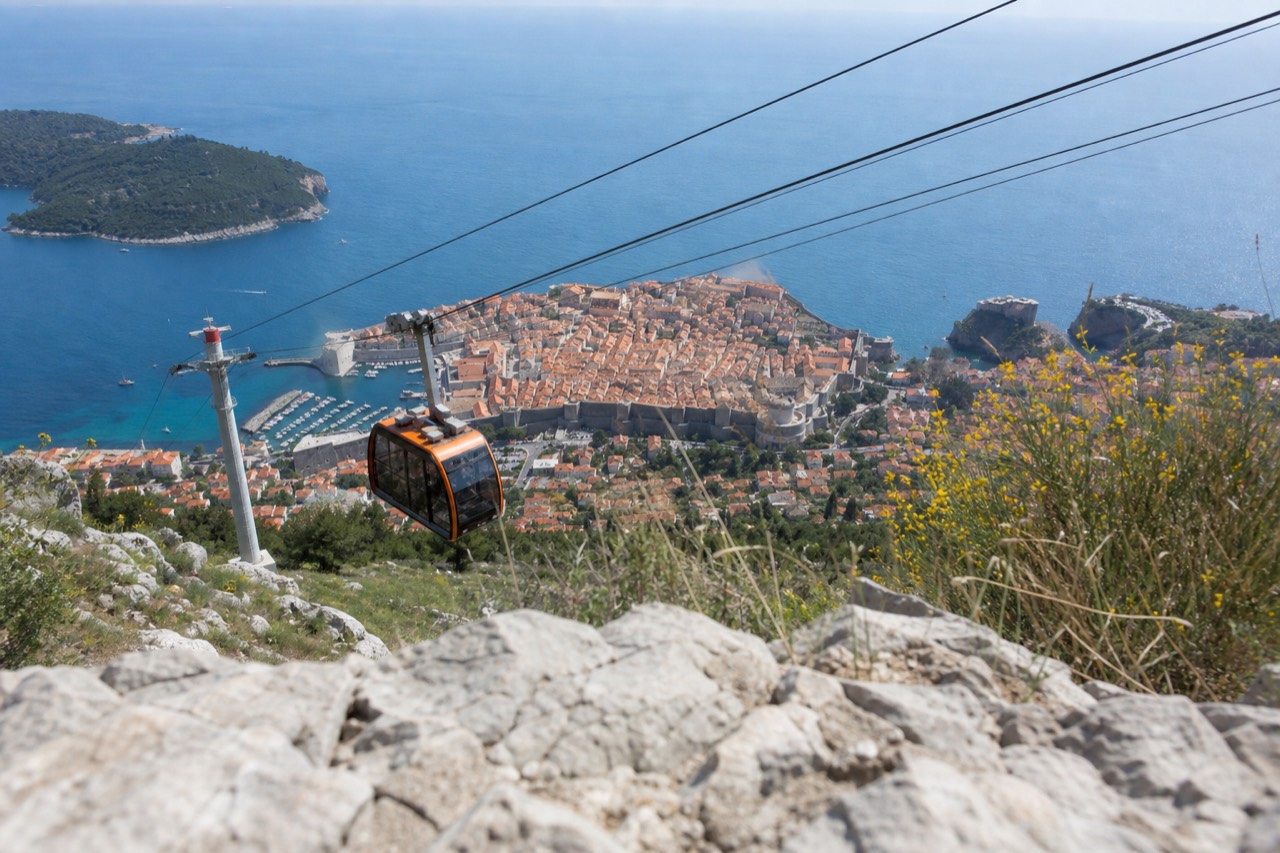
Two cabins, each carrying 32 plus one crew member, shuttle between a lower terminal 38.0 metres above sea level and the Mount Srd station at 405.0 metres. The ride itself takes 3 minutes 30 seconds at 6.5 metres per second along a 778.2-metre track, so the cable car is not the day trip, it is the four minutes that frames one. What you see in those minutes, and how long you are willing to queue for them, depends almost entirely on the hour you choose.
I have watched that line from the Ploče side of the Old Town at every hour of the tourist day, and the pattern never changes: a thin queue at opening, a wall of people from late morning through mid afternoon, and a second surge, more cheerful and better dressed for photographs, about ninety minutes before sunset. The question is which of those three windows fits what you came for.
What Is the Best Time of Day to Ride the Dubrovnik Cable Car?
For the clearest view, ride within the first two hours of operation, when the air over the channel is still cool and haze has not built up; for the best photographs, ride about 90 minutes before sunset and come down after dark. Midday is the worst slot: the queue is longest, the sun is overhead, and the sea flattens into glare. The operator's stated view range is up to 60 km, about 37 miles, on a clear day.
That 60 km figure comes from the operator's own site, and it is honest: from the upper station you can read the Elaphiti islands, the Lapad peninsula, the whole walled city and the Montenegrin coast on the right kind of morning. Clarity is a morning property. Warm afternoons over the Adriatic push a soft haze onto the horizon, and by late afternoon distant islands lose their edges even when the sky is technically cloudless. If the panorama itself is the point of your trip, go early.
Sunset is the other honest answer, and the one most visitors actually want. The walled city faces roughly west across the water, so from Srd you watch the light come off the limestone roofs while the sea behind you goes gold. The trade-off is company: everyone in Dubrovnik with a camera has the same idea, and the queue at the lower station builds steadily through the last two operating hours. In June, July and August the operator runs until midnight, and September 1 to 14 the same, so a late dinner up top is possible; check the current timetable on the operator's timetable and prices page before you plan around it, because hours step down through the back half of September and reduce from October.
There is a third variable most visitors never check, and it matters more than the weather forecast: cruise traffic. The Port Authority's own figures show cruise passengers at Dubrovnik peaked in September 2025 at 101,246 and October at 100,132, above July's 96,072 and August's 87,385. The intuition that August is the crushing month is simply wrong. Cruise passengers come ashore in the morning and flood the Old Town and the cable car queue from mid morning, so in September and October an early ride matters just as much as in high summer. The Port Authority limits cruise passengers to 8,000 a day in most cases, and of 243 cruise days a year only 18 exceed that number, but 8,000 ashore is still a very busy town.
The counting system makes this plannable rather than guessable. Six counters at every Old Town entrance update a headcount every 15 minutes, and the official carrying capacity of the historic core, from the UNESCO carrying-capacity assessment, is 11,275 people. On a real September morning the count read 5,419 at 08:00, climbed to a 7,739 peak at 10:00, and still held 7,205 at 11:00. That curve is the cruise-ashore curve, and the cable car queue tracks it almost exactly. If you ride before 09:00 you are ahead of it; if you arrive at the lower terminal at 11:00 you are inside it.
| Time slot | Queue | Light and view | Best for |
|---|---|---|---|
| First hour after opening | Short | Clearest air, low haze | The panorama, photographers |
| Mid morning to mid afternoon | Longest | Harsh overhead sun, glare on the sea | Nothing, honestly |
| About 90 minutes before sunset | Building | Warm light on the city, gold sea | Photographs, drinks at the top |
| After dark in summer | Short again | City lights below | A late dinner or a nightcap view |
One practical note on tickets: an adult round trip is 30 euro in 2026, one way 17 euro, children 4 to 12 pay 8 euro round trip and 5 euro one way, and under 4s ride free. If you plan to walk down, a one-way ticket up is the smart buy, and I will come back to that below. For everything else on the mountain, our cable car tickets and prices guide works through the options.
What Is at the Top of the Cable Car in Dubrovnik?
The upper station on Mount Srd holds a large panoramic terrace, a restaurant, a café, a souvenir shop and the Imperial Fortress, whose interior houses the Dubrovnik Homeland War Museum. There are also marked walking paths along the ridge. The fortress and the museum are the reason the mountain is more than a viewpoint; the terrace alone justifies the ride for most people.
The Imperial Fortress is the squat stone building beside the upper station, and it carries the heaviest history on the mountain. During the 1991 to 1998 period when the Old Town sat on UNESCO's List of World Heritage in Danger, Srd was a front line, and the fortress walls still show it. The Homeland War Museum inside documents the siege of Dubrovnik with photographs, artefacts and equipment. Visitors expecting only a pretty terrace are often caught off guard by how affecting the museum is, and it is worth budgeting half an hour for it even on a short visit.
Outside, the terrace wraps the summit. The city side gives you the full walled town, the islet of Lokrum directly below the old harbour, and the coastline running out toward Cavtat. The land side looks across rugged karst toward Herzegovina. On a genuinely clear day the operator's stated 60 km range lets you pick out the Elaphiti chain island by island, and that clarity is, again, a morning thing.
For the wider picture of what else sits on and around the mountain, including the paths and the viewpoints below the station, our Mount Srd guide covers the ground. And if your day is really about the walls rather than the mountain, the pairing is natural: the walls circuit is 1,940 metres long, up to 25 metres high, and the same ticket that covers it also covers Fort Lovrijenac, which you can see perfectly from up here, standing on its 37-metre sea rock on the far side of the town.
Is It Worth Taking the Cable Car in Dubrovnik?
Yes, for almost every visitor, because no other viewpoint combines height, immediacy and the Old Town's full footprint in one frame. The main exceptions are travellers on a tight budget, since a round trip is 30 euro per adult, and anyone visiting between January and March, when the cable car is closed. If you only care about the sea, a boat gives you a comparable wow for similar money.
Worth is a budget question and a taste question. On the taste side, the cable car is the only place you see the entire walled city as a single shape, the red roofs, the walls, Lokrum and the sea in one glance. The city walls give you intimacy, the cable car gives you the map. I tell first-time visitors to do both and to do the walls first, because after you have walked the circuit you recognise everything you see from the top. The full index of guides sits on Things to Do in Dubrovnik.
On the budget side, compare honestly. The cheapest paid Old Town walking tour starts at $20 per person, a two-hour sea kayak tour around Lokrum and Betina Cave starts at $35.49, and the cable car round trip at 30 euro sits squarely between them. It buys you four minutes of travel and as long as you like on the mountain, which is a fair deal if you use the time, and a poor one if you ride up, take one photo and ride straight back down.
The strongest value case is the combined product. The Cable Car Ride and Old Town Walking Tour runs about 4 hours 30 minutes, is rated 4.6 across 716 reviews, and folds the ascent, time on the mountain and a guided walk of the streets below into one booking from $163.50 per person. One review of that tour calls it out well: "Great tour with a great guide. Terrific views from the cable car. The old town is fascinating. We walked part of the wall because it was very hot. Sara was a fabulous guide and gave us recommendations for lunch and what else we should see." That heat note is real planning advice: in July and August the terrace is fierce by midday, which is one more argument for the morning or sunset slots.
If a full tour is more structure than you want, the sightseeing buses make a cheaper panorama alternative. The hop-on hop-off yellow bus with audio guide runs about 1 hour 30 minutes from $35.46 per person and is rated 4.9 across 1,147 reviews, while the convertible panorama bus tour starts at $34.77 and carries a 4.6 across 796 reviews. Neither reaches 405 metres, but both lift you out of the street canyon for less than the cable car.
What Is the Restaurant on Top of the Cable Car in Dubrovnik?
The restaurant at the upper cable car station is Panorama, a sit-down terrace restaurant and bar built into the Imperial Fortress complex with the city and sea below it. It is the restaurant people mean when they ask this question, and it is the reason the sunset queue exists: tables facing the old town book out first. The station also has a separate café for coffee and drinks.
Panorama is the headline act, and its position is genuinely unmatched, a terrace at the top of the cable car looking straight down at the walled city. The kitchen runs Mediterranean and Croatian plates, and the bar service continues after dark in the summer months when the cable car operates until midnight. The practical advice is simple: if you want a sunset table in July, August or early September, reserve well ahead, because walk-up tables at the golden hour are close to nonexistent in high season. Our longer treatment of eating with a view, including how Panorama compares to the Old Town's terrace restaurants, is in the restaurants with a view guide.
Timing interacts with the restaurant in a way people miss. If you dine at sunset you will come down after dark, which is fine in summer, when the last cabins run late, but the hours step down from mid September and reduce from October, so a late dinner can turn into a race for the final descent. Check the operating hours for your exact dates before you book an 8pm table in the shoulder season. And if you are eating up top, buy a round-trip ticket; the one-way saving only makes sense for walkers, which is the next question.
| Item | 2026 price |
|---|---|
| Cable car, adult round trip | 30 euro |
| Cable car, adult one way | 17 euro |
| Cable car, child 4 to 12 round trip | 8 euro |
| Cable car, child 4 to 12 one way | 5 euro |
| Child under 4 | free |
The café beside the station is the budget answer: a coffee and a pastry with the same view, no reservation, no bill that competes with your hotel rate. For a family of four, the difference between a Panorama dinner and café stops is a meaningful chunk of a day's budget in a town that recorded about 4.2 million overnight stays in 2025, sharing first place in Croatia with Rovinj. Popular is the baseline here; plan around it.
Can You Walk Down From the Cable Car in Dubrovnik?
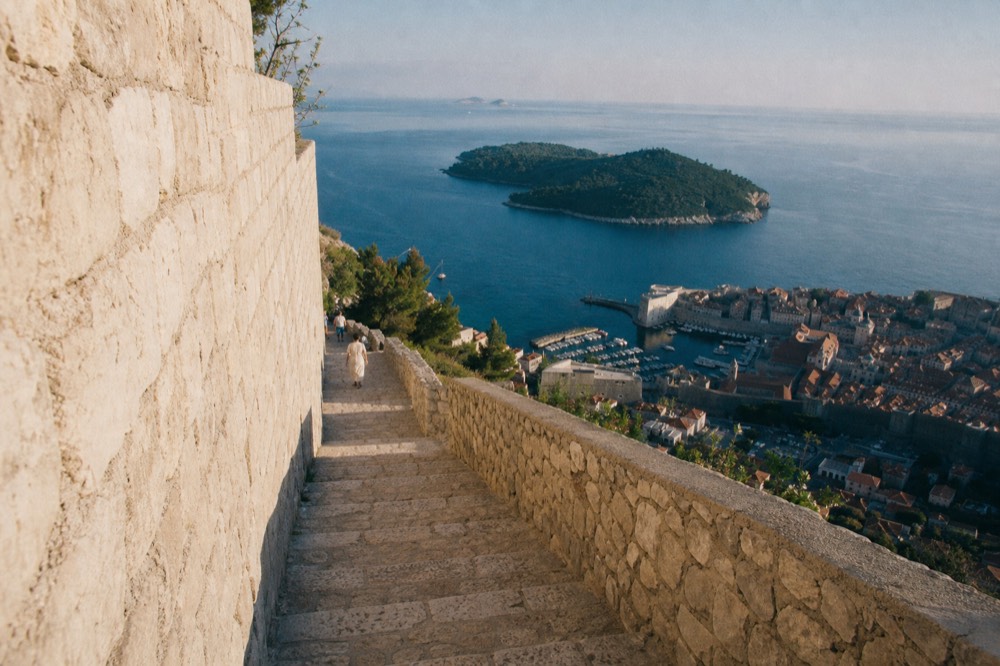
Yes. A marked path descends from the upper station to the road above the Old Town, and locals walk it regularly, but it is a steep, exposed, rocky descent of 367 metres on uneven stone, not a gentle stroll. Wear real shoes, carry water, allow roughly an hour or more, and do not attempt it in flip-flops, in the midday heat, or in the dark.
The elevation difference is the whole story: the lower terminal sits at 38.0 metres and the upper at 405.0, a 367.0-metre drop, and the path does it in switchbacks over karst limestone. Coming down is knee work rather than cardio, and loose stone makes footing the real hazard. Going up is a serious climb in summer heat, and I would only recommend the ascent to people who hike at home. The operator's technical details page gives the geometry; the path itself you judge with your own eyes at the top before committing.
The smart pattern, if you want the walk without the punishment, is the one-way ticket. Ride up at 17 euro, spend the golden hour on the terrace, then walk down as the light fades, which lands you at street level right as the Old Town's evening begins. The reverse, walking up and riding down, is the version hikers like, and it costs the same 17 euro one way. What you cannot do is start the descent too late: once the cable car stops running you are committed to the path or a taxi from the top, and the path after dark is a bad idea on any holiday.
For walkers who want the mountain without the route-finding, a guided option folds the cable car into a bigger morning: the cable car and Old Town walking tour covers the ascent, the terrace time and a guided circuit of the streets, which spares you the queue decisions entirely. And if the descent idea appeals but the knees disagree, the panorama buses below are the compromise, wheels instead of switchbacks.
The short version of all of this: ride in the first two hours for clarity, ride before sunset for photographs and Panorama, avoid the middle of the day in every season, and remember that September, not August, is when the town is fullest of day visitors. Whatever hour you pick, the mountain itself does not disappoint; it has been standing over this city since long before the cable car, built in 1969, first carried anyone up to look.
Common Questions About the Best Time to Ride the Dubrovnik Cable Car
What is the best time of day to ride the Dubrovnik Cable Car?
Ride within the first two hours of operation for the clearest air, or about 90 minutes before sunset for the best light on the city. Avoid midday, when queues are longest and the sun flattens the view. In summer the cable car runs until midnight, so an after-dark descent is also an option.
What Is at the Top of the Cable Car in Dubrovnik?
A panoramic terrace, the Panorama restaurant, a café, a souvenir shop and the Imperial Fortress, which houses the Dubrovnik Homeland War Museum. Marked walking paths run along the ridge from the upper station.
Is It Worth Taking the Cable Car in Dubrovnik?
For most visitors, yes: it is the only viewpoint that shows the entire walled city as one shape. An adult round trip costs 30 euro. It is closed January to March, and budget travellers may prefer a panorama bus tour for less.
What Is the Restaurant on Top of the Cable Car in Dubrovnik?
Panorama, a terrace restaurant and bar beside the upper station with the city and sea below. Reserve ahead for a sunset table in high season. There is also a separate café at the station for coffee and drinks.
Can You Walk Down From the Cable Car in Dubrovnik?
Yes, on a marked but steep and rocky path that drops 367 metres to the road above the Old Town. Wear proper shoes, carry water and allow at least an hour. A one-way ticket up at 17 euro makes the descent the sensible half of the trip.