Can I Walk Down from the Dubrovnik Cable Car?
Yes, you can walk down from the Dubrovnik cable car on Mount Srd. Here is what the descent is like, what it costs to ride up, and what waits at the top.
Can I Walk Down from the Dubrovnik Cable Car?
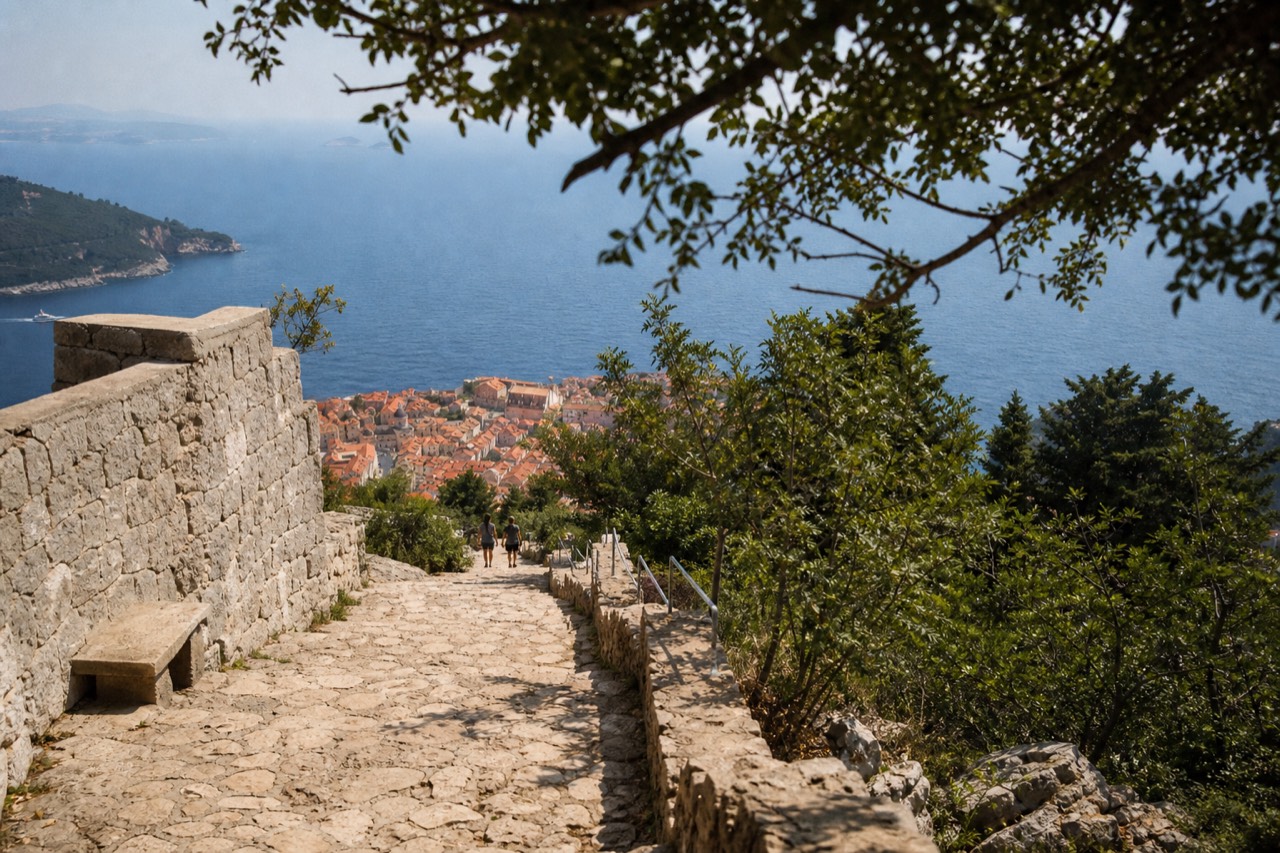
Yes, you can walk down from the Dubrovnik cable car, and it is a well-established local route rather than a dare. The upper station sits at 405 metres above sea level, and a dusty footpath zigzags down the slope of Mount Srd toward the road above the Old Town. Most people who walk it down allow a leisurely pace, wear closed shoes, and carry water, because the path is exposed to sun almost the whole way.
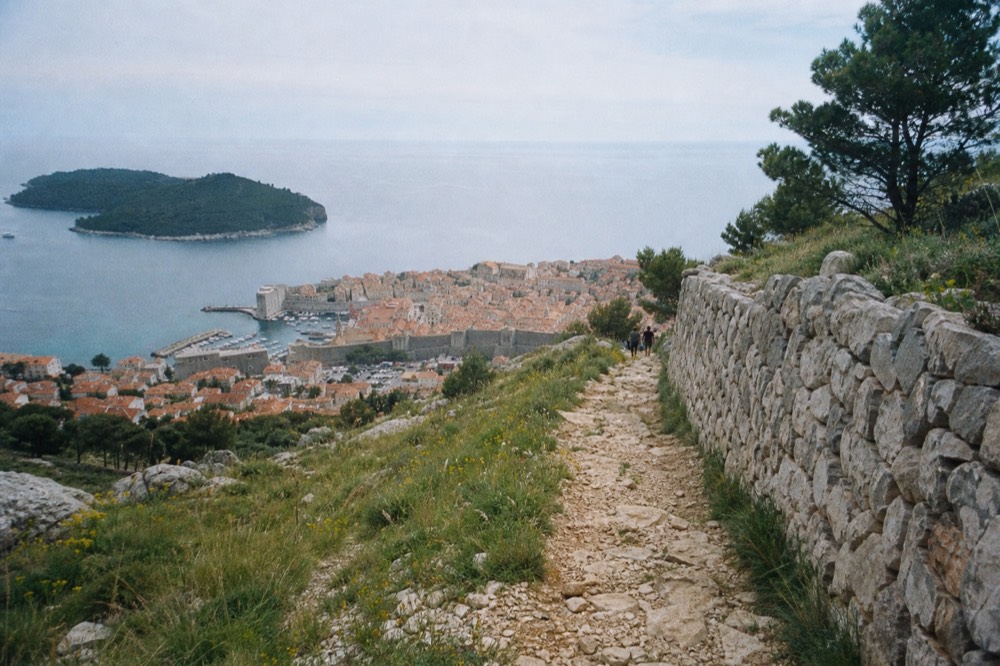
I have walked this slope more times than I can count, in both directions, and it is one of my favourite pieces of honest advice to give visitors: buy a one-way ticket up, then walk down. The cable car does the climbing for you, 367 metres of elevation over a 778.2-metre track in three minutes and thirty seconds at 6.5 metres per second, according to the operator's own technical page. Walking down gives you the same panorama at a human speed, with the terracotta roofs of the Old Town growing larger in front of you the whole way.
A few things to be clear about before you commit. The descent is on a rough trail, not a paved promenade. It is loose stone and packed earth in places, zigzagging under the cable line and beside it, and it is slippery when wet. There is no shade to speak of, no water fountain on the slope, and no handrail. In July and August the midday sun on that rock is brutal; I would not send anyone down between noon and four in high summer. Go early, or wait until late afternoon when the light turns gold and the cruise crowds have thinned.
The direction matters more than most people expect. Walking down is a knee workout on loose gravel, and it is the sane option for anyone with reasonable legs. Walking up is a different proposition entirely, a sustained climb on exposed ground that only fit hikers enjoy. If you want the exercise, ride up first and descend on foot, so that a wrong turn or a tired knee still ends at sea level rather than stranded halfway up a mountain.
It is also worth saying who should not do this. If you are travelling with small children, if your knees have opinions about downhill stairs, or if you are wearing anything you would not hike in, take the cabin both ways. The 13 euro you save walking down is real money, but a twisted ankle on loose rock costs far more than a round-trip ticket. There is no shame in the cabin, and no rescue infrastructure on the slope either: if you get into trouble, help comes the slow way.
If riding up and walking down appeals, or if you would rather combine the panorama with a guided introduction to the city, there are three tours built around exactly that idea. The first band below covers the full cable car and walking combination, a version bundled with the city walls, and a lighter ticket-plus-tour option.
For more on the ride itself, timings and the queue problem, read the full cable car guide, and see whether you need cable car tickets in advance before you commit to a summer afternoon slot.
Is a Dubrovnik Cable Car Worth It?
For most visitors, yes, especially as a one-way ticket paired with a walk down. The adult round trip costs 30 euro and the one-way up costs 17 euro in 2026, so riding up and walking back saves 13 euro and buys you an hour of the best views in Dalmatia for free. Nothing at street level matches the summit panorama.
The value question really hinges on timing. The cable car was built in 1969 and has been carrying visitors up Mount Srd ever since, two cabins shuttling opposite directions on a single haul. In peak season the queue at the lower terminal, just outside the Old Town walls near Ploče, can stretch long in the middle of the day. The operator's timetable reflects the demand: April runs 09:00 to 21:00, the first half of May until 22:00, the second half until 23:30, and June through mid-September right up to midnight. Those late hours are the secret. A sunset or early-evening ascent is cooler, quieter and cheaper in patience, and the illuminated city below is arguably better than the daytime version.
| Cable car ticket (2026) | Price | Good for |
|---|---|---|
| Adult round trip | 30 euro | Ride up, ride down |
| Adult one way | 17 euro | Ride up, walk down (or reverse) |
| Child 4 to 12 round trip | 8 euro | Families riding both ways |
| Child 4 to 12 one way | 5 euro | Children walking one direction |
| Under 4 | Free | Any ticket type |
Compare that one-way strategy against the alternatives and it holds up well. A round trip is 30 euro for roughly seven minutes of cabin time plus whatever you spend at the top. A one-way up plus a walk down is 17 euro for the same ride, the same summit, and a descent that is itself a highlight. The catch is simple: you need decent shoes, water, and a morning or late-afternoon slot, and you should not attempt the trail in flip-flops or in the dark.
There is a middle option too, and it is the one I suggest to people who want the exercise without committing to the full descent. Ride up, spend your time at the fort and the terraces, then walk only the upper half of the trail before rejoining the road and hopping on a local bus from the Bogišićeva side back toward Pile or Ploče. You get the best of the path, the section where the whole Old Town unfolds below you, without the last stretch of loose gravel above the rooftops. It is a compromise, but a good one on a hot day.
The other comparison worth making is against doing the whole thing as a tour. A guided product bundles the ticket, removes the queue-guessing, and adds an Old Town walk below, which is a genuinely different proposition from a bare ride. The cable car ride with Old Town walking tour runs about 4 hours 30 minutes from $163.50 per person and is rated 4.6 across 716 reviews. One guest review sums up the combination neatly:
Great tour with a great guide. Terrific views from the cable car. The old town is fascinating. We walked part of the wall because it was very hot. Sara was a fabulous guide and gave us recommendations for lunch and what else we should see.
Fred_W
Whether you ride alone or with a guide, the honest verdict on worth is this: the cable car is expensive per minute but the panorama is the single best overview of Dubrovnik that exists, and the one-way-plus-walk-down plan is the cheapest honest way to get it.
What Is at the Top of the Cable Car in Dubrovnik?
The top of the cable car is a small summit complex on Mount Srd: an upper station with terraces, a panoramic restaurant, the large stone Fort Imperial, and a war museum inside it, all wrapped in the widest view in the city. The fort dominates the summit and the museum inside tells the story of the 1991 siege from the Croatian defenders' perspective. Around it are terraces, a cafe, and the trailheads for walking down.
Fort Imperial is the reason the summit is more than a viewpoint. The fort sits right at the top of the cable line, and during the siege of 1991 it was a Croatian defensive position holding the high ground over the city. Today it houses a museum of that period, and even visitors with no appetite for military history tend to come down quiet. The view from the fort's terraces is the one you have seen in photographs: the complete outline of the walled city, the island of Lokrum directly offshore, and the Elaphiti islands strung out along the horizon toward the northwest. The rest of the planning pages sit on Things to Do in Dubrovnik.
The restaurant at the upper station is the other draw, and it is a real destination in its own right rather than a snack bar. It sits at 405 metres with floor-to-ceiling glass facing the Old Town, which makes it one of the most dramatic dining rooms on the Adriatic. Dinner there during the summer season, when the cable car runs until midnight in the height of summer, is a splurge with an unmatched backdrop. Book ahead if you want a window table at sunset; walk-ins get the view but not necessarily the glass.
Beyond the fort and the restaurant, the summit is a modest plateau of scrub, cypress and stone, with a few vendors in season and a cross near the edge. The real attraction after the first ten minutes is choosing your way back down, and that is where this article started. The trail down begins near the upper station and drops toward the road and the Old Town, and the walkable route down from Srd is worth understanding before you set off rather than after.
Give the summit more time than you think it needs. Most visitors budget twenty minutes, see the terrace, photograph the Old Town and leave. But the light on Srd changes fast, especially in the golden hour: the limestone of the walls shifts from cream to amber, the sea goes from turquoise to slate, and the shadows of the islands lengthen across the water. If your schedule allows, arrive an hour before sunset, do the fort museum first while the light is still flat, and save the terraces for the show. It costs you nothing extra and it is the difference between a good photo and the photo of your trip.
For anyone who wants the summit without the hiking question at all, the panorama zipline runs from the Srd side too, rated 4.9 across 2,109 reviews from $64 per person, if descending by gravity with a harness appeals more than descending by gravity with sore knees.
What Is the Walk Down From Mount Srd Actually Like?
The descent is a rough, sun-exposed footpath of loose stone and packed earth that zigzags roughly 367 vertical metres from the upper station toward the road above the Old Town. There is no shade, no water and no handrail, and the surface is slippery after rain. With sensible shoes and an early or late start it is the best free walk in Dubrovnik; in flip-flops at midday it is a bad idea.
The trail is not waymarked like a national park path, but it is not hard to follow either. From the area around the upper station you pick up the worn line that drops southeast of the cable line, and from there the route is a matter of reading the ground: follow the most trodden line, keep the city in view ahead of you, and resist the temptation to cut the zigzags, which is how ankles get hurt. Local runners and dog walkers use the path daily, so if you are unsure, wait thirty seconds and someone who knows it will come past.
Underfoot, the surface changes as you descend. The upper third is rockier, with loose scree where the slope is steepest, and this is where trekking poles earn their keep if you carry them. The middle third softens into packed earth and low scrub, with the best uninterrupted views of the walled city on the whole mountain. The final third steepens again above the rooftops and can be gravelly, so this is where most slips happen, usually on the last stretch when people relax. Treat the bottom third with the same respect as the top and you will be fine.
Timing changes the walk completely. Before 10:00 the slope is still cool, the light comes in low from the east across the water, and you will share the trail with a handful of locals. After 17:00 the sun drops behind the summit ridge and the whole descent happens in shade, which is why late afternoon is my favourite slot: you ride up in daylight, watch the sunset from the terrace, and walk down through the blue hour with the city lights coming on below you. Either slot works. The middle of the day does not, from June through September at least.
A note on the sea view as you descend, because it deserves one. From the trail you can see Lokrum sitting directly offshore from the Old Town, and on clear days the Elaphiti islands beyond it. The September average sea temperature on this coast is about 23.6 degrees, a long-run open-water average rather than a beach reading, and sheltered bays along this shore run warmer than that in late summer. It is a good reminder as you walk down that a swim is waiting at the bottom, and Banje beach sits just below the Ploče side where the trail effectively delivers you.
Is It Worth Taking the Cable Car in Dubrovnik?
Yes, if you want the panorama and you time it well; no, if your only plan is a midday round trip in August. The ride lasts three minutes and thirty seconds, so the value is entirely in the summit and the timing: early morning, sunset, or a summer evening when the cabin runs until midnight. Anyone who can walk down should buy one-way up at 17 euro.
The strongest argument for the cable car is that nothing else in the city replaces it. The walls give you the city from the inside, the sea gives you the city from the water, and Srd alone gives you the city whole. On a clear day the operator advertises a view range of up to 60 km, which on a good autumn afternoon means you can see the mountains of Montenegro to the southeast and the Dalmatian islands to the northwest from one spot. That is the product, and at 17 euro one way it is fair value.
The strongest argument against is the queue-and-heat combination. In peak season the middle of the day stacks cruise passengers, tour groups and heat into the same window, and the terrace at the top gets correspondingly busy. The counter is arithmetic rather than opinion: September and October were the two busiest cruise months of 2025 at the Port of Dubrovnik, with 101,246 and 100,132 passengers respectively, ahead of July at 96,072 and August at 87,385, so the "avoid summer crowds by coming in autumn" logic does not fully work here. What does work is the clock. Ride before 10:00 or after 18:00 and you will share the summit with a fraction of the people.
| Plan | Cost (adult) | Best time | Watch out for |
|---|---|---|---|
| Round trip, no walking | 30 euro | Sunset or evening | MIDDAY queues in July and August |
| One way up, walk down | 17 euro | Morning, before the heat | Loose stone, no shade, closed shoes |
| Walk up, one way down | 17 euro | Early morning, fit hikers only | Sustained climb on exposed ground |
| Cable car tour with Old Town walk | From $163.50 | Any guided slot | Longer commitment, about 4 hours 30 minutes |
My own recommendation, after years of watching people do this both well and badly: ride up in the last hour before sunset, give the fort and the terraces forty minutes, and then decide on the spot. If the light is golden and your legs are fresh, walk down and arrive at street level just as the Old Town lights come on. If you are tired, hungry or in sandals, take the cabin and plan the walk for another morning. The mountain is not going anywhere, and neither is the view.
One practical footnote for planners: the cable car is closed entirely from January through March, so winter visitors cannot ride or take the summit walk as an add-on at all. April onward it opens at 09:00, and the closing time stretches with the season, up to midnight in June, July and August and through mid-September, then 23:00 in the second half of September before reducing from October. Check the operator's timetable and prices page for the day you will actually be there, because the monthly shifts are easy to miss.
A last word on combining the cable car with the rest of your day, because the geography rewards a plan. The lower terminal sits on the Ploče side of the Old Town, minutes from the eastern end of the Stradun, so a morning ascent slots naturally before a walls walk: up the mountain while the air is still cool, down by 10:00, then into the city before the tour groups thicken. The walls operator's stated hours at the time of check run 08:00 to 19:30, and the adult ticket is 40 euro in main season, 1 March to 30 November, which also covers Fort Lovrijenac across the bay. Doing Srd first and the walls second, in that order, is the single best day shape I know in this city.
If the combined approach sounds like your kind of day, these are the three tours built around the cable car, from the full ride-and-walk pairing to the lighter ticket-included version.
Common Questions About Walking Down From the Dubrovnik Cable Car
Can I walk down from the Dubrovnik Cable Car?
Yes. A rough footpath descends from the upper station on Mount Srd toward the road above the Old Town. Wear closed shoes, carry water, avoid the midday heat in summer, and allow a leisurely pace. Buy a one-way ticket up at 17 euro and the descent becomes the cheapest great walk in the city.
How long does the cable car ride take?
The ride lasts three minutes and thirty seconds. Two cabins, each carrying 32 plus 1 persons, travel the 778.2-metre track at 6.5 metres per second, rising 367 metres from the lower terminal at 38 metres to the upper station at 405 metres above sea level.
How much does the cable car cost in 2026?
An adult round trip is 30 euro, a one-way adult ticket is 17 euro, children 4 to 12 pay 8 euro round trip and 5 euro one way, and children under 4 ride free. Prices are from the operator's own price page.
When is the cable car open?
It is closed January through March. April runs 09:00 to 21:00, May stretches to 22:00 and then 23:30, June through mid-September runs to midnight, late September until 23:00, and hours reduce from October. Check the operator's timetable for your exact date.
What is at the top of the cable car?
A summit complex on Mount Srd: the stone Fort Imperial with its siege museum, a panoramic restaurant at 405 metres, terraces with a view range of up to 60 km on a clear day, and the trailhead for the walk back down.
Is it better to walk up or down?
Down, for almost everyone. The descent is a knee workout on loose stone but manageable with reasonable fitness, while the climb up is a sustained effort on exposed ground with no shade or water. Ride up, walk down, and keep the hard direction as the optional one.